The Garden Nobody Could See
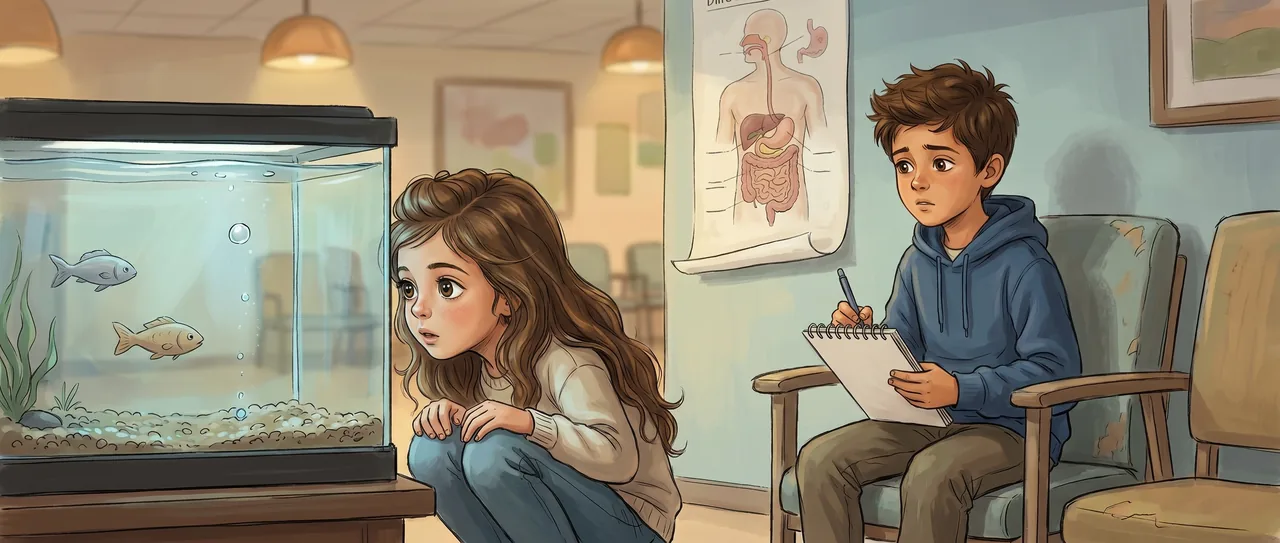
The lounge had a fish tank with two fish and a poster of the digestive system curling off the wall at one corner. Soren had read the poster four times. Maya had read it once and was now staring at the fish.
"They keep giving her antibiotics," Soren said. "Three rounds. It comes back every time. Worse."
"That's the part that doesn't fit," Maya said. "Antibiotics kill bacteria. So why does killing the bacteria make it come back?"
Soren had been wondering the same thing for two days and hadn't found a door into it. "The doctor said a word. Difficile. It's a bacterium that won't leave."
"Then more antibiotics should kill it."
"They don't."
Maya turned away from the fish. "Okay. Picture the tank. Two fish. Clean water. Now imagine you wanted to get rid of one kind of algae, so you poured bleach in."
"The fish die too."
"Everything dies. Then what grows back first?"
Soren thought about a sidewalk crack, the weed that always came up before anything else. "Whatever's toughest. Whatever doesn't care about bleach."
"So if the difficile is the toughest weed," Maya said, slower now, "every time they bleach the gut, it wins. Because it's the only thing left standing."
Soren pulled out his notebook. He wrote gut = garden, not battlefield, and underneath it antibiotics = bleach, and stopped with the pen on the paper because the next line wouldn't come.
"There's a thing missing," he said. "If bleach makes it worse, the answer can't be more bleach. The answer has to be the opposite of bleach."
"What's the opposite of killing everything?"
They looked at each other.
"Planting," Maya said.
A nurse came through with a tray and Soren caught her sleeve before she could pass. "Excuse me. My grandmother. Is there anything they do that isn't antibiotics?"
The nurse was young and tired and clearly behind on something. "They're discussing a transplant for her, actually. If the next round fails."
"A transplant of what?" Maya asked. "She doesn't need a new stomach."
"Not an organ." The nurse glanced at the door, weighing whether she had time for this. She decided she did. "A microbiota transplant. They take the gut bacteria from a healthy donor and put it into the patient. A whole community of them. Trillions."
Soren wrote the word community. "Where do you get trillions of healthy gut bacteria?"
The nurse gave a small, dry smile. "From a healthy person's stool. Screened, processed, completely safe. People donate it. It's medicine."
Maya did not flinch the way the nurse seemed braced for. "So someone else's gut garden," she said. "You move the whole garden in."
"That's exactly it," the nurse said, surprised. "The new bacteria move in and take up all the room. The difficile can't get a foothold anymore. Cures it when nothing else can. Better than ninety out of a hundred times." She looked at the door again. "I have to go."
She went.
Soren stared at the poster of the digestive system, that long folded tube, and for the first time it didn't look like plumbing.
"Soren." Maya's voice had changed. "How many of them are there. In a person."
He flipped pages. He'd copied a number from a library book a month ago and not understood it then. "Roughly the same number of bacterial cells as human cells. Maybe more."
They sat with that.
"So she's not one person fighting an infection," Maya said. "She's a place. She's a whole place where trillions of things live. And the things that live there are what keep her well."
"And when the garden's healthy," Soren said, "it defends itself. Nothing leaves room for the weed. The medicine isn't a poison. The medicine is more life."
Maya stood up and walked to the fish tank and looked at the water, really looked, the way you look when you've just been told the water is full of something you can't see.
"Every person is a garden," she said quietly. "And nobody can see it. You walk around all day carrying trillions of living things that are basically rooting for you, and you can't feel a single one."
Soren wrote that down too, almost all of it. His hand was not quite keeping up.
"Here's what gets me," he said. "They're transplanting an ecosystem. Not a cell, not a chemical. A whole living web, from one person into another, and the web does the healing by itself. Nobody designed it. They just move it and it knows what to do."
"Because it's been doing it for a million years," Maya said. "Longer. The garden's older than the gardener."
A door opened down the hall. Soren's mother leaned out, and she was smiling, the real kind, the kind that had been missing for two days.
"They have a donor matched," she said. "They're going to try the transplant. The doctor thinks it'll hold."
Soren felt something loosen in his chest. But it wasn't relief he wanted to say out loud. It was the other thing.
"Mom," he said. "Grandma's going to get better because somebody she's never met gave her a garden."
His mother tilted her head, not quite following, still smiling. "I'll tell her you said that." She ducked back in.
Maya was still at the tank. "Soren. If everybody's a garden, then every single person who ever annoyed you, every stranger on a bus, every single one of them is walking around as a whole living world that nobody will ever see the inside of."
"Including us."
"Including us right now."
Soren looked down at his own hands holding the notebook. He thought about the trillions, busy, alive, going about their work in the dark, asking nothing, keeping him standing here.
"There's a forest inside me," he said, "and I have never once thanked it."
Maya laughed, but it came out shaky, the laugh you do when a thing is too big to hold any other way.
The two fish turned in the tank, slow, and the water caught the light, and for a second the lounge was full of invisible gardens, every chair, every visitor, every nurse hurrying past, each one a place trillions of living things called home.
Maya pressed her face close to the glass and watched a single bubble climb from the gravel and break at the surface where the unseen water met the air.
Read the interactive version, listen to the narration, and earn a gold star →
A science-verified short story for curious kids · Curiosity Land