The Color of Tuesday
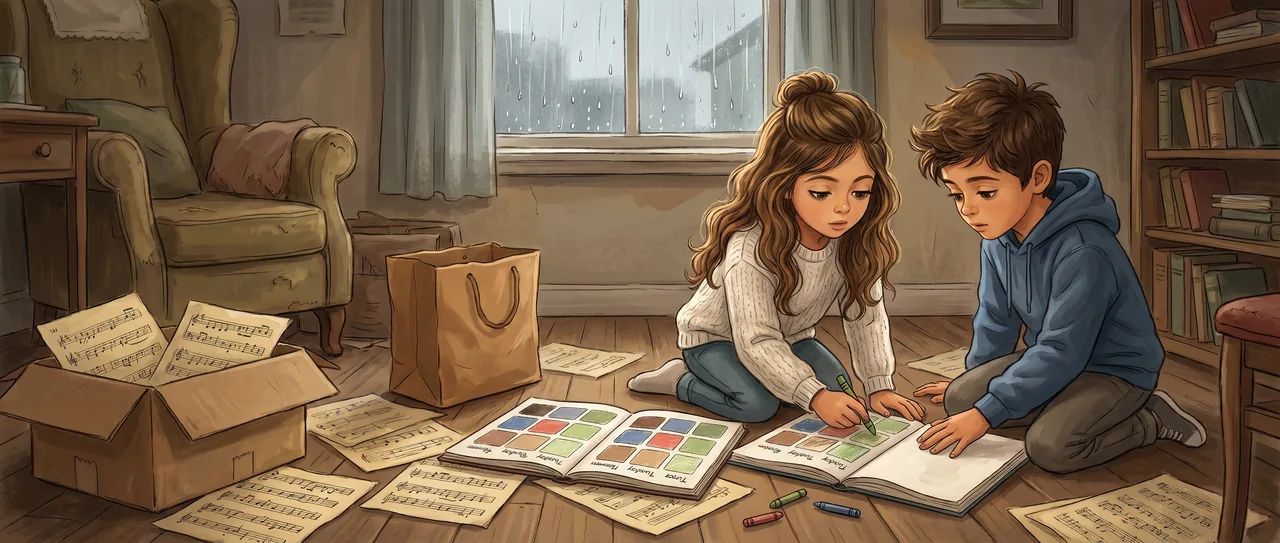
The rain had been going so long it stopped being weather and turned into furniture. Maya and Soren sat on the floor of the back room with a cardboard box of Soren's grandmother's old sheet music spreading out around them like fallen leaves.
"This one's brown," Maya said, holding up a yellowed page.
"It's a song," said Soren. "You can't see a song."
"I'm not seeing the song. I'm seeing the note at the top. C. C is brown."
Soren looked at her. "C is a letter."
"Right. And it's brown. Like a paper bag."
"What's D, then."
"Yellow. Obviously yellow." She said it the way you'd say water is wet, then noticed his face and stopped. "What."
"Nothing's obviously a color," Soren said. "Letters are black. They're printed in black ink."
Maya put the page down very slowly. "Wait," she said. "You don't see them?"
"See what?"
"The colors. When I think Tuesday I think pale green. When you think Tuesday what do you think?"
"I think it's a Tuesday," Soren said. "It doesn't have a color. It's a day."
They stared at each other across the sheet music. Outside, the rain kept arranging itself on the window.
"Okay," said Soren, and reached for his notebook. He drew seven boxes and labeled them with the days. "Color them. Don't think. Just go fast."
Maya colored them without hesitating. Monday white. Tuesday pale green. Wednesday a kind of dull red. Thursday dark blue. She filled all seven in less time than it took him to ask why.
"Now," said Soren, "would you color them the same next week?"
"They are the same. They've always been the same. They came that way."
He didn't believe her. He wanted to, but believing without checking felt like skipping a stair in the dark. So he tore out a fresh page, covered her boxes with his hand, and made her do it again.
Monday white. Tuesday pale green. Wednesday dull red.
The same. All of it the same.
"Huh," Soren said, and the huh had weight in it.
"Why is that strange?" Maya asked. "Doesn't everyone have colors for things?"
"I don't," he said. "My grandmother might. Let's find out."
They found her in the kitchen, peeling apples, the radio playing something with a piano in it.
"Gran," said Soren, "does Tuesday have a color?"
She didn't look up. "Tuesday's yellow," she said, like he'd asked whether the stove was on. "Always has been. Friday's the trouble. Friday won't settle. Some weeks it's orange and some weeks I think it's just being difficult."
Maya laughed out loud, a bright surprised laugh.
"Yours is yellow and mine is green," she said.
"Then one of us is wrong," said Gran, peeling.
"No," said Soren, and he said it fast, before he'd finished working out why. "No, that's the thing. You can't both be wrong about something you both feel. You just have different wiring."
The radio swelled. Gran's knife paused.
"That note there," she said, tilting her head at the radio. "The high one. That's a sort of silver. You hear it?"
"I hear a note," said Soren.
"I see silver," said Gran, and went back to her apples like she'd reported the temperature.
They went back to the box. Soren sat with his notebook open and didn't write anything for a while, which was unusual.
"It's real," he said finally.
"I told you it was real."
"No, listen. I thought maybe you were making it up, or remembering a color you'd decided on once. But you colored it the same twice and didn't even slow down, and Gran's been seeing yellow Tuesdays for sixty years, and her yellow isn't your green. That can't be a habit. A habit you could change. You can't change it."
"I couldn't make Tuesday red if you paid me," Maya admitted. "I tried just now. It stayed green."
Soren wrote one line. His hand moved and the page took it: Tuesday is green for Maya and yellow for Gran and nothing for me, and all three are correct.
"Here's what's bending my brain," he said. "If the note really is silver, I should hear silver too. The note is the same note for everybody. The radio doesn't change. So the silver isn't in the radio."
"Then where is it," said Maya.
"It's inside her. The note goes in her ear and somewhere in there it turns silver. It's not coming from the sound. It's coming from her."
Maya went still, looking at the box of old songs in a new way.
"So when she played these," she said slowly, "when she was young, sitting at a piano, she wasn't just hearing them."
"She was watching them," said Soren. "A whole color show. And nobody else in the room could see it. She'd have thought everyone could. The way you thought everyone could."
Maya picked up the brown C again. She looked at it for a long time.
"There are people walking around right now," she said, "hearing a song and seeing a sunset. Tasting somebody's name. And they don't know they're the only one in the room doing it. Because how would they know? Nobody can climb inside."
"Nobody can climb inside," Soren repeated. He turned and looked at her, then at the kitchen door, then at his own two hands holding the notebook.
"I can't get into your green," he said. "You can't get into my nothing. I can only ever know it's there because you told me. Everybody's been a little bit alone the whole time and just covering it really well."
"That's the loneliest thing you've ever said."
"It's also the least lonely," said Soren. "Because Gran said hers out loud and now I know it's there."
In the kitchen the radio climbed to the high note again. Gran's knife stopped. "Silver," she called through the doorway, to no one, to everyone, and went back to peeling.
Read the interactive version, listen to the narration, and earn a gold star →
A science-verified short story for curious kids · Curiosity Land