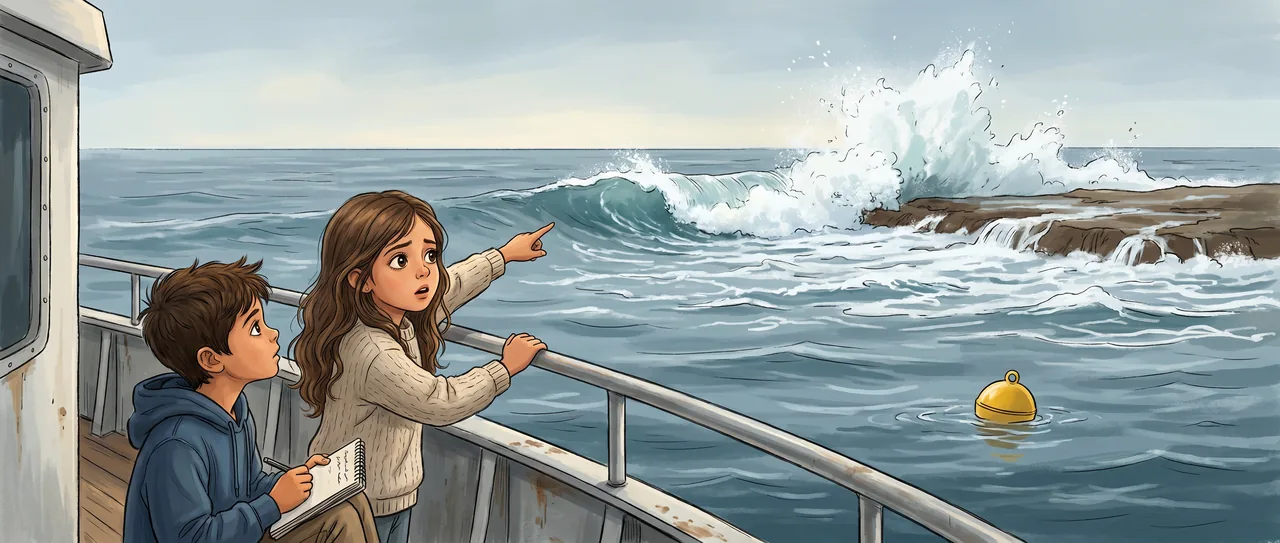
The Wave That Was Already Here
The buoy bobbed beside the boat like a yellow barrel that had escaped from somewhere. Maya leaned over the rail and watched it. It did not look like an instrument. It looked like a toy that had gotten lost two thousand kilometers from any beach.
"It feels the floor," said Aunt Reyes. She was crouched over a laptop wedged into a crate, her coffee going cold beside her. "The real sensor sits on the seafloor, six kilometers straight down. It measures the weight of the water on top of it. When the water gets heavier, the floor unit pings the buoy, the buoy pings the satellite, and I get to be out here in the wind instead of at my desk."
Soren had his notebook open against his knee, shielding the page from the spray. He had drawn the buoy, the long invisible tether, the gray box on the bottom of the sea.
"How heavy does the water have to get," he asked, "before it pings?"
"A centimeter of extra water column," said Aunt Reyes. "That's all. Out here a tsunami is barely a centimeter. People always picture the wall. The wall is a coast thing."
Maya stopped looking at the buoy.
"Say that again," she said.
"The wall is a coast thing." Aunt Reyes sipped the cold coffee and made a face. "Open ocean, a tsunami is a hump of water maybe half a meter tall, but hundreds of kilometers wide. A ship rides right over it and the crew never feels a thing. They'd swear nothing happened."
Maya looked back at the water. It was doing ordinary water things. Long swells, white edges, the slap and hush against the hull. She watched a swell lift the buoy and set it down.
"How fast does the hump move," she asked.
Aunt Reyes was typing. "Deep water, about eight hundred kilometers an hour."
Soren's pencil stopped.
"That's a plane," he said. "That's the speed of the flight we took to get to the boat."
"That's the speed of the flight you took to get to the boat," Aunt Reyes agreed, not looking up. "A wave half a meter tall, crossing the whole ocean at the speed of a jet, and nobody on the surface can see it. The energy isn't in the height. It's in the width. The whole column of water is moving, top to bottom, six kilometers down."
Maya put both hands on the rail.
She was thinking about the swell that had just passed under the buoy. A normal swell, her aunt had explained earlier, only moves the surface. The water down deep stays still. You could be ten meters under and feel nothing.
"So a normal wave is just the top of the ocean wiggling," Maya said slowly. "But the tsunami is the whole thing. All six kilometers. Moving at once."
"That's it," said Aunt Reyes. "That's the part people get wrong. They think bigger wave, more water on top. It's not on top. It's underneath. It goes all the way down."
Soren was drawing again, fast now. He drew a normal swell as a little curl on a line. Then he drew the tsunami, and to draw it honestly he had to make the line itself bend, the whole depth of it, the seafloor pushing up into the page.
"Then why does it stand up at the beach," he said. "If it's only half a meter out here. Why does it turn into a wall."
Nobody answered. Aunt Reyes had turned back to her readings. The boat rocked.
Maya watched the swell roll toward the shallows of a reef that broke the surface a hundred meters off, a brown shelf with foam around its edges. A swell came in long and low across the deep water. Then it reached the shelf. And it reared up, suddenly, and threw itself white over the reef, twice as tall as it had been a second before.
"There," Maya said. "Soren. There."
He looked up.
"It got tall when it hit the shallow part," she said. "The bottom came up and the wave got tall."
Soren looked at the reef. He looked at the open water, where the same swell had been flat and harmless. He looked back at his drawing, at the line that bent all the way down to the seafloor.
"Because the bottom of the wave touches first," he said. "Out here it has six kilometers of room. The whole column moves. Near the shore the floor rises up and the bottom of the wave drags, it slows down, but the back is still coming at eight hundred. So all that width, all that water that was spread out flat and fast, it has nowhere to go but "
"Up," said Maya.
"Up," said Soren.
They both looked at the reef. The next swell reared and broke. A small one. A toy of the thing they were talking about.
"The wall was never out there," Maya said. "It was here the whole time. Lying down. Half a meter tall and a hundred kilometers wide, going past us, and we'd never know." She turned and looked back the way the boat had come, across kilometers of calm and ordinary swell. "It could be under us right now and we wouldn't feel it."
Aunt Reyes glanced up. "It's not," she said. "I'd see it on the floor sensor before you'd see anything up here. That's the whole point of the buoy. We feel it for you. Down where it actually is."
Maya was not really listening. She was looking at the flat, deep, innocent water with new respect, the way you look at a sleeping animal you had mistaken for a rug.
Soren wrote one line under his drawing, pressing hard so the spray wouldn't blur it. Then he closed the cover over his thumb to keep his place and looked out at the reef with Maya.
The buoy dipped. Six kilometers under it, the gray box sat in the dark on the floor of the world, weighing the water, counting centimeters, waiting to feel the thing pass over it that the surface would never confess to.
A swell rolled in from the open sea, long and low and harmless, crossed the deep, reached the shelf, and stood up white against the sky.
Read the interactive version, listen to the narration, and earn a gold star →
A science-verified short story for curious kids · Curiosity Land