The Star That Already Did It
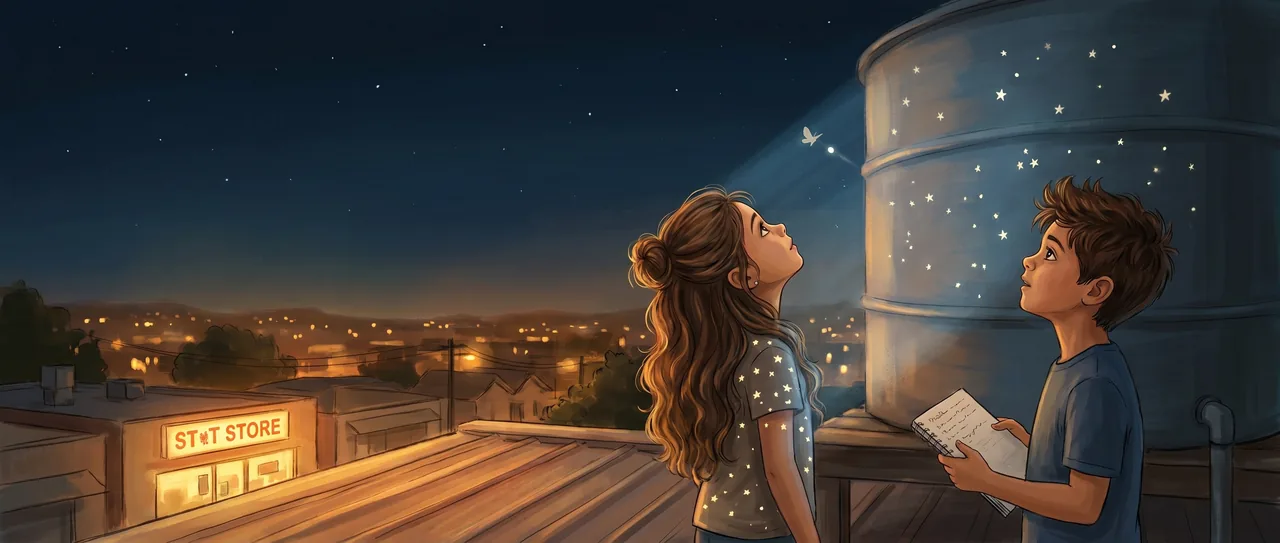
The projector was meant for school slides, but Soren had drilled a pinhole disk over the lens, and now the whole curve of the water tank above them was a fake sky.
"That one's wrong," Maya said.
"They're all wrong. I poked the holes by hand."
"No. That one." She pointed at a bright dot near the edge, where the tin started to bend. "It's twitching."
Soren leaned back on his elbows. The dot was wobbling, just slightly, but only because a moth kept crossing the projector beam. He told her so.
"Okay, but which star is it supposed to be?"
He checked the disk against the printout taped to the projector. "Down there, that's the keel of the ship. Carina. So that bright one is Eta Carinae."
"Say it again."
"Eta Carinae." He flipped his notebook open and held it toward the city-glow to read his own writing. "I copied stuff about it from the library. It's enormous. Like a hundred times the sun's mass. Maybe more."
"How much more."
"Nobody's sure. It's so bright it's hard to weigh."
Maya sat up. "You can't weigh a star?"
"You can. Sort of. You watch how things move around it. But this one's wrapped in a cloud it coughed up."
"Coughed up when?"
Soren found the line and read it slow. "In the eighteen forties, it got brighter for about twenty years. Almost the brightest star in the sky. Then it faded. Sailors wrote it down. People in the southern hemisphere watched it happen."
"What happened to it?"
"It threw off a huge amount of itself. Like, a chunk of star, blasted outward. There's a nebula around it now shaped like two balloons. The Homunculus."
Maya was quiet. Then: "So it exploded."
"Partly. It survived."
"A star can partly explode and live?"
"This one did."
She pulled her knees up. "That's the wrong kind of strange. Things either explode or they don't."
"This one's too big to follow the rules." Soren turned a page. "It's so massive it's barely holding itself together. The light pressure coming out of it is almost enough to blow the whole thing apart. All the time. Just from being bright."
"Wait." Maya turned to him. "Light can push?"
"Light pushes. Yeah. A little. On us it's nothing. On a star that bright it's almost everything."
She stared at the projector beam, at the cone of dust glowing inside it. "So it's a star that's always falling apart and never finishing."
"Until it does."
"Does what."
Soren put the notebook down on the warm tin. "The book says when it really goes, it won't be a normal supernova. It'll be a hypernova. One of the biggest explosions there is. And we'd see it from here. In the daytime."
Maya didn't say anything for a second. The hardware store's sign buzzed below them.
"In the daytime," she repeated.
"A star you could see with the sun up."
"When."
"That's the part I keep rereading." He picked the notebook back up but didn't read from it. "Nobody knows. Could be ten thousand years. Could be tonight."
"Tonight."
"Could be. Or it could have already happened."
Maya turned all the way around to face him, and the projected stars slid across her shirt. "Say that part again. Carefully."
Soren took a breath, because he wanted to get it right. "It's about seven thousand five hundred light-years away. So the light we see left it seven thousand five hundred years ago."
"So that dot on the tank." She looked up at it. "That's old."
"That's how it looked when people were first farming. Before any of the writing. The light's been crossing the whole way here since then."
Maya stood up slowly on the tin roof, which popped under her sneakers.
"Soren. If it's that far. And it could already have gone." She stopped. "Then it might be dead right now and we wouldn't know."
"Right."
"Like, right now, this exact second, it could be a hypernova, and the daytime star could be on its way, and it's just— not here yet."
"It would be somewhere out there." Soren stood up too. "Crossing. The flash already left. We're just downstream of it."
Maya put her hand out flat, the way you check for rain. "How far does it get in a year?"
"One light-year. That's what a light-year is. How far light goes in a year."
"So if it blew up a thousand years ago, the flash is a thousand years closer than the star looks." She was working it out into the dark. "And it's still got six thousand five hundred to go."
"If it blew up a thousand years ago."
"But we can't tell."
"We can't tell," Soren said. "The star we're looking at and the explosion that might already have happened are the same light to us. Until the flash arrives, the old picture is the only news we've got."
Maya laughed, but it wasn't a funny laugh. "So everybody who ever looked up at that star," she said, "all those sailors in the eighteen forties, writing down how bright it got— they were watching something that already finished doing it. Thousands of years before they were born."
"They were watching the past arrive on time."
Maya looked at the dot on the water tank, the fake one, the pinhole one. Then she tipped her head back past the edge of the tank, into the real sky, the smear of it over the rooftops.
"It's not even down there," Soren said. "Carina's a southern thing. We can't see the real one from here at all."
"So we're staring at a hole you poked in a disk," Maya said.
"Pretty much."
"And the real one is below the whole world. Either fine. Or already gone. And the answer is just— traveling."
The moth crossed the beam again, and the bright dot twitched on the curved tin, and for a second neither of them could have told you whether they were looking at a moth, or a pinhole, or a star that was no longer there.
Maya stayed standing, her face turned up toward the part of the sky where, if the Earth weren't in the way, the news would come in over the rooftops some ordinary afternoon, with the sun still up.
Read the interactive version, listen to the narration, and earn a gold star →
A science-verified short story for curious kids · Curiosity Land