The Far Side of the Backyard
Soren's aunt had a name for the Moon's dark patches and she said it the way other people said the names of relatives.
Mare Imbrium, she said, swinging the long lens a millimeter to the left. Mare Serenitatis. Hold the tripod leg, Soren, you breathing on it counts as an earthquake up there.
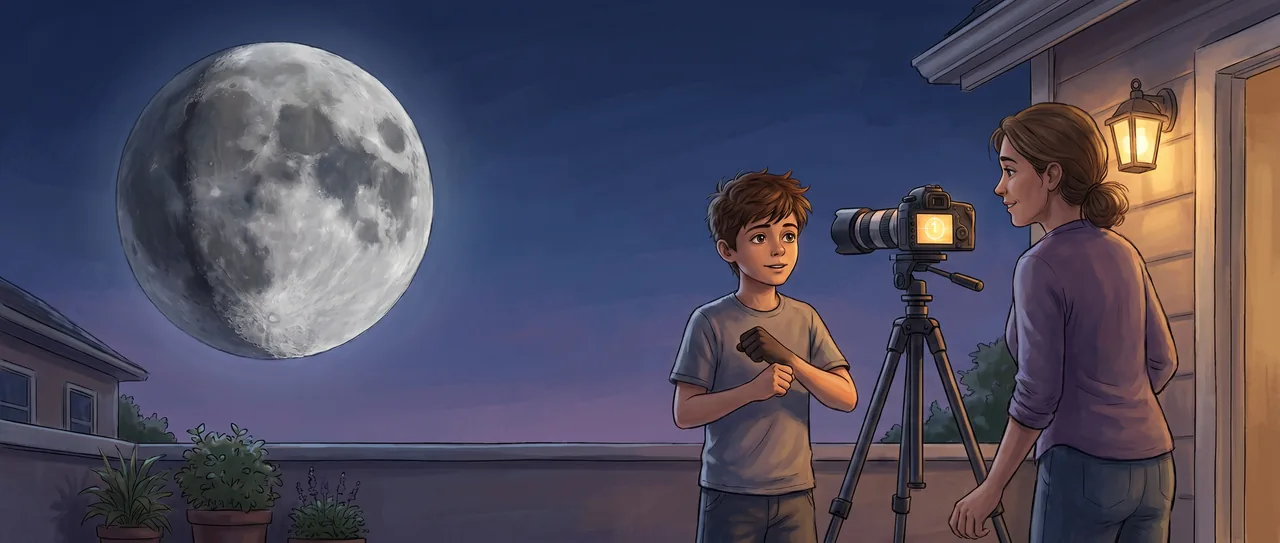
Soren held the tripod leg. Through the small screen on the back of her camera the Moon sat enormous and gray, every crater throwing a little shadow because it was a few days past full and the light came in sideways. He had seen the Moon his whole life. He had never seen it big enough to have a geography.
The Sea of Showers, his aunt said, pointing at a smooth dark oval. Not real water. Old lava, frozen flat. She was making a calendar, twelve months of the same Moon, and she wanted each photo crisp enough to count the rilles.
Soren looked from the screen to the actual Moon in the actual sky, then back to the screen. Then he did it again. There was something his eyes kept doing that he could not turn off, a small itch of wrongness, the way it feels when a picture on the wall is tilted by half a degree.
It's the same one, he said.
The same what, said his aunt.
The same picture. The dark parts. They're in the same places they were in your photo from June. You showed me the June one. It's the exact same.
Well, yes, she said, the way adults say yes when they are not actually paying attention. It's the Moon. It looks like the Moon.
Soren let go of the tripod leg, which made her hiss, and he picked it up again. He was not arguing. He was checking. He pulled his notebook out of his back pocket and held it under the porch light and there it was, a sketch he had done in spring of the two big dark seas, the round one and the long one, the round one slightly up and to the right. He held the notebook beside the camera screen. The round one was up and to the right.
The Moon goes around us, he said slowly. It goes all the way around. Every month.
Four weeks, more or less, said his aunt, adjusting the focus ring.
So it turns all the way around the Earth. But it never turns around. He stopped. He was trying to hold two motions in his head at once and they kept sliding off each other. If it goes all the way around us and we always see the same face, then it has to be spinning too. It has to be turning itself around exactly once every time it goes around us. Or we'd see the back.
His aunt's hand came off the focus ring.
Say that again, she said.
If it didn't spin at all, Soren said, getting faster now, we'd see the whole thing over a month. The front, then the side, then the back, then the other side. Like if you walked around me and didn't turn your head, I'd see your face, your ear, the back of your hair, your other ear. But we never see the back of the Moon. We've never once seen the back of the Moon. So it must be turning its head to keep looking at us the whole way around.
He stood very still on the roof. Below them a sprinkler ticked across somebody's lawn.
His aunt was quiet for a second. Then she laughed, a short surprised laugh, not at him.
They call it tidal locking, she said. I knew the words. I never once put it together the way you just did. The Moon spins exactly once per orbit. Has for billions of years. The Earth's gravity dragged on it until it slowed down and stopped, like a hand on a spinning globe, and it locked facing us.
Forever, said Soren.
Forever, she said. There's a whole half of that thing up there that no human eye on Earth has ever seen. Not Galileo. Not your great-grandmother. Not anybody, ever, standing where we're standing. The far side. We only got to see it when we flew machines around the back.
Soren looked up at the Moon again, the real one, hanging there pretending to be a flat coin.
It's a ball, he said. It's a whole ball and it's hiding half of itself from us. On purpose. Not on purpose. He frowned. Because we made it. Our gravity made it stop that way.
We slowed it down, his aunt said softly. And it's still slowing us down, a tiny bit, every year. The Moon is pulling on our oceans and the friction is stealing a sliver of Earth's spin. Days are getting longer. Microscopically. A day was shorter when the dinosaurs were here.
Soren put the notebook down on the tripod's flat plate so he could use both hands. He held his left fist still in the air for the Earth. He started walking his right fist around it, slowly, and as he walked it he turned his wrist, keeping the knuckles always pointed at the left fist, the same knuckles, the whole way around. One trip. One turn. The back of his right hand swept across the whole sky and never once showed itself to the left fist.
He did it again. He wanted to feel how exact it had to be. Too slow a spin and the back would peek. Too fast and it would peek the other way. It had to match. It had to match perfectly, and it did, every large moon in the solar system did this, his aunt was saying now, Jupiter's, Saturn's, all of them caught and held facing inward, a whole family of worlds each keeping one secret face turned away.
The camera's timer went off, a small chirp, and took a photo by itself of a Moon nobody was aiming at anymore.
Soren kept walking his fist around his fist, watching the dark side of his own knuckles travel across the porch light, never showing, never showing, and somewhere up past the sprinkler and the roofline a real other half hung in real cold sunlight with nobody on Earth, ever, looking at it.
He turned his wrist again and the back of his hand swept past his face and away.
Read the interactive version, listen to the narration, and earn a gold star →
A science-verified short story for curious kids · Curiosity Land