The Copy That Was Older Than the Coin
The buzzer medal had a chip in it.
Maya turned it under the lamp in her grandmother's hobby room and found the bare spot where the gold had worn off the edge, showing dull gray underneath. Her grandmother had won it for swimming in nineteen sixty-one, and now half a letter of the word CHAMPION was gone.
"It's not solid gold," her grandmother said from the doorway, not looking up from the necklace clasp she was bending. "It never was. Just a skin of it. They dunk the cheap metal in a bath and the gold grows on like frost."
Maya stopped turning the medal.
"Grows," she said.
"There's a kit in the green box. I haven't touched it in years. Don't electrocute yourself." And her grandmother went back to her clasp, half there, half somewhere in nineteen sixty-one.
The green box smelled like a battery and old pennies. Inside were two clips with wires, a small bottle of bluish liquid, and a strip of bright copper. Maya knew the word from the side of the bottle. Electroplating. She had read about it once and not understood it, the way you can hold a smooth stone and still not know the river that made it.
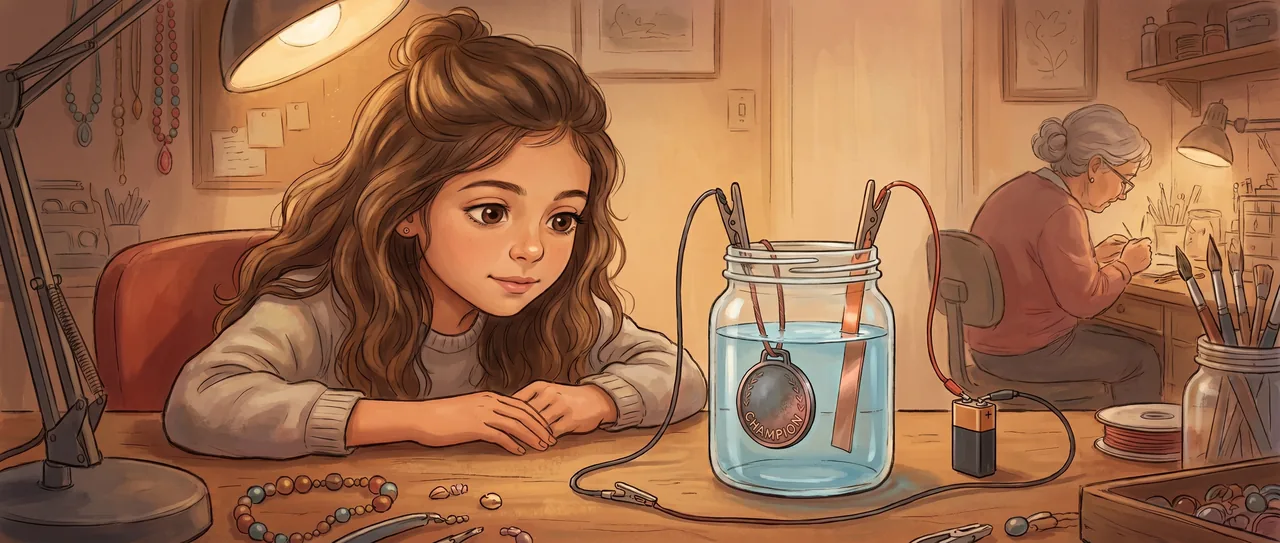
She set up a jar of the blue solution. The instructions said to hang the copper strip on one wire and the thing she wanted to coat on the other, and connect a battery. She did not have a gold thing to dissolve, but she had the copper strip, and copper solution, and a tarnished old nickel from the change jar that she didn't mind ruining.
She clipped the nickel to one wire, the copper strip to the other, and lowered them both into the blue.
Nothing happened that her eyes could catch.
Then the nickel began to change color under the liquid. Not painted. Not dipped. It was warming from silver toward a faint pink, the pink deepening while she watched, the way the sky fills in at dawn without any single moment you could call the start.
She lifted it out. The nickel was the color of a new penny. She rubbed her thumb across Jefferson's face and the copper did not smear, did not flake. It was attached. It was part of him now.
"How thick is it," she said out loud.
Her grandmother shrugged at her clasp. "Thin as you leave it."
That was the thing Maya could not let go of. She put the nickel back in. She left it longer this time, and the surface grew rougher, grainier, building. The copper was not spreading like spilled paint across the top. It was arriving. Atom landing on atom, out of the blue water, each one finding the place under it and stopping there.
She thought about frost on a window, how it never lands as a sheet, how it builds one needle of ice onto the needle before it until the whole pane is feathered. The copper was doing that, except the needles were single atoms, and the window was Jefferson's cheek.
The coldness of the idea went up her arms. Every penny in the change jar. Every gold ring. Every shiny phone part. None of them were dipped in a coat. They were grown, one layer of atoms at a time, out of water that had the metal dissolved invisibly inside it. The metal had been there in the liquid the whole time. You could not see it. You had to call it out with a wire.
She looked at the blue solution in the jar. It looked like nothing. It looked like mouthwash. And it was full of copper, atom by atom, waiting.
"Grandma," Maya said. "Could you copy something with this? Not just cover it. Copy it."
Now her grandmother looked up.
"That's the old trick," she said. "That's how the museums did it, before cameras were any good. You'd press a statue into wax, peel the wax off, and grow metal into the hollow of it. Layer after layer. When you peeled the wax away, you had the statue back. Not a photograph of it. The actual shape, in real metal, down to the fingerprints of the artist." Down to the fingerprints.
If the metal arrived atom by atom into the hollow of the wax, then it filled every dent, every scratch, every place a thumbnail had once dragged across soft clay a hundred years ago. The copy would not be approximately the statue. It would be the statue, the way the statue would be if you could rebuild it from the outside in, one atom thick at a time, never missing a single pocket because atoms are smaller than any pocket a hand can make.
A copy more exact than a hand could carve. Made by water and a wire. Made the same way the copper was right now climbing onto Jefferson's face in the jar beside her.
"The ones in the museums," Maya said slowly. "The copper copies. They'd be more perfect than something carved by a person."
"Some of them," her grandmother said, "are the only thing left. The marble ones cracked. The copper copies didn't." She turned back to her clasp. "Funny. The fake outlasted the real."
Maya did not think it was funny. She thought it was the largest thing she had heard all year, and it would not fit anywhere.
There were statues that no longer existed except as their own exact shadows, grown in metal, atom by atom, from a bath that looked like nothing. The original was dust. The copy held the artist's fingerprints. And the same patient arriving, the same atoms-out-of-water, was laying copper onto every circuit board in every phone in every pocket, building the lines that carried thoughts across the world, the same way, the same dawn-filling-in, the same frost.
She lowered the nickel back into the jar and pressed the wires tight.
Under the blue, on the worn gray edge where CHAMPION had broken, the metal began to come back, letter rebuilding itself out of water, one layer she could not see laid onto the layer beneath it, the word arriving the way it must have arrived the first time, in nineteen sixty-one, in a bath exactly like this one.
Read the interactive version, listen to the narration, and earn a gold star →
A science-verified short story for curious kids · Curiosity Land