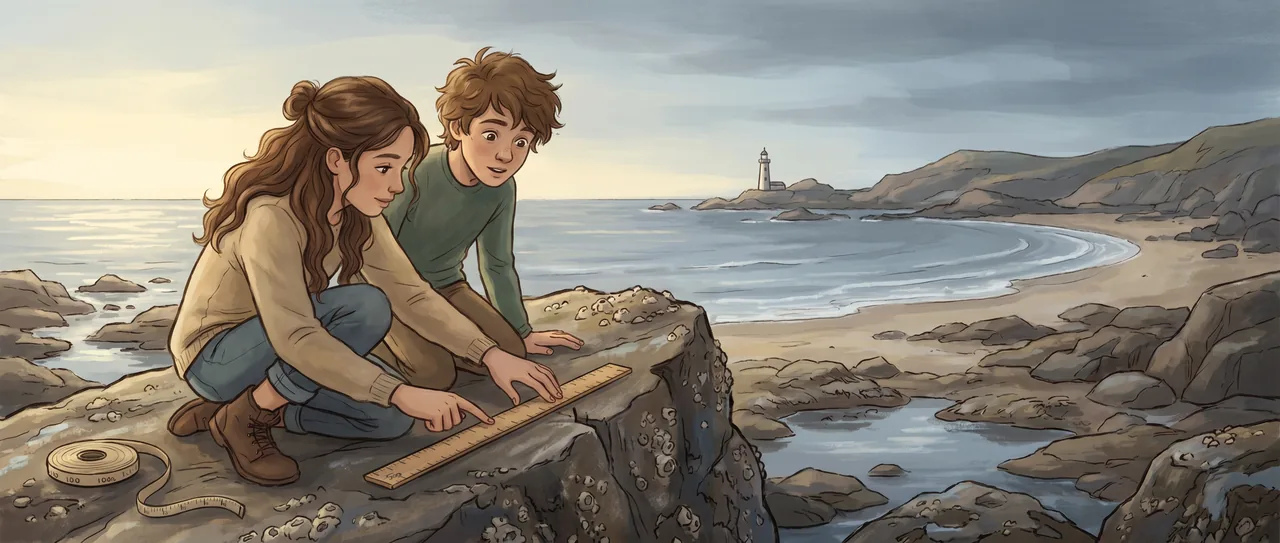
The Coastline That Wouldn't Stop
The contest rule was simple. Whoever measured the coast most exactly won the prize, a real surveyor's tablet, the kind that talks to satellites.
"We just walk it with the long tape," Soren said. He had borrowed a hundred-meter measuring tape from the gym storage closet. "Tide's out till four. We have time."
They started at the lighthouse rocks. Maya held one end, Soren walked the tape out straight along the water's edge until it pulled tight, and they wrote down the number. They did it again. And again.
After an hour they had a number. Two thousand, one hundred meters.
"Done," Soren said.
"It's wrong," said Maya.
She was looking back at the line they had walked. The tape went straight from rock to rock. But the actual edge of the water didn't. It curled into every little gap between the stones.
"We skipped all the wiggles," she said. "Look. We cut across that whole bay."
Soren looked. She was right. Where they had stretched one straight length of tape, the real shore had bent in and out three times.
"Okay," he said. "Smaller pieces. We use the meter stick instead of the long tape. More accurate."
So they did it again with the meter stick, going into the little bays the tape had jumped over. It took the rest of the morning. They got a new number.
Two thousand, nine hundred meters.
"Eight hundred meters longer," Soren said slowly. "From the same beach."
Maya wasn't celebrating. She was crouched down by a tide pool, staring at the edge of a single rock.
"Soren. The meter stick skips things too."
He came and crouched beside her. The rock's edge, up close, was not a smooth curve. It had notches. Little inlets the size of his hand, water sitting in each one. The meter stick had bridged right over all of them.
"So we use something smaller," Soren said. He pulled a school ruler out of his bag. Thirty centimeters.
They measured one stretch of rock both ways. Meter stick: four meters. Ruler, going into every notch: four and a half meters.
Maya sat back on her heels. "It got longer again."
"Because the ruler fits into smaller dents," Soren said. He was writing the numbers down, and his hand had slowed. "The smaller the thing you measure with, the more dents you find, the longer it gets."
"So what's the real number?"
Neither of them said anything for a moment. A gull walked the wet sand between them and the water.
"Smaller than the ruler," Maya said. "There's stuff smaller than the ruler."
She put her finger against the edge of the rock. Right where her fingertip touched, there was a tiny ragged line of grit and barnacle, in and out, in and out, smaller than the ruler could ever follow.
"And under that," she said, "there's the edge of each grain of sand. In and out. And the edge of the bumps on each grain."
Soren stopped writing.
"It never stops," he said.
"It never stops," Maya said.
They looked at each other.
"Wait," Soren said. "Wait. If every time we use a smaller measure the number gets bigger, and there's always something smaller we could use, then the number never stops growing."
"There is no real number," Maya said.
"There can't be a longest. Any length we say, we could find a smaller measuring stick and the coast would be longer than that."
Maya stood up fast. She was looking at the whole curve of the shore now, the big bays, and then she crouched again at the little notch in the one rock, and then she held her thumb and finger close together to imagine something smaller than that.
"It's the same shape," she said. "Soren. The little notch in this rock is the same shape as the whole bay. The bay is the same shape as the whole coast."
He stared at the rock. Then at the bay. Then at the long curve of the coast running off toward the headland.
The big bay swept in and out. The rock's edge swept in and out, the same way, smaller. The grit on the rock swept in and out, the same way, smaller still.
"It's the same wiggle," Soren said. "At every size. The whole thing is made of little copies of itself."
"So the answer to how long is it," Maya said, and she started to laugh, but it was a strange shaky laugh, "is bigger than any number. It's infinite. The coast of our town is infinitely long."
Soren looked at the tape, still lying across the rocks. Two thousand one hundred meters, it had told them. Such a confident, wrong little number.
"We can't win the contest," he said. "There's no answer to give."
But he was smiling, and he couldn't stop, because the reason they couldn't win was the most interesting thing that had ever happened to him.
"Everybody else is going to write down a number," Maya said. "Two thousand something. And they'll all be sure. And they'll all be wrong, and they won't even know they're wrong."
"We're the only ones who know there isn't an answer."
"That's better than the tablet," Maya said.
Soren thought about it, and decided she was right. "My lungs do this," he said suddenly.
Maya turned.
"Inside. The tubes split into smaller tubes, and those split into smaller tubes, smaller and smaller. Same shape every time. I read it. The surface inside your lungs, if you spread it flat, is huge, because it keeps folding into smaller copies of itself." He pressed his hand flat against his own chest without thinking. "It's the same thing. The coast is the same thing as the inside of me."
They stood on the wet rocks. The tide was turning. The water came up over the lowest notches first, the smallest ones, then began to fill the bigger dents, then the bays, the same shape swallowing the same shape swallowing the same shape.
Maya crouched one more time and put the school ruler down flat against a single barnacle, against the rough ragged rim of it, smaller than anything they had measured yet, and watched a thin line of seawater run in and out of dents too small for the ruler to ever reach.
Read the interactive version, listen to the narration, and earn a gold star →
A science-verified short story for curious kids · Curiosity Land