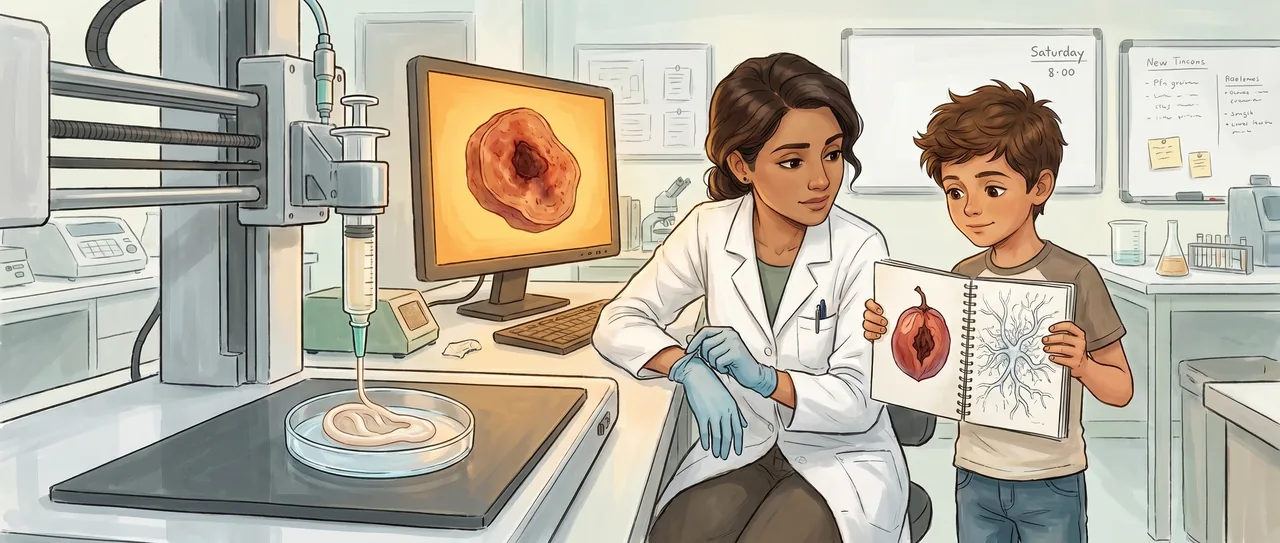
The Cartilage in the Glass Bowl
Aunt Priya parked Soren on a stool by the wall and told him not to touch the cold things, the warm things, or the things in between. Then she went back to the machine.
The machine did not look like much. It looked like a glue gun bolted to a robot arm, leaning over a small glass bowl. Inside the bowl, a thread of pale gel went down in a line, and the arm came back, and laid another line beside it, and another. A grid. Then a grid on top of the grid.
Soren watched for eleven minutes. He counted the layers under his breath. By the time he reached forty, the gel had become a small ridged shape, curved like the top of an ear.
"What is it making?" he asked.
"Cartilage," Priya said, not turning around. "The scaffold part. The bendy stuff in your nose and your ears."
"Out of glue."
"Out of cells. The glue is just to hold them still while they figure out what they are."
Soren took out his notebook and a pencil. He drew the bowl, the arm, the grid. He wrote down forty layers and a question mark.
The cells, Priya had said. He looked harder at the pale gel. It did not look alive. It looked like the inside of an aloe leaf. He had expected alive things to do something, to twitch or pull or shine. This just sat in its bowl getting taller one line at a time.
"How do they know it's a nose and not a knee?" he asked.
Priya laughed, but it was a real laugh, not a brush-off. "That's the actual question. That's the whole field, basically." She came over and crouched by his stool, pulling her gloves off finger by finger. "We don't tell them. We can't. We just put them in the right place next to the right neighbors and give them the right food and they sort it out."
"They sort it out," Soren repeated.
"A cartilage cell that lands next to other cartilage cells, with the right chemistry around it, keeps being cartilage. Builds more of the rubbery stuff. We print the arrangement. They print themselves."
Soren looked at the bowl. The arm laid down another line. Forty-one.
He thought about that for a while, which Priya let him do without filling the quiet. Then he asked the thing that had been bothering him since layer twenty.
"If you can print the arrangement, why don't you print a whole one? A whole ear. A whole heart."
Priya's face changed. Not unhappy. More like he'd touched the exact spot that hurt.
"Come look," she said.
She walked him to a different machine, switched off, its bowl empty and rinsed. On the screen beside it was a picture of something printed and then gone wrong, a thick reddish lump with a dark dead center.
"That," she said, "was supposed to be a chunk of liver tissue. About the size of a grape. We printed the cells perfectly. Right cells, right arrangement, right neighbors."
"What happened?"
"The middle died." She tapped the dark center. "Cells need feeding. Out at the edges, the food soaks in from the liquid around them. But the ones in the middle are too far from any edge. The food can't reach them. They starve before anything else can go right."
Soren stared at the dark center of the dead grape.
"So you have to feed the middle," he said.
"We have to feed the middle. Which means the middle needs roads. Tiny tubes, going all through it, carrying food in and waste out. Blood vessels." She straightened up. "We can print blood vessels. We've done it. Little ones. But printing the whole tangle, every fork, every branch, fine enough and deep enough to feed every single cell in a real organ, all at once, while the cells are still alive and waiting? Nobody has done that. Not yet."
Soren turned back toward the first machine, the one still working. The pale cartilage ear was up to maybe fifty layers now.
And he understood why it worked. Cartilage was the one part of the body with no blood vessels at all. It fed itself the slow way, soaking food in from its edges, no roads required. That was why they could build it. It was the only kind of tissue thin enough and patient enough to live without a middle that needed feeding.
"That's why it's a nose," he said slowly. "And not a heart. You're printing the part of me that doesn't need roads."
Priya went very quiet.
"Yeah," she said. "That's exactly it. That's the part we can do."
Soren looked at the little ear in its bowl. Fifty-one layers. A whole structure, real cells, being itself, getting taller. And it was the easy one. The simple one. The one that survived precisely because it was alone, because nothing depended on reaching its center.
He thought about everything inside a person that the easy method could never make. The heart with its hungry middle. The liver, the kidney, the brain, all of them so dense with need that you couldn't build them without first solving the roads.
He opened his notebook again. He drew the dead grape with its dark center. Beside it he drew a tangle of tiny branching lines, finer and finer, the way frost spreads on a window, reaching every corner of the lump so that no part of it was ever too far from a road.
He held the drawing up next to the working machine, the live one, the patient one laying down its fifty-second line.
"How small can the tubes go?" he asked.
"Smaller every year," Priya said. "Not small enough yet."
"But smaller every year."
"Smaller every year."
Soren put the pencil down on the bench. He watched the arm swing back over the bowl and start the next layer, the cells below it already deciding, without being told, what they were going to be.
Read the interactive version, listen to the narration, and earn a gold star →
A science-verified short story for curious kids · Curiosity Land