The Yellow Thing in the Drain Pan
"Don't squash it," Maya said. "Look how it's moving."
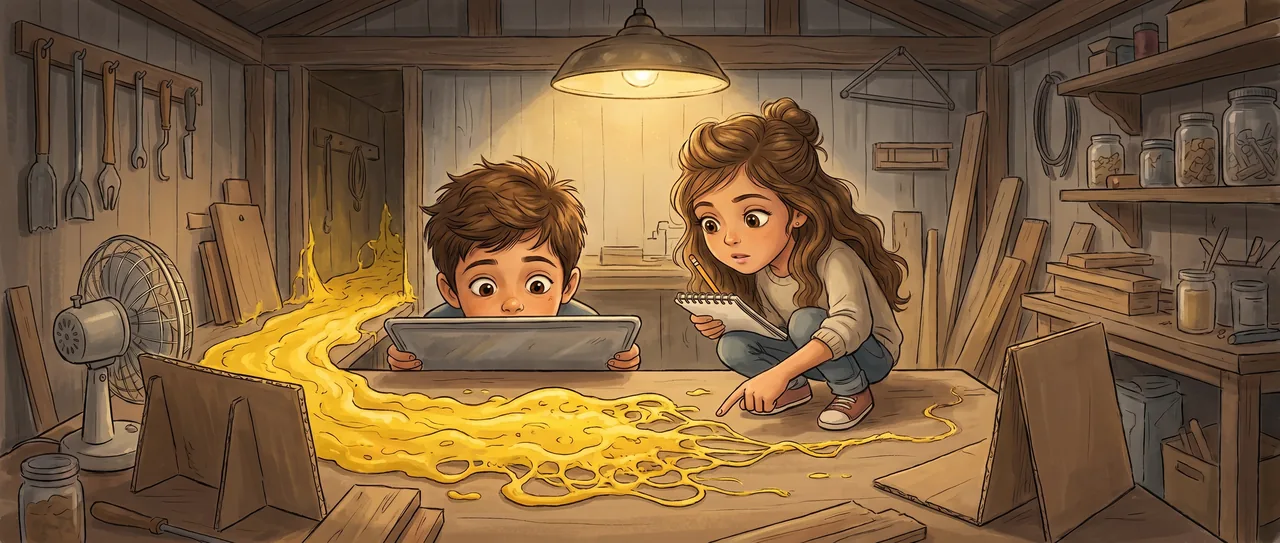
Soren had lifted the potato bucket off the shed floor and underneath was a thing the color of egg yolk, spread across the concrete like spilled paint that had decided to crawl. It had fingers. The fingers reached toward the gap under the door, where the morning light came in.
"It's a fungus," Soren said.
"It's not, though," Maya said. "A fungus doesn't aim."
They crouched. The yellow thing was aiming. Every thread of it leaned the same direction, toward the crack of light and the smell of the oats Soren's grandmother kept in a torn sack by the wall.
"There's no eyes on it," Soren said. "There's no front. How does it know which way the oats are?"
"Let's find out," Maya said.
They scraped a piece of it onto a jar lid with a popsicle stick. It did not seem to mind. By the time they had it out on the workbench under the lamp, the piece had already changed shape, gone from a blob to a smear with a leading edge, the way a drop of water finds the low side of a table.
Soren built a maze out of strips of cardboard hot-glued to a cookie sheet. Two ways through. One short, one long, both ending at a smear of oat paste.
"It won't pick," he said. "It can't pick. There's nothing in there to pick with."
"Put it in the middle," Maya said. "And we wait."
They waited the way eleven-year-olds wait, badly, leaving and coming back. After lunch the yellow thing had sent a thread down both hallways. After an hour more, the thread in the long hallway had thinned to almost nothing, drying back, while the short one had fattened into a yellow road.
Soren put his face right down level with the cookie sheet.
"It abandoned the long way," he said. "It tried both and it kept the short one."
"It found the answer," Maya said.
"With what," Soren said. He wasn't arguing. He sounded almost upset. "Maya. There's no neuron. There's not one. It's a bag of goo. I want to know what's doing the deciding."
"Maybe the goo is doing the deciding," Maya said.
Soren got out the notebook. His pencil moved down the page. Two hallways. An arrow on the short one. A question mark the size of a thumbnail.
"Here's what I don't get," Maya said. She was already somewhere ahead. "It found the short way without knowing the long way was long. It can't see the whole maze. It's only ever touching the part it's on."
"So it's not looking at the map," Soren said slowly. "It's being the map."
They looked at each other.
"Test it again," Maya said. "But meaner."
This time Soren read something out loud from his grandmother's old phone, an article he'd found, and his voice went careful the way it did when he didn't want to get a fact wrong. "It says people blew cold air on one. Cold dry air, it doesn't like. They did it three times. Evenly spaced. Then on the fourth time they didn't blow any air."
"And?" Maya said.
"And it slowed down anyway," Soren said. "At the exact moment the air should have come. It got ready for a thing that didn't happen."
Maya went very quiet. Then she said, "It kept time."
"There's no clock in it," Soren said. "There's no brain to count with."
"But it counted," Maya said.
They set up the meaner test with what they had, which was a desk fan and a cardboard flap. Three puffs of cool air across the yellow thing, one minute apart, Soren watching the second hand and saying now, now, now. Each time, the threads pulled in a little, flinched, kept going.
Then the fourth minute came. Soren didn't lift the flap. No air.
The yellow thing pulled in anyway.
It flinched at empty air, at nothing, at the memory of a rhythm, and then, finding no cold, it spread back out and went on reaching for the oats.
Nobody said anything for a while.
"It remembered," Soren said finally. His voice had gone small. "A thing with no place to keep a memory remembered when to be afraid."
"It's not the parts," Maya said. She was working it out as she said it, slow for her. "You keep asking which part is smart. Maybe none of the parts are smart. Maybe the smart is in how the whole thing moves together. Like how nobody in a flock of birds is the boss but the flock still turns."
Soren looked at the yellow thing. He had spent his whole life being the kind of person who needed to find the mechanism, the gear, the one piece that explained it, and people sometimes looked at him sideways for that, for not letting a thing just be amazing.
But here was a creature that had no gear either. No center. No one piece in charge. It solved the maze with its whole spread-out body the way you'd solve it with your whole spread-out attention, and it was still, by every measure they could throw at it, thinking.
"It's the same as me," Soren said.
"What is," Maya said.
"There's no boss in there. There's just a lot of slow careful parts all paying attention at once." He put his pencil down. "That's how I do it too."
Maya grinned. "It's how everybody does it," she said. "They just have a skull around it so it looks tidy."
They carried the cookie sheet back to the shed and tipped the yellow thing gently down next to its bigger self, near the gap under the door where the light came in. The two pieces would find each other by morning. They always did.
"Soren," Maya said. "If a thing with no brain can keep time and learn a maze and remember to be scared, then thinking isn't a brain thing."
"Then what is it," Soren said.
"I don't know yet," Maya said, and she sounded delighted about it.
In the dim of the shed the yellow thing put out a single thread toward the oat sack, slow as a minute hand, and began, with no eyes and no brain and no hurry, to choose its way.
Read the interactive version, listen to the narration, and earn a gold star →
A science-verified short story for curious kids · Curiosity Land