The Mice Who Lived in the Cleanest Room in the World
The tour guide kept saying the word sterile like it was the best word she knew.
"Everything that touches these mice is sterilized," she said. "The air, the food, the water, the bedding. They have never met a single microbe in their entire lives. Cleanest animals on Earth."
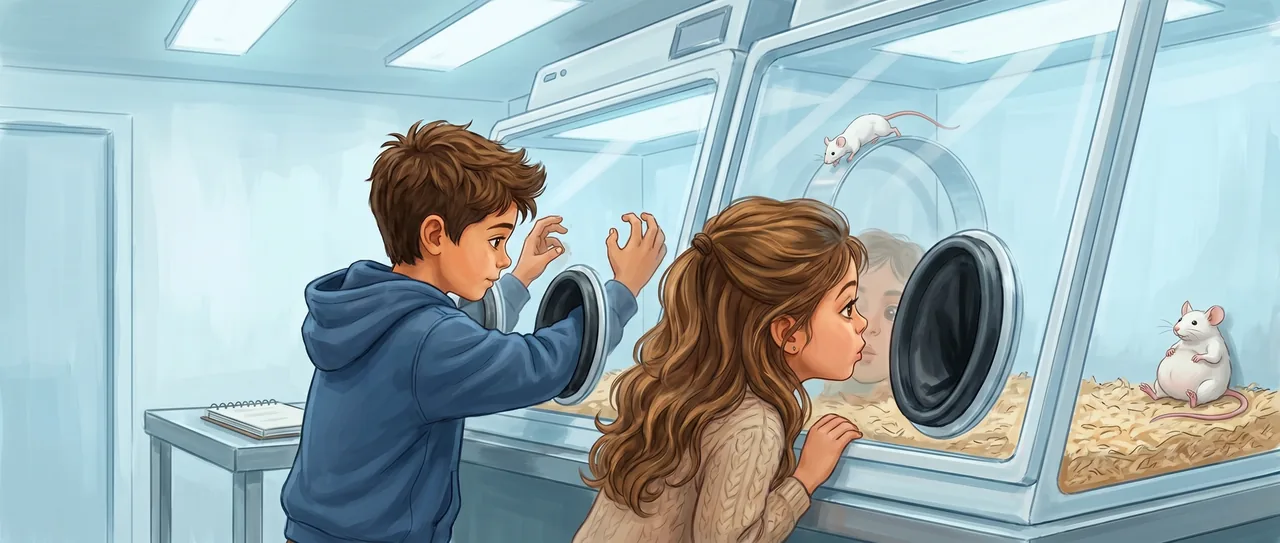
Maya pressed close to the viewing window. The isolator was a fat plastic bubble with black rubber gloves built into the sides, the kind you'd push your arms into to work without ever opening it.
"They look weird," she said.
"They look fine," said the guide, already walking.
Soren stayed. He had his notebook out and a pencil moving.
"Their bellies," Maya said. "Look how big."
The guide came back. She was not old, and she had the bright tired voice of someone who gave this talk four times a day. "That's the cecum," she said. "Part of the gut. In a normal mouse it's small. In these it gets huge."
"Why?" said Soren.
"Because there's nothing in it," she said, like that settled it, and moved to the next window.
Maya frowned. "That's backwards. Empty things get smaller. Like a balloon."
"Unless," said Soren, writing, "something was supposed to be eating it down. And nothing is."
They looked at each other.
"There's two mice in that one," Maya said. "Watch them."
They watched. Two white mice in a clean white world. Normal mice, Soren knew, were nosy. They climbed on each other, sniffed, tangled, fought, made up. These two stayed apart. One ran the same loop along one wall. The other sat in the corner with its big belly and did not investigate anything.
"They're ignoring each other," Maya said.
"Mice don't ignore each other," said Soren.
The guide was talking to the rest of the class about airlocks. Soren raised his hand anyway.
"Are these mice shy on purpose?" he asked. "Like, were they bred that way?"
"No," the guide said. "Same genes as regular lab mice. Exactly the same. Born by C-section into the bubble so they never pick anything up."
"Same genes," Maya repeated. She said it slow.
Soren felt the thing happen in his chest that happened when two facts that didn't want to be near each other got shoved together.
"Same genes," he said. "But they act different. So it isn't the genes making them act different."
"It's the empty," Maya said.
The guide laughed, not unkindly. "They're just a control group, guys. The boring version. The point is the mice we add bacteria to. Those are the interesting ones."
She moved on with the class. Maya did not move on. She had the look she got when something had stopped fitting and would not start fitting until she made it.
"Soren," she said. "What's the difference between us and them."
"Lots of things."
"No. Pretend we're a mouse. Same as them. What's the one thing they don't have."
"Germs."
"And we're covered in germs. Inside, even. Mom said most of the cells carrying my last name aren't even mine." She stopped. "Wait. That's a real thing she said."
Soren's pencil went still over the page. "There's more bacteria cells in a person than person cells," he said. "I read that. About the same number, at least. Trillions."
"So when I say me," Maya said, "I'm saying a whole crowd."
They stood with that. Through the glass, the lonely mouse ran its loop.
"Okay but here's the part," Maya said. "That mouse isn't sick. Nobody made it sick. They just kept it clean. And it came out with a giant gut and no friends and it's scared of its own room."
"We don't know it's scared," Soren said.
"Then we find out."
Soren went and got the guide. He was good at this, getting an adult to come back without making them feel managed. "The mice that get bacteria added," he said. "Do they change? After?"
The guide's tired voice picked up a little, because this was the part she actually liked. "That's the whole thing," she said. "You take a germ-free mouse, you give it the right gut bacteria, and the gut shrinks back to normal. The immune system starts working. Their stress chemistry calms down. There's work showing the social stuff comes back too, when you do it early enough."
"So the bacteria," Soren said carefully, "fix the brain part."
"Influence it," the guide corrected. "Nobody's fully untangled how. The gut talks to the brain. We're still figuring out the language." She shrugged like that was a small thing instead of the largest thing anyone had said all day.
Maya wasn't listening to the guide anymore. She was looking at the mouse in the corner, the one with the big belly that hadn't moved.
"Soren," she said quietly. "That mouse didn't choose to be alone. The clean did it. Take away the crowd inside it and it can't be a normal mouse on the outside."
"Right," he said.
"So the crowd inside isn't extra." She turned to him. "It's part of what makes a mouse act like a mouse. Part of what makes a me act like a me."
Soren looked down at his own hands on the cold edge of the viewing ledge. He thought about the trillions. The ones that weren't him and had been with him since the day he was born, riding along, doing something, talking in a language nobody had finished translating, helping decide, maybe, whether he wanted to go say hi to somebody or stay in the corner.
"That's not the boring version," he said.
"No," Maya said. "They had it backwards. The empty mouse is the loudest thing in the room."
The guide was calling them. The class was filing toward the airlock and the next bright clean fact.
Soren pushed his arms into the black rubber gloves built into the side of the isolator. They reached into the empty bubble where no mouse was, just clean air that had never carried anything alive. He flexed his fingers inside them and felt how the gloves held the exact shape of hands that weren't there.
Read the interactive version, listen to the narration, and earn a gold star →
A science-verified short story for curious kids · Curiosity Land