The Map That Wouldn't Finish
The bet was simple, and then it wasn't.
"My way home is shorter," Maya said. "Along the water. Your way goes up over the road."
"Prove it," said Soren. He had a measuring wheel from his dad's garage, the kind that clicks once every meter. "We measure the beach edge. Where the water meets the stones. That's your way."
They started at the old jetty. Soren walked the wheel along the line where the sea touched the land, and it clicked, and clicked, and Maya counted under her breath.
"Three hundred and twelve meters," Soren said at the end.
"That can't be right."
"Why not? It clicked. I counted too."
Maya was looking back along the way they'd come. The wheel was big. It rolled straight over every little dip and curve where the water poked into the stones. It bridged across them like a plank laid over a ditch.
"You skipped the wiggles," she said.
"What wiggles?"
"All of them." She crouched. Where the sea met the beach, the line wasn't a line. It went in around a wet hollow, out around a fat stone, in again behind a clump of weed. "The wheel's too big. It only touches the bumps. It misses everything between."
Soren crouched next to her. He looked at the wheel, then at the actual edge of the water, which did not look like anything the wheel had been measuring.
"So the real edge is longer," he said slowly. "Because the real edge goes in and out around all of that."
"Way longer. Get the tape."
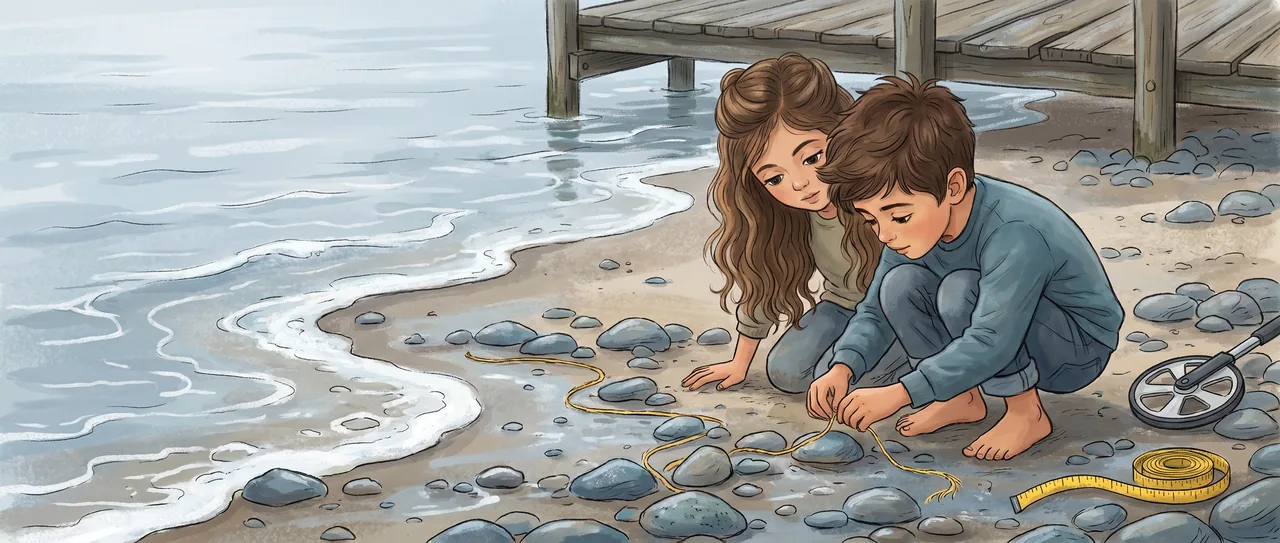
They had a tape measure, the soft yellow kind for sewing. They laid it along the same stretch the wheel had rolled, but this time they bent it into every curve, around every stone the size of a fist, into every little bay the width of a hand.
It took them forty minutes to do the part the wheel had crossed in seconds.
"Five hundred and forty," Maya read off. She sat back on her heels. "For the same piece. The wheel said way less."
"Because the tape went into the wiggles the wheel jumped over." Soren wrote both numbers down, three twelve and five forty, one under the other, and stared at the gap between them. "That's a huge difference. One of them has to be wrong."
"Why does one have to be wrong?"
"Because there's a real length. The beach is the beach. It has a length." He said it like it was obvious. Then he heard himself say it and stopped.
Maya was already at the water's edge with her face close to the stones. "Soren. The tape skipped things too."
"It can't have. We did every stone."
"Every big stone." She pointed. Between two fist-sized stones the tape had gone straight across. But the water didn't go straight across. It went in around a pebble, and out, and in around a smaller pebble. "The tape's too thick to get in there. It bridges the little ones the way the wheel bridged the big ones."
Soren got down low. He pulled a single thread loose from the frayed end of the tape and laid it along one hand's width of shoreline, threading it around every pebble he could see. The thread that should have covered a hand's width needed three hands' worth before it ran out.
"Okay," he said. His voice had gone careful. "So the thread says the little stretch is three times longer than the tape said."
"And if we measured around every grain of sand?"
"Longer again."
"And around every bump on every grain?"
Soren didn't answer. He was looking at the thread, and past the thread, at the wet sand grain by grain, and Maya watched him not answer.
"It doesn't stop," he said finally. "Maya. There's no bottom. Every time we use a smaller ruler, it gets longer. There's no number it's heading toward. It just keeps going up."
"So how long is the beach?"
"There isn't an answer. That's the thing. It's not that we haven't measured it carefully enough yet." He looked at his notebook, at three twelve and five forty sitting there like they'd settle something. "It's that the more carefully you measure it, the bigger the answer gets, forever. The beach doesn't have a length. It has as many lengths as you have rulers."
Maya sat down in the wet sand and didn't care. "Then I can't win the bet."
"You can't win the bet. Neither can I. The road's got the same problem. Every road's got the same problem." He laughed, a little stunned. "Every coastline on Earth. Nobody actually knows how long any of them are. They just pick a ruler and agree to use it."
"Pick a ruler and agree." Maya turned the words over. "So when a book says a country's coast is some number of kilometers, that number is just—"
"The size of the ruler they used. Use a smaller one and the country gets a bigger coast. Same country. Same shore."
They sat with that. The tide was the smallest bit higher than when they'd started, and the line they'd been measuring, the line they had argued over and threaded and bent the yellow tape around, was already a different line. The water had erased the part near the jetty and drawn a new edge over the stones, with new wiggles, new pebbles, a whole new uncountable shore.
"It moved," Maya said. "The thing we were measuring. It's not even in the same place now."
Soren watched the water find its way in around a stone it hadn't touched a minute ago, then out, then in around a smaller one.
"We were never going to finish," he said.
Maya pulled the loose thread off the end of the tape, the one Soren had used, and held it up. It was maybe as long as her arm. Somewhere in its little crooked path it had measured one hand's width of the world, and it had not been enough, and nothing would have been enough.
She laid the thread down at the new water's edge and let the next small wave curl over it, and the two of them leaned in close to watch where the sea decided to go this time, stone by stone by stone, all the way down to a smallness they would never reach the bottom of.
Read the interactive version, listen to the narration, and earn a gold star →
A science-verified short story for curious kids · Curiosity Land