The Garden With No Sun
The canister came up cold on the outside and warm in Maya's hands, which was the first thing that did not fit.
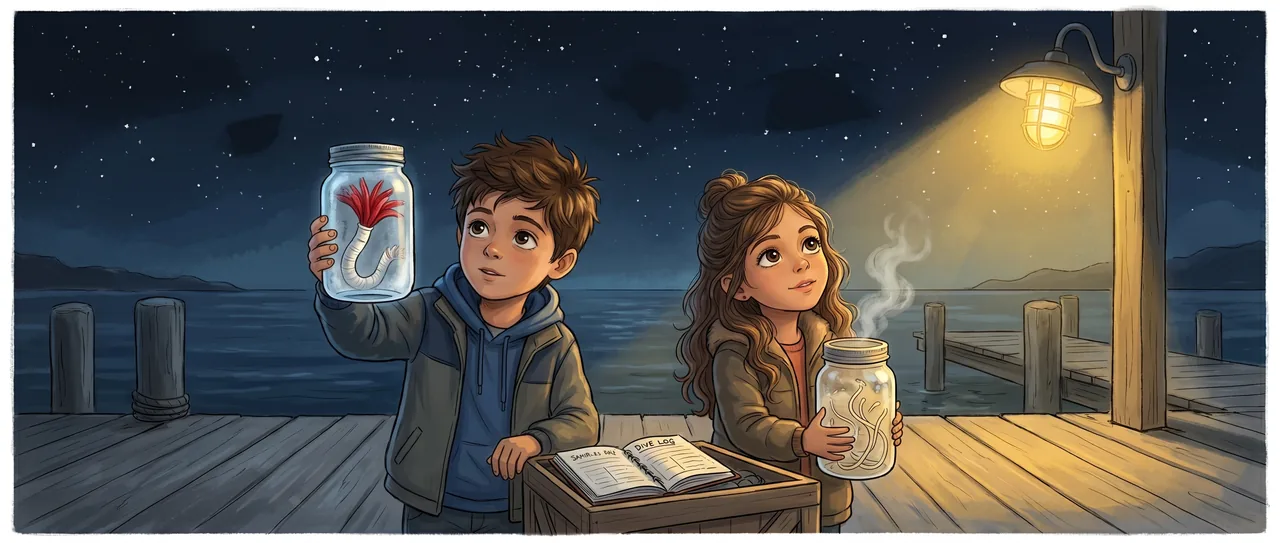
It had been three kilometers down. The water that deep was supposed to be near freezing, dark as the inside of a closed mouth, pressure heavy enough to crush a steel drum. Maya had heard the dive team say all of that over dinner before they left the two of them on the dock with the sample crate and a single yellow work light.
Now she held the sealed sample jar against her cheek the way you test if a baby is too warm. It was warm. The water inside had come from the bottom of the sea, and it carried heat up into the open air.
"Don't drink it," Soren said. He was crouched over the crate, reading the label upside down. "It smells like a struck match."
Maya breathed it in. Rotten eggs. Matches. A sharp mineral stink that made the back of her throat close. "That's the smell of the bottom of the ocean?"
"It's the smell of the rocks down there bleeding," Soren said. He had the dive log open on his knees. "Listen. They pulled this off a vent. A crack in the seafloor. Hot water comes out of it. Hotter than boiling, except it can't boil because the pressure holds it down."
Maya turned the jar in the yellow light. Cloudy. Threaded with pale strings, like somebody had stirred milk into it and the milk had refused to dissolve. She tipped it slowly. The pale strings did not settle. They drifted and hung.
"Those aren't minerals," she said.
Soren looked up.
"Minerals sink," Maya said. "I shook it. They're not sinking. They're just floating there like they want to be where they are."
Soren set the log down. There was a second jar, a smaller one, fogged with cold. He wiped it clear with his sleeve and held it under the light. Inside, fastened to a chip of dark rock, was a tube. White, soft, the width of a drinking straw, and out of its open end came a red plume, blood red, the brightest single thing on the whole gray dock.
Neither of them said anything for a moment. The harbor water slapped the pilings underneath them.
"It's a worm," Soren said finally. "It has to be a worm." He turned the jar. The red plume swayed inside its own dead water. "It doesn't have a mouth. Maya, I'm looking at the whole thing and there's no mouth and no eyes."
"Why would it have eyes," Maya said slowly. "There's no light down there. None. Not a glow, not a star, nothing reaches that deep."
She felt the cold of the harbor and the warmth still leaving the jar in her other hand, and the two did not belong together.
"Then what does it eat," she said. "If there's no light there's no plants. No plants, nothing eats the plants, nothing eats the things that eat the plants. The whole stack falls over. Everything I've ever learned about who eats what starts with the sun."
Soren picked up the dive log again and read with his finger moving under the line. "It says the red part is full of blood. It says the worm doesn't eat at all. It farms."
"Farms what?"
"Bacteria. Inside its own body. Billions of them." He looked at the steaming jar in her hand, then at the matchstick smell rising off it. "And the bacteria eat the smell."
Maya went still. The two jars sat in front of her, the warm cloudy one and the cold one with the red worm, and her hands had stopped moving.
"The poison," she said. "The match smell. That's not waste. That's the food."
"The chemicals come up out of the rock," Soren said, reading, building it. "Out of the planet itself. The heat and the chemicals come from inside the Earth and never touch the sun at all. The bacteria pull them apart and make sugar out of them. The worm grows the bacteria and lives off the sugar." He stopped. "There's a whole world down there. It eats the planet. It doesn't need the sky."
Maya looked up.
The sky over the harbor was full of stars, the ordinary ones, the ones you were always told everything depended on. She had spent her whole life being told that the sun was the engine, that every leaf and cow and child traced back to it, that without a star you got nothing, a dead rock, an empty dark.
And in her hand was a jar of warm water from a place the sun had never once reached. And it was not empty. It was crowded. It was a garden.
"Soren," she said. Her voice came out smaller than she meant. "If life can do this here. If it can build a whole garden out of a crack in the rock and never need a star."
She did not finish. She did not have to.
Soren had stopped writing. He was looking at the red worm in its cold jar, and then he was looking up, past the work light, past the dock, at the dark between the stars where there were no stars, the cold places, the rogue planets thrown out of their systems, the moons with frozen crusts and warm cracked rock underneath.
"All those worlds without a sun," he said. "We always crossed them off."
Maya set the warm jar down very carefully, the way you set down something that might still be alive.
The pale strings inside it lifted and turned and hung in the water, lit only by the one yellow lamp, reaching out into the dark in every direction the way they must have reached three kilometers down, in the place that had never seen a star and had decided, anyway, to be full.
Read the interactive version, listen to the narration, and earn a gold star →
A science-verified short story for curious kids · Curiosity Land