The Compass That Couldn't Decide
The compass would not hold still.
Soren had brought it to find north so they could angle the rod holder out of the morning sun. The needle swung, settled, then drifted, then swung again, like it was sniffing for something it kept losing.
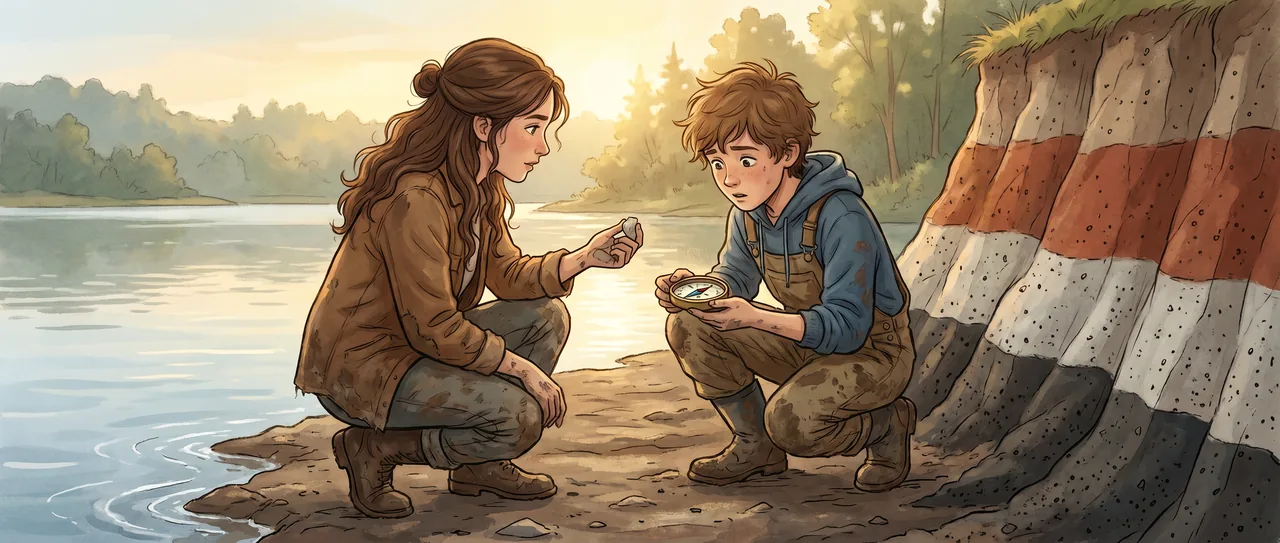
"Yours is broken," Maya said. She was knee-deep in the cut bank, scooping wet clay with a trowel, and the clay came up cold and smelled like pennies and rain.
"It worked in the parking lot." Soren tapped the glass. The needle wandered.
Maya wasn't listening. She had stopped digging. Her thumb was moving across the side of the cut, where the mud was not one color. It was striped. Pale gray, then a band of rust-red, then dark almost-black, then gray again, the lines thin as the pages of a soaked book.
"Soren. Feel this."
He set the compass on a root and pressed his fingers where she pointed. The bands had different textures under the skin. The red ones were grittier. The dark ones were smooth and slick and cold, colder than the rest, the way the bottom of a pond feels colder than the top.
"Mud doesn't stripe itself," Maya said.
"Floods," Soren guessed. "Each flood drops a layer."
"Then why are some red and some black?"
He didn't have it yet. He scraped a thumbnail of the dark band onto his palm and held it to the light. Tiny flecks in it, darker than the clay, catching the sun like ground pepper. He brought it close to the compass needle on the root.
The needle twitched toward his hand.
"Whoa." He moved his palm left. The needle followed. He moved it right. It followed.
Maya was already digging the dark band out with her fingers, fast, the way she did everything. "There's iron in it. Little iron in the mud." She held a clump near the needle and it leaned toward her too. "The mud is magnetic."
"Some of it," Soren said. He pinched a bit of the red band and held it near the needle. The needle barely moved. He held the dark band up. The needle swung hard. "This one's stronger. The dark layers have more of the iron grains in them, or bigger ones, I don't know."
The water lapped at their boots. A dragonfly stitched the air over the reeds. Maya was rubbing two clumps of the dark stuff together, frowning, smelling them.
"When the mud was soft," she said slowly, "the iron bits could turn."
Soren went still over the compass.
"Like the needle," she said. "When the mud was soup at the bottom, each little iron grain floated loose and turned to point along the Earth. North. Then the mud dried and went hard and froze them all pointing that way. Forever."
Soren picked up the dark clump and held the compass beside it and turned the clump slowly. The needle tracked it the whole way around. A whole layer of frozen needles. Thousands of them. Millions. Each one a tiny arrow that had pointed north on the day it settled and never moved again.
"It's a recording," he said. His voice came out smaller than he meant it to. "Every layer is a different day. The mud wrote down where north was."
"So if we read up the bank," Maya said, "we read forward in time."
They read it together. Soren held the compass, Maya pried out a pinch from each band and pressed it close, and they watched which way the frozen arrows pulled. Bottom band: the needle leaned one way. The band above it: same way. The next: same. Their hands were freezing. Neither of them stopped.
Then Maya's pinch came from a band near the middle, a thin pale one between two dark ones, and the needle did the thing it had done all morning.
It wandered.
"That one's just weak," Soren said. "Less iron."
"No." Maya held it still. Held her own breath. "Watch."
The needle didn't lean one way. It hunted. It pointed half toward the reeds, then drifted, then seemed to be pulled two directions at once and couldn't choose, exactly the way it had behaved when he first pulled it out of his pocket.
Soren took the pinch from her and held it under the glass himself. He turned it. The needle confused itself. He set it down, picked up the dark band below it, clear strong pull one way. Picked up the dark band above it, clear strong pull, but the other way. Back behind them, ahead of them.
"The arrows below point this way," he said. "The arrows above point backwards. And this one in the middle, the day this one settled, they couldn't agree. They froze pointing everywhere."
Maya sat back on her heels in the cold mud. The lake breathed in and out at the edge of her boots.
"North moved," she said. "Not the mud. North. The whole Earth flipped which way was north, and we're holding the day it couldn't make up its mind."
"It can't just flip," Soren said, but he was already not believing himself, because the band was right there in his fingers, gray and uncertain, sandwiched between two layers that pointed opposite ways like the world had turned over in its sleep.
"For that one layer there wasn't one north." Maya touched the pale band, barely, like it might still be soft. "There were maybe two. Three. The compass needle wouldn't know where to go. Sailors wouldn't. Birds wouldn't." She looked at the dark band above it, the one that pointed the wrong way, the after. "And then it picked. And stayed wrong-way-round for a long time. Long enough to stack all those layers."
Soren looked up the bank, at all the stripes above the confused one, dark and pale and red climbing toward the grass and the present day. Each one a settled answer. Somewhere up near the top, he knew, the arrows would swing back to agreeing with his compass. They had to. North was north this morning in the parking lot.
He held the compass over the pale band one more time and let go of the idea that it was broken.
The needle drifted, and hunted, and pointed at nothing the lake could show him, the same way it had pointed when he first lifted it out of his pocket into the wandering air.
Read the interactive version, listen to the narration, and earn a gold star →
A science-verified short story for curious kids · Curiosity Land