The Air in the Bread
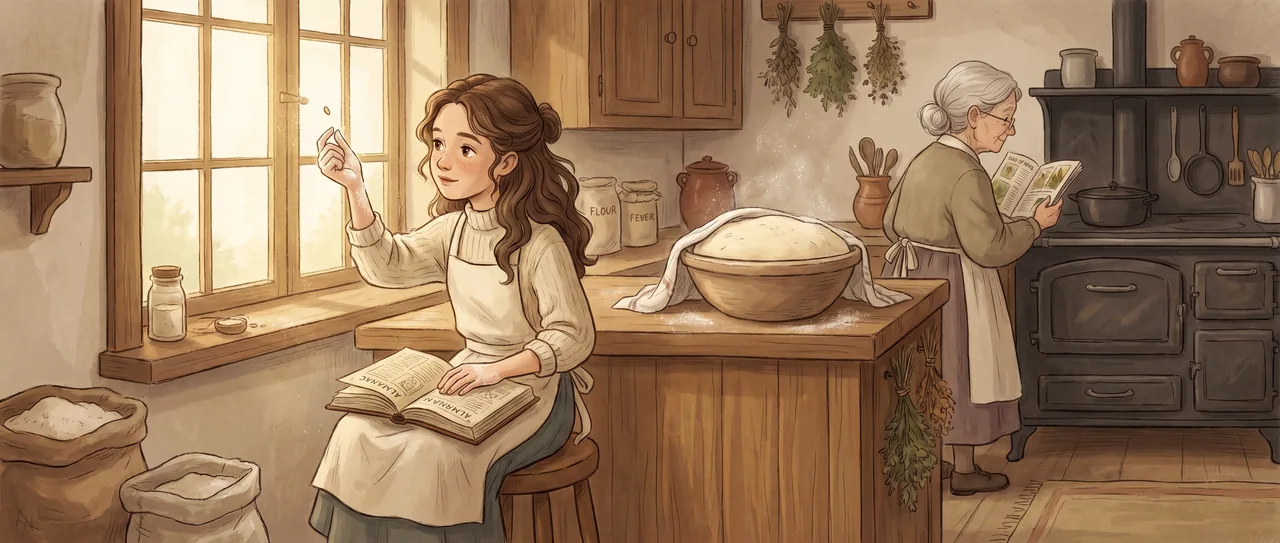
The dough breathed under Maya's hands. That was the only word for it. Warm, slightly damp, pushing back when she pressed, like something half awake. Gran said you had to knead until it stopped tearing and started stretching, and Maya could feel the exact moment it happened, the dough going from crumbly to smooth, like a fist unclenching.
Flour hung in the light from the window. Maya watched a single grain of it drift, turn, settle on the back of her wrist.
"This came from a field," she said.
"Wheat usually does," said Gran, not looking up from the seed catalog she read every winter the way other people read novels.
"No, but the wheat. It had to build itself. Out of something." Maya pushed the heel of her hand into the dough. "Dirt and water and air."
"And sunshine," said Gran. "Don't forget the sunshine."
Maya did not forget the sunshine. She was stuck on the air. There was a fact lodged in her, the way the flour grain was lodged on her wrist, and it would not come loose. She had read it in a library book about explosives, of all things, which was not what she had gone looking for. The book said that the same discovery that let people make bombs also let them make bread. It had not explained how a thing could be both. It had just dropped that sentence and moved on, and Maya had been carrying it around for two weeks like a stone in her shoe.
"Gran. What makes plants green and growing? Not the color. The growing."
Gran turned a page. "Your grandfather swore by fish heads buried under the tomatoes."
"But why fish heads."
"Nitrogen," said Gran, and the word landed in the kitchen like a dropped spoon. "That's what the bag says, anyway. Nitrogen makes them leaf out." She tapped the catalog. "This one's twelve percent. Costs the earth."
Maya stopped kneading.
Nitrogen. She knew where nitrogen was. It was everywhere. It was the air. Almost four fifths of every breath she had ever taken was nitrogen, sliding in and sliding out, doing nothing, touching nothing, a gas so uninterested in the world that it just passed straight through her.
She breathed in on purpose. Held it. Felt her chest go tight and full.
Most of what she was holding was nitrogen. And it would not become anything. It would not feed the wheat. It would not feed her. The plants were standing in an ocean of it, drowning in it, and starving.
"That doesn't make sense," Maya said. "It's right there. The air is full of it. Why do you have to buy it in a bag?"
Gran laughed, the dry little laugh she saved for the universe being ridiculous. "You ask your grandfather that. Oh. You can't. Well. People wondered that for a long time, sweet pea. A long, long time."
Maya looked at the dough. She looked at her own hands, pale with flour, and under the flour the skin, and under the skin the muscle, the muscle that was built of, that was mostly, that needed.
Protein. She knew this one. Protein had nitrogen in it. Her hair had nitrogen in it. The thoughts going through her head right now were running on nerves built out of it. She was made of the stuff. She was made of air that had somehow learned to stay.
But the air didn't stay. That was the whole problem. The nitrogen in the air held onto itself so hard, two atoms locked together so tightly that nothing in a field could pull them apart. Not the wheat. Not Maya's body. The lock was too strong.
"So how," she said slowly, to the dough now, because the dough was listening better than Gran, "does it get out of the air and into me."
The almanac was on the windowsill, the fat old paperback Gran kept for the planting dates. Maya wiped her hands and flipped to the back, where the boring pages were, the tables and the histories nobody read. She found it under a heading about modern farming. A name. A year, nineteen hundred and nine. A description so plain it almost hid what it was saying.
Two men. A machine. Enormous heat and a crushing, mountain-deep pressure, squeezing the air against itself until the lock broke. Until the nitrogen let go and joined with hydrogen and became something new, something soft and sharp-smelling, something a plant could finally eat.
They had reached into the air and pulled the nitrogen down.
Maya sat very still on the kitchen stool. The almanac said that without this, the soil of the whole world could feed only so many people, and no more. It gave a number. She read the next line twice.
The nitrogen in roughly half the people alive right now, it said, came out of that machine.
Half.
Maya put the book down on her knees. The kitchen was the same. The flour still drifted. The dough still breathed under its towel. But she was counting now, the way she always counted when something would not sit still. Half the people on the planet. Half of everyone in her class. Maybe half of her own self, the atoms in her hair and her hands and the thoughts going through her, atoms that had floated as useless air over some field in nineteen-something, untouchable, locked, until a machine breathed them in and breathed them back out as something a root could drink.
She held her wrist up to the light. The single grain of flour was still there. It had been wheat. The wheat had been built out of fertilizer. The fertilizer had been built out of air. The air had been everywhere and inside everyone since before there were people to breathe it, and it had done nothing, gone nowhere, become no one, for billions of years.
Until somebody figured out how to ask it to stay.
"Gran," Maya said. "Breathe in."
Gran, baffled, breathed in.
"That's going to be somebody someday," Maya said. "Some of it. The part that gets caught."
The oven timer was ticking down. Gran got up to check the heat, muttering that the child got stranger every visit, and Maya pulled the towel off the bowl. The dough had doubled. It had filled itself with bubbles of its own breath, risen up pale and round and full of trapped air, and she pressed one finger into the center and watched it slowly, slowly push back up toward her.
Read the interactive version, listen to the narration, and earn a gold star →
A science-verified short story for curious kids · Curiosity Land