What the Sequences Knew
Maya's aunt Reza made vases for a living and proteins for fun. The proteins were free, she said, which was more than you could say for cobalt glass.
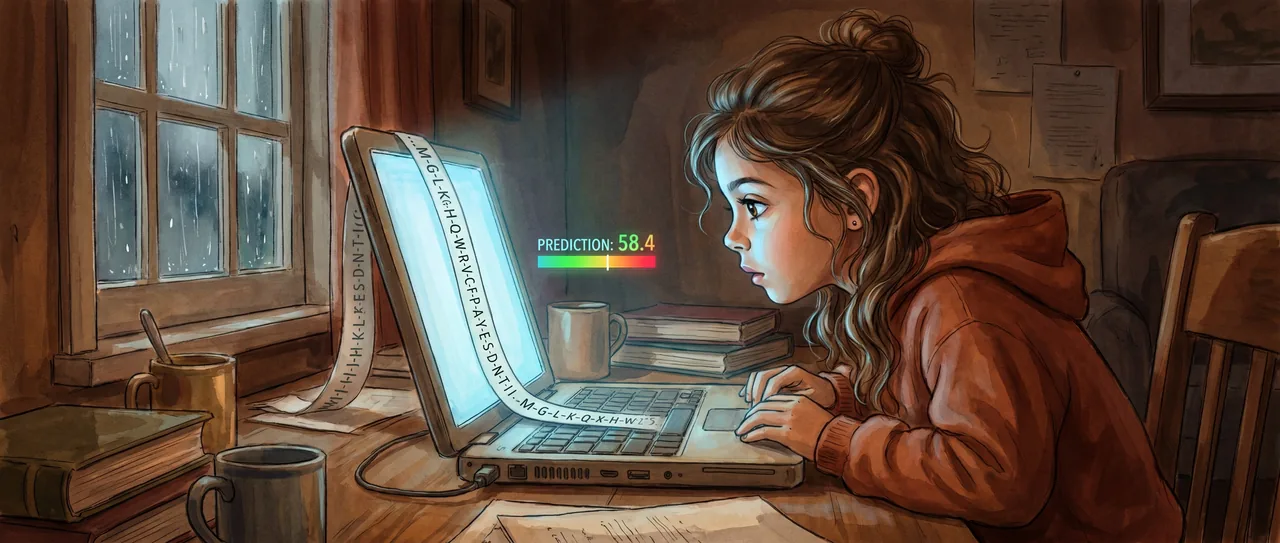
The laptop on the spare-room desk had a program already open. A long ribbon of letters scrolled down the screen. Just letters. M, K, V, L, the same twenty over and over in different orders, like someone had spilled alphabet soup and called it science.
"That's a protein," Reza said, pulling on her coat. "Or the recipe for one. Every living thing is written in those twenty letters. There's a button that says Predict. Press it if you get bored. Don't melt the laptop."
Then she left for the studio, and the rain came down, and Maya was alone with the soup.
She read the instructions taped to the desk in Reza's slanted writing. The program had been fed millions of these letter-strings, scraped from every creature anyone had ever sequenced. Bacteria. Whales. The mold on old bread. It had been shown the strings and nothing else. Not what an atom was. Not what a bond was. Not heat, not water, not charge. Only the letters, and which letters tended to sit beside which.
Maya changed one letter in the middle of the ribbon. An L became a P. She pressed Predict.
The screen thought for a moment. Then a number turned red. Less stable, it said. This protein would fall apart faster.
She frowned. She had not told it the protein would fall apart. She had not told it anything could fall apart. She had only changed a P for an L.
She changed it back. The number went green. She tried a different spot, swapped two letters there. Red again, darker. The program seemed very sure. It had opinions about letters it had never seen in that order before.
Maya leaned back. Here was a thing that did not make sense yet, and she added it to the list she kept in her head.
The program did not know physics. The instructions said so twice, underlined. So how did it know that one swap would weaken the protein and another would not? A weakened protein was a physics fact. It was about how the chain folded, how it held its shape against the jostling of a warm wet world. That was atoms and angles. That was chemistry.
But the program had never met an atom.
Maya did the thing she always did when something refused to fit. She tried to break it.
She found a position the program was certain about, a letter it insisted must be W and nothing else. She changed it to everything else, one at a time, pressing Predict after each. Red, red, red, red. The program hated all of them. It wanted W there and would not be talked out of it.
Why W. She did not know what W was. She looked it up. Tryptophan, the biggest of the twenty, a great flat ring of a thing. The program did not know W was big. The program had never been told the shape of anything. All it had ever seen was that, in millions of real living creatures, this spot in this kind of protein was almost always W. The ones where it wasn't W, mostly, were not around anymore to be sequenced. They had failed. They had fallen apart, or folded wrong, or never worked at all, and their letters had vanished from the world along with them.
So the program had learned the rule without the reason. It had learned that W belonged there because every creature that disagreed was gone.
Maya's skin prickled.
The physics was still in the letters. That was the thing. The folding, the bonding, the heat, the water, all of it had been pressing on living things for four billion years, deciding which letter-strings survived and which ones died. The survivors were the answer key. And the program had read four billion years of answer keys and worked backward to the test.
Nobody taught it the laws. The laws taught the creatures, the creatures wrote it down in letters whether they meant to or not, and the program read what they wrote.
She tested it again, harder, because she did not believe things on the first pass. She picked a spot where two faraway letters sat at opposite ends of the ribbon. She changed one. The number dropped. Then she changed the distant other one too, a different letter, and the number climbed back, almost all the way.
She stared. The two letters were nowhere near each other in the line. But the program knew they belonged together, that a change in one wanted a matching change in the other, the way two ends of a rope have to agree about a knot.
The program had never seen the knot. It had only seen that, across all of life, those two positions always changed in step, like dancers who never touch but always turn at the same moment. When the protein folded, those two far-apart letters came close. They held hands in space. And the program had felt the holding-hands purely from the letters, purely from the company they kept.
Maya thought about all the children who got told they noticed too much. Who got asked why they couldn't just accept the answer instead of taking it apart. The program was the opposite of that. The program was rewarded, completely, for nothing but noticing what kept company with what. It had no physics, no teacher, no hands. It had paid attention to patterns longer and harder than anything alive, and out of pure attention it had rebuilt the laws of the world.
Nobody had given it the reasons. It had earned them.
The rain kept on. Maya pulled the laptop closer and went looking for the place where the program was least sure, the spot where the letters disagreed with themselves, where life had not yet decided. She wanted to see what the program did at the edge of its knowing.
She found one. A position the program rated almost even, three different letters nearly tied, none of them clearly right.
Maya put her finger on the trackpad. On the screen the cursor hovered over a letter no living creature, maybe, had ever tried in that spot.
She pressed Predict.
Read the interactive version, listen to the narration, and earn a gold star →
A science-verified short story for curious kids · Curiosity Land