The Planet With No Sun
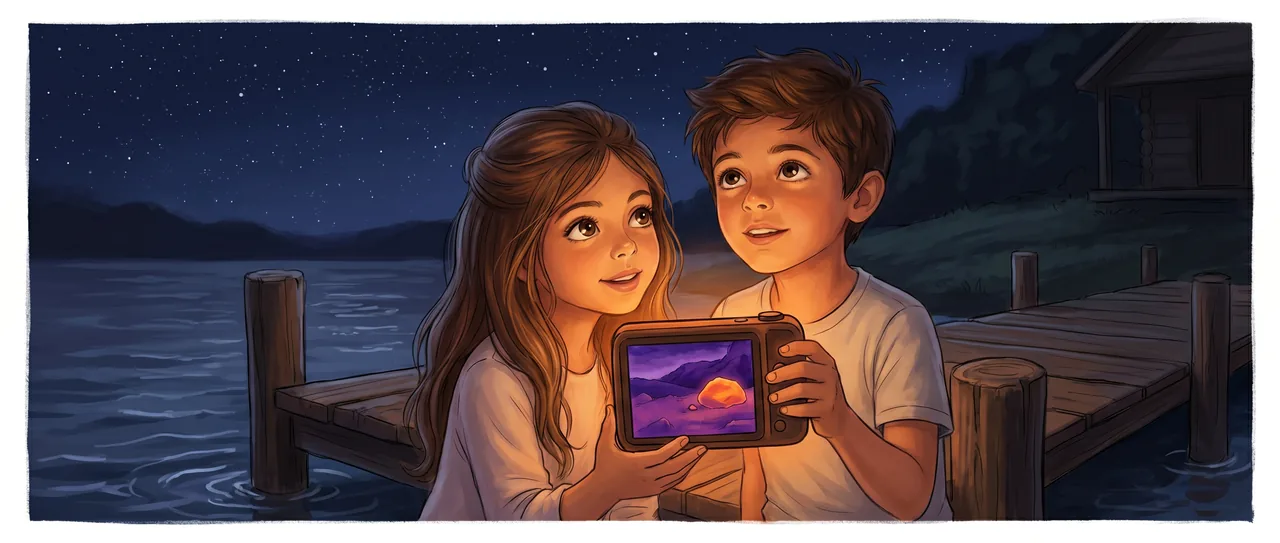
The thermal camera made everything look like a bruise. Maya swung it across the lake and the water glowed cold purple. The dock glowed warmer. Soren, sitting beside her, glowed like a small orange ghost.
"You're hot," she said.
"I know."
"No, the camera. You're the hottest thing here."
"That's because I'm alive. The lake isn't." Soren leaned over the screen. "Point it up."
Maya tilted the camera at the sky. The stars didn't show. Just flat, even cold, edge to edge.
"Boring," she said.
"Stars are far. The camera only sees close heat. Raccoons. Us." He paused. "The ground holds warmth longer than the air. Watch."
She panned down to the hillside. He was right. The rocks were warmer than the air around them, hours after the sun had gone.
"They're keeping it," Maya said. "The heat. From the day."
"Stored," said Soren. "They'll let it go all night. Slowly."
Maya went quiet. She lowered the camera and looked at the actual sky, the real one, thick with stars.
"Soren. How many stars up there?"
"In the galaxy? A few hundred billion."
"And every star gets planets?"
"Most do, I think."
"So more planets than stars."
"Probably way more."
She lifted the camera again, then put it down again, like she couldn't decide which sky she wanted.
"Okay," she said. "Here's the thing that doesn't fit. When a solar system is forming, it's a mess, right? Lots of planets bumping each other."
"Gravity slinging them around. Yes."
"So some get slung too hard."
Soren sat up. "Out. They get thrown out of the system entirely."
"Where do they go?"
"Nowhere. Everywhere. They just leave." He was talking faster now. "No star. No orbit. Just out into the dark between stars, forever."
Maya turned that over. "How many?"
"I don't actually know."
"Guess."
Soren was quiet for a second. "If it happens to even a couple planets per system, and there are billions of systems." He stopped. "There could be more loose planets out there than stars. Wandering. Alone. Maya, there could be more planets with no sun than planets with one."
The lake lapped against the dock posts.
"That's the saddest thing you've ever said," Maya said.
"Why sad?"
"No sun. Frozen solid. Just falling through the dark with nobody. For billions of years." She picked up the camera and aimed it at the dark hillside again, at the warm rocks. "Dead. Like the lake. Cold all the way through."
She held the camera there. The rocks glowed back, patient and orange.
Soren looked at the same screen.
"Wait," he said.
"What."
"The rocks. Why are they warm?"
"The sun. From today. We said."
"The surface, yes." Soren took the camera from her, gently, and aimed it at a boulder half-buried in the slope. "But the deep ground. Caves. Old mines. They stay the same temperature all year. Winter and summer. The sun doesn't reach down there."
"So what keeps them warm?"
"The Earth does. From inside. There's heat coming up out of the rock itself." He lowered the camera slowly. "Maya. Where does that heat come from? It's not the sun. The sun never touched it."
Maya's mouth opened. "The rocks make their own."
"Not make. Hold." He was reaching for the word. "There's stuff inside rock. Heavy stuff. It breaks down, super slowly, atom by atom, over billions of years. And every time a piece breaks, it lets out a tiny bit of heat. Radioactive decay. It's why the inside of the Earth is hot. Not the sun. The sun has nothing to do with it."
Maya grabbed his arm.
"Soren."
"I know."
"Say it."
"A rogue planet is made of rock too."
"Say it."
Soren put the camera down in his lap. "A planet thrown out of its system still has all that heavy stuff inside it. The decay doesn't need a sun. It doesn't care that there's no star. It just keeps going. Billions of years. The whole time the planet's falling through the dark." He swallowed. "It's warm. From the inside. The surface would be frozen solid, ice miles thick. But underneath the ice."
"Water," Maya whispered. "There could be water. Liquid water."
"An ocean," said Soren. "Under the ice. Heated from below by the rock. In a planet with no sun. In the dark between the stars."
Neither of them said anything. The lake breathed against the dock.
Maya took the camera back. She aimed it at the hillside, at the rocks letting out their slow, buried warmth into the night air.
"It's not dead," she said. "That's what I got wrong. I thought no sun meant dead. But the sun's just one way to be warm."
"It's the loud way," Soren said. "The decay is the quiet way. It works in the dark just as well."
Maya turned the camera straight up, at the real sky, knowing it couldn't see that far, aiming it anyway. The screen stayed flat and cold, edge to edge, all those stars too distant to register.
"There could be one up there right now," she said. "Going past. Closer than most of those stars. Black, so we'd never see it. And inside it, under the ice, an ocean nobody's ever going to find."
"Warm," said Soren.
"Warm," said Maya. "Maybe more of those than stars. Maya did the math wrong on what alone means." She lowered the camera and looked at him. "You can be alone and not be cold. Those are different things."
Soren reached for his notebook in the dark, found the page by feel, and wrote without looking up at the sky he could no longer stop thinking about.
On the hillside, the buried rocks kept letting go of their heat, one slow degree at a time, the way they had every night for longer than there had been anyone on the dock to point a camera at them.
Read the interactive version, listen to the narration, and earn a gold star →
A science-verified short story for curious kids · Curiosity Land