The Number That Wouldn't Fit
The roll of paper was taller than Soren and heavier than it looked.
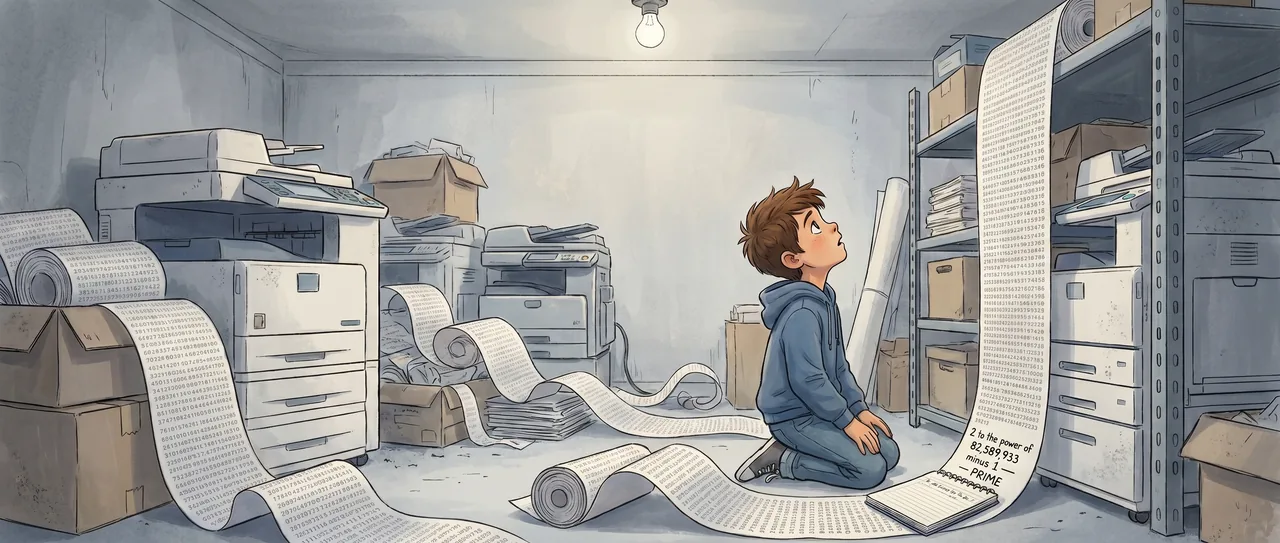
It had been leaning in the back corner of the storage unit, behind the dead photocopiers, wrapped in plastic gone milky with dust. His uncle wanted everything gone by Sunday. Soren had been told to flatten the boxes. Instead he was on his knees in the cold concrete light, picking at the tape with his thumbnail, because the roll had a label, and the label said something that did not make sense.
ONE NUMBER. DO NOT FOLD.
He got the plastic off. The paper inside was the kind that fed through old machines in one endless sheet, the edges punched with little holes. He unrolled an arm's length. It was covered in digits. Not sums, not columns, not money. Just digits, packed edge to edge, marching on with no gaps and no commas, tiny and gray.
He unrolled another arm's length. More digits.
The paper was cold under his palms and smelled like a basement, like toner and old glue. He kept unrolling. His arms got tired. The number did not stop. It poured off the roll and pooled on the floor and kept pouring, and somewhere in his chest a strange feeling started, the feeling of standing at the bottom of something very tall and tipping his head back to find the top.
The last few inches finally came free. The whole unit floor was a river of paper. And at the very end, in big handwriting, someone had written: 2 to the power of 82,589,933, minus 1. And under that: PRIME. And under that, smaller: 24,862,048 digits. Found 2018.
Soren sat back on his heels.
He knew what a prime number was. Three was prime. Seven was prime. A prime was a number you could not build out of smaller pieces multiplied together, a number with no way in except one and itself. They were the bricks. Everything else was made of them.
He looked at the river on the floor. One brick. This entire river was one brick. A number with no way in except one and itself, and it stretched across the floor and under the dead photocopiers and you could not hold it in your head, you could not hold it in this room.
He pulled his notebook out of his back pocket and wrote: 2 to the power of n, minus 1. He wrote three. Then seven. Then he stopped writing and did it in his head instead, because it was faster than the pen.
Two times two was four, minus one was three. Prime.
Two times two times two was eight, minus one was seven. Prime.
Two to the four was sixteen, minus one was fifteen. Fifteen was three times five. Not prime.
His thumb pressed the cold paper. So it was not every time. The trick did not always work. Two to the five, thirty-two, minus one was thirty-one, and thirty-one was prime, he was almost sure. The pattern blinked on and off like a faulty light. On at two, on at three, on at five. Off at four. He tried to feel where it would be on next and could not. There was no rhythm he could catch.
He unrolled the very end again to look at the exponent. Eighty-two million, five hundred eighty-nine thousand, nine hundred thirty-three. Somebody had fed two into itself that many times. Then taken away a single one. And the answer was a brick. One of the biggest bricks anyone had ever found.
The cold from the floor was coming up through his knees now. He barely noticed.
Because here was the thing the river was actually telling him, and it arrived slowly, the way the bottom of a tall thing arrives when you finally understand how far up the top is. Somebody found this one in 2018. Which meant it was the biggest one known. Which meant the words biggest one known were words people actually used. Which meant nobody had the last one. There was no last one printed anywhere, in any storage unit, in any building, because nobody knew if there was a last one at all.
He turned to a clean page and wrote the question down plainly, the way you write a thing so you can look at it from outside your own skull: are there always more.
He sat with it. The honest answer pressed back at him through the paper. Nobody knew. Not his uncle, not the person who printed this river and rolled it up and wrote DO NOT FOLD because folding it would have crushed the digits where they crossed. Not the people who built the machines that fed two into itself eighty-two million times. They had this one. They did not have proof there was a next one. They did not have proof there wasn't.
Soren had spent a lot of his life feeling like the only one in the room asking the question after the teacher had moved on. Are there always more. He had learned to keep it behind his teeth. And here, on a printout some stranger had cared enough to label like a sleeping animal, was the exact question, asked by people with supercomputers, still open, still waiting, with no one in the world able to close it.
The stranger had not solved it either. The stranger had just printed the biggest one they could reach and rolled it up gently so the next person would see how big a single brick could get, and how the bricks kept coming, and how nobody had found the bottom of the supply.
He started to roll the paper back up. He did it carefully, keeping the digits flat, matching the punched holes. It took a long time. His uncle called from the doorway that the boxes were not flattening themselves.
Soren did not fold it. He slid the roll back into its milky plastic, lifted it, and carried it out past the dead photocopiers to put it in the car, both arms wrapped around one number that did not fit in the room, walking slowly so the end of it would not drag.
Read the interactive version, listen to the narration, and earn a gold star →
A science-verified short story for curious kids · Curiosity Land