The Heavy Brain
The robot could tell a quarter from a nickel ninety-eight times out of a hundred. The problem was that the robot would not fit inside itself.
"It's too big," Soren said. He was reading the little screen on the cheap chip, the one they had pooled three weeks of allowance to buy. "The brain file is too big. There isn't room."
Maya was holding a quarter up to the camera eye, watching the numbers jump. "But it works. We trained it. It knows."
"It knows on the laptop. The laptop has room. This thing doesn't." Soren tapped the chip. "We need a brain that's one tenth the size. We don't have a brain that's one tenth the size."
Maya put the quarter down. "So we make one smaller."
"You can't just make it smaller. It learned everything it learned. If you cut it, it forgets."
"Does it, though." She wasn't really asking him. She pulled the laptop toward her. "How many of those little number things are in there?"
"Weights. They're called weights." Soren leaned over. "A lot. Like, a few hundred thousand."
"And every single one of them is doing a job."
"That's the idea."
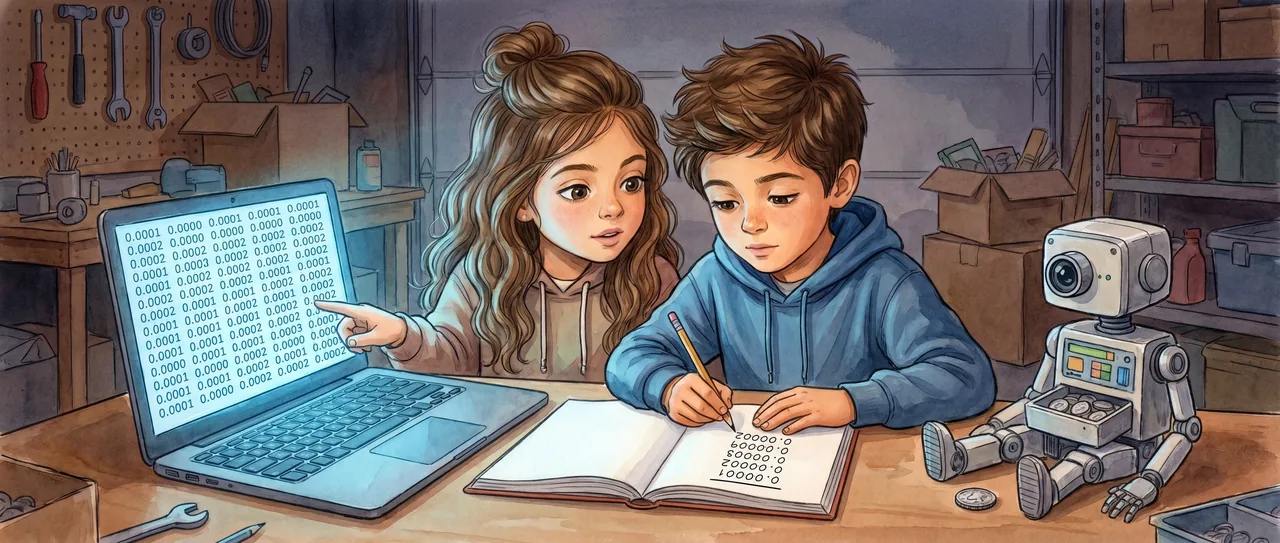
Maya stared at the screen, scrolling. The weights went by in a gray river of tiny numbers. Some of them were big. Most of them, she noticed, were almost nothing. Zero point zero zero zero one. Zero point zero zero zero zero three. Hundreds of them, thousands of them, sitting there being barely anything at all.
"Soren. Look how many are nearly zero."
He looked. "Yeah. That's normal. They're small."
"If they're nearly zero, what are they doing?"
He opened his mouth. Then he closed it. He pulled the notebook out of his back pocket and wrote a column of the tiny numbers down, the page filling with zeros and the little tails after them.
"A number that's nearly zero," he said slowly, "when it multiplies something, gives you nearly nothing."
"So it's not really voting."
"It's voting," Soren said. "It's just voting so quietly nobody hears it."
Maya was already grinning. "So what if we kicked the quiet ones out."
"Then the brain forgets."
"Or," she said, "the brain doesn't notice, because the quiet ones weren't saying anything."
Soren did not like guessing without testing. But he liked this enough to test it. "Okay. Okay. We could set all the small ones to actually zero. Then we don't have to store them at all. Empty space doesn't take room."
"How many can we cut?"
"Let's be careful. Let's cut the smallest tenth."
They cut the smallest tenth. They ran a hundred coins through it on the laptop.
"Ninety-eight," Soren read. "Same as before."
Maya leaned back. "Cut another tenth."
They cut another tenth. Ninety-eight.
"That's weird," Soren said, and his voice had changed, gone careful and bright the way it did when something was behaving wrong in an interesting direction. "We just deleted twenty thousand connections and it's exactly as smart."
"Cut half."
"Maya."
"Cut half. If it breaks we put it back."
They cut half the weights. Half. A hundred and some thousand little numbers, gone, replaced with nothing.
Ninety-seven.
Soren sat very still and then wrote the number ninety-seven down and underlined it twice. "It dropped by one," he said. "We threw away half its brain and it got one coin wrong that it used to get right."
"Keep going."
They kept going. Seventy percent gone. Ninety-seven. Eighty percent gone. Ninety-six.
"How far," Maya whispered.
Ninety percent. They cut ninety percent of the weights. Nine out of every ten connections in the whole brain, erased. The file shrank and shrank until Soren said, in a flat amazed voice, "It fits. It fits on the chip now. With room."
They ran the hundred coins.
Ninety-five.
"It's still basically perfect," Soren said. "We cut away ninety percent of it and it's still basically perfect." He looked at the column of numbers in his notebook, the river of nearly-nothings they had thrown out. "All that. All those weights. Almost none of them were doing the real work."
Maya wasn't grinning anymore. She had gone quiet. "Then where is it," she said. "The knowing. If it's not spread out across all of them. Where actually is it."
Soren turned that over. "In the ones we kept. The loud ones. A small number of them, doing almost all of it."
"But we couldn't tell which ones mattered by looking. They all looked the same when it was learning. They were all just sitting there." Maya pressed her hands flat on the bench. "It had to grow the whole giant brain. The whole hundred thousand. It had to grow all of it to figure out which tiny handful it actually needed."
"You can't skip to the small one," Soren said. He was getting it now, the strange shape of it. "You can't build the small smart brain on purpose. You have to build the big wasteful one first, and let it learn, and then most of it turns out to be packaging."
"Why," Maya said.
Soren opened his mouth to answer and found he had nothing. He checked the laptop, as if it might say. It said ninety-five. It did not say why.
"Nobody really knows why," he admitted. "They do it all the time. The big phone-brains, the ones that talk, they squeeze them down like this so they fit on a phone. It works. They just. They have to grow them huge first and then find out almost all of it was empty."
Maya looked at the chip, the tiny cheap chip that now held a brain that was ninety percent gone and still knew a quarter from a nickel.
"So somewhere in there," she said, "is a really small thing that knows. And it's wearing a giant body it didn't need. And the only way to find the small thing is to build the giant."
Soren screwed the chip into the robot's head and turned it on. They fed it a quarter.
The robot, lighter by ninety percent, dropped it into the right cup.
Read the interactive version, listen to the narration, and earn a gold star →
A science-verified short story for curious kids · Curiosity Land