The Hatchlings Under the Pond
The ice on the pond rang when Soren tapped it with his heel. Not a crack. A note, low and round, like the inside of a bell. He stood very still to feel it travel up through his boots.
"Stop bouncing," Maya said. "You'll go through."
"It's twenty centimeters thick. I measured at the hole." But he stepped off the ice anyway, onto the bank where the snow had thinned to a crust over bare dirt.
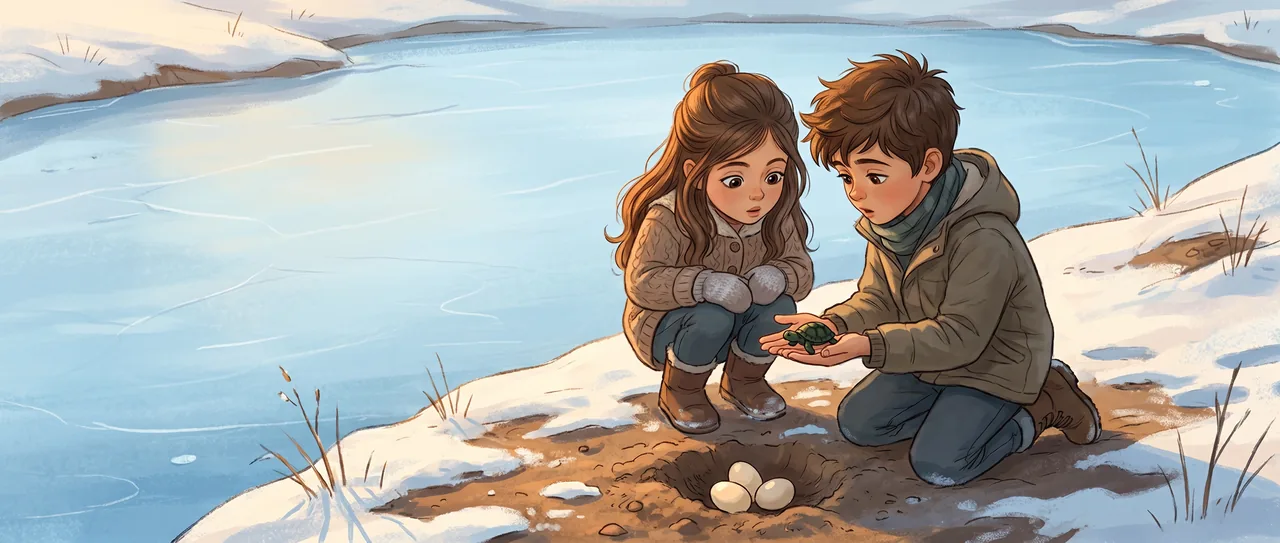
That was where Maya was crouched, scraping at something with one mittened finger. The bank faced south. The sun had been working on it all afternoon, and the top half-inch of soil had gone soft and dark and smelled, faintly, like a basement.
"There's a hole," she said.
Soren knelt. The cold came up through his knees instantly. The hole was the size of a fifty-cent piece, packed at the edges, and inside it the dirt was packed too, into a little dome. Under his breath he counted the things that were wrong with it. It was too round to be an accident. It was sealed but hollow. And there was a smell coming out of it that did not belong to February.
Maya pressed her ear to the ground next to it the way you press your ear to a shell.
"Don't be weird," Soren said.
"I want to know if it's hollow all the way down." She knocked, two knuckles. The sound that came back was the sound of an empty room.
They looked at each other.
Then Maya did the thing she did, which was to start digging before she had a reason. The frozen crust gave way to the soft layer and then to a colder layer underneath, and three inches down her finger touched something that was not a stone. It was smooth. It had a seam.
It was an egg. And next to it, another, and then a shape that was not an egg at all but a turtle the size of a quarter, legs folded, eyes shut, dark green going to black, lying in the dirt like a stopped watch.
"It's dead," Soren said. The word came out flat. He had not expected to mind so much.
Maya lifted it onto her palm. It did not move. It was cold, properly cold, the cold of a thing the same temperature as the ground around it. She turned it over. The shell was perfect. No crack, no chew mark, no caved-in place where the winter had gotten in.
"Nothing ate it," she said. "Nothing hurt it. It just stopped."
"Things that freeze burst," Soren said. He knew this the way he knew most things, from watching them happen. "We left a soda in the truck once. The can split. Water gets bigger when it turns to ice and it tears everything open from the inside."
He took the hatchling from her, carefully, and held it close to his face. He breathed on it, once, the way you breathe on cold glass. A patch of dampness bloomed on the shell and shrank.
"It's not split," he said slowly. "It froze and it's not split."
Maya had gone quiet "How much of it is ice right now?"
Neither of them knew. But the asking changed the turtle in Soren's hand. A minute ago it had been a small dead thing. Now it was a small thing with a riddle inside it, and he could not stop looking at it.
He set it on his scarf, on his lap, out of the wind. He cupped both hands around it without touching, the way you shelter a match. The pond rang once behind them as the ice shifted.
"My grandmother freezes lettuce by accident every winter," Maya said. "It comes out like wet paper. The cells all popped." She was watching the turtle. "This didn't pop. So either it didn't really freeze, or there's a way to freeze that doesn't pop."
"It froze," Soren said. "It's the same temperature as the dirt. The dirt is below freezing."
"Then there's a way." Maya said it like she was placing a stone on a wall. "There has to be a way to let the water turn to ice in the right places and not the wrong places. Outside the cells, maybe. Around them instead of through them."
Soren did not answer, because he was watching the turtle.
The patch where his breath had landed had not refrozen. And below it, so small he might have invented it, there was a movement. Not a leg. Not an eye. Something further in. The smallest possible swelling and falling, the way a sleeping person's chest moves under a blanket so thick you only believe it because you keep looking.
He didn't say anything. He held very still and watched it happen four more times to be sure. Then he held the turtle out flat on his open hand so Maya could see, and he didn't have to say which part to look at, because she had already stopped breathing herself.
Half of it was ice. More than half, maybe. It had spent the whole winter as something closer to a stone than a body, with the water inside it sorted gently into the places where ice could form without tearing anything, waiting under twenty centimeters of pond-song and a roof of its own mother's making for the bank to face the sun long enough.
"We have to put it back," Maya whispered. "It's not done."
"It's not even started," Soren said.
They scooped the soft dirt back over it, and the egg, and the second egg, loose enough to breathe, and they patted the little dome closed exactly as round as they had found it. Maya marked the spot with three white stones from the bank in a line pointing at the hole.
Then they sat back on their heels in the cold and did not leave. The sun was low and orange and the south-facing bank held it like a hand holds water.
Under the dirt, in the dark, in the part of the year that looks like nothing is happening, the smallest of the chests went on rising and falling, half ice and half waiting, counting down to a spring it had never seen and already trusted.
Read the interactive version, listen to the narration, and earn a gold star →
A science-verified short story for curious kids · Curiosity Land