The Floor That Holds You Up
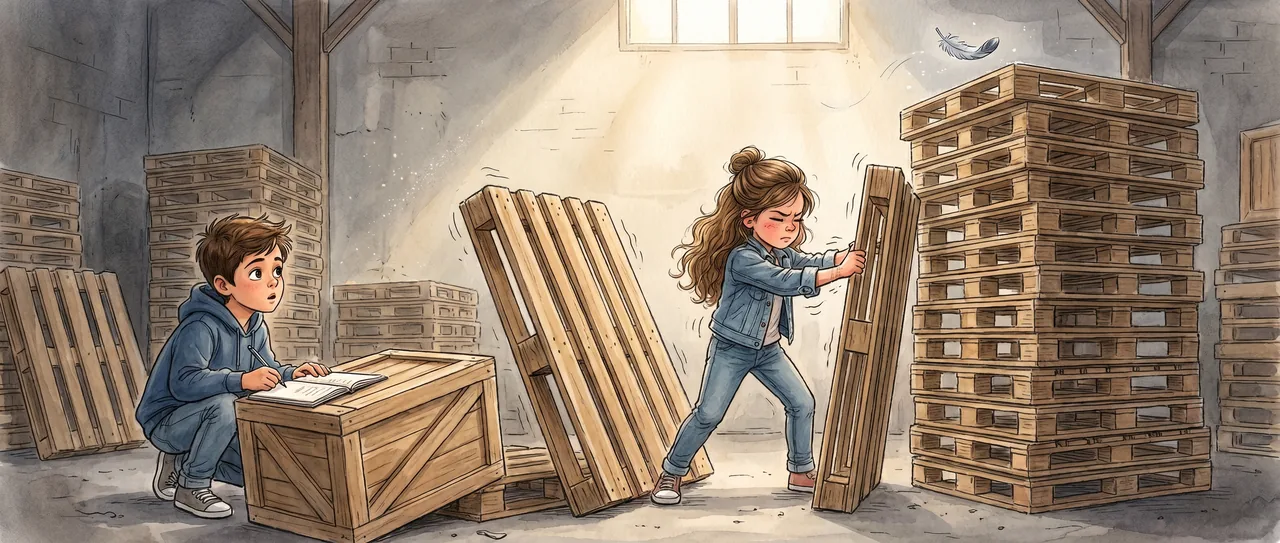
Maya dropped another pallet onto the stack and it landed with a flat smack that echoed up to the warehouse ceiling.
"Eleven," said Soren. "They're not sinking."
"Why would they sink?" Maya climbed up two pallets and stood on top, bouncing a little. "It's wood. On wood."
"That's the part I keep getting stuck on," said Soren. He had his notebook open on an upside-down crate. "What's actually stopping you from falling through?"
Maya stopped bouncing. "Easy. It's solid."
"Yeah, but what does solid mean." He tapped his pen on the page. "My dad says atoms are mostly empty space. Like, almost all empty. If the nucleus was a marble, the next atom over would be a kilometer away."
"So the wood is mostly nothing."
"Mostly nothing. And you're mostly nothing. So why don't the two nothings just slide past each other?"
Maya sat down on the top pallet and let her legs hang. She didn't answer right away. "Magnets," she tried. "The electrons push. Negative pushes negative."
"I thought that too." Soren flipped back a page where he'd written something the night before. "But I read it's not enough. The electric push is real but it's not strong enough to explain how hard the floor pushes back. There's a second thing. A bigger thing."
"A second thing." Maya leaned forward. She liked second things. "What is it."
"It has a name I can barely say. Pauli. The exclusion principle." He said it carefully, like he was carrying it. "Two electrons can't be in the same state at the same time. In the same place, doing the same thing. They're not allowed."
"Not allowed by who."
"By the universe. It's a rule. Not a law somebody made. A rule the way one and one is two."
Maya climbed down. She picked up two pallets, identical ones, and held one in each hand. "So if I push these together."
"The electrons in your hand and the electrons in the pallet would have to crowd into the same states. And they refuse. They'd rather do anything than be identical in the same spot."
Maya pressed the two pallets face to face, hard. They stopped. Wood on wood. Her arms shook.
"That," said Soren, watching her arms. "That push back. Most of that isn't magnets. That's the refusing."
Maya let the pallets drop. She looked at her own hand like it belonged to someone else. "So the floor holds me up because the electrons won't share."
"Won't and can't. Same thing for them."
She was quiet. Then she said, "How big does that go."
"What do you mean."
"The rule. Does it only hold up floors? Or does it hold up bigger stuff."
Soren went still and looked at the page where he'd copied a sentence out of a library book that morning, because the book had a chapter he hadn't expected. He read it out loud.
"When a big star runs out of fuel, gravity tries to crush it down to nothing. And for a while, the same rule stops it. The electrons refuse to be squeezed into the same states, and that refusing holds up the whole star. A whole dead sun, the size of the Earth, held up by electrons not being allowed to match."
Maya sat back down on the warehouse floor. The concrete was cold through her jeans.
"Say that again," she said.
"The same reason you don't fall through the floor is the reason a dead star doesn't collapse into a dot."
"The exact same reason."
"The exact same one. Bigger version. Same rule."
Maya put both hands flat on the concrete and pressed, the way you press when you want to feel something pushing back. The floor held. The floor always held. She'd never once thought about why, the same way she'd never thought about why up was up.
"Okay," she said slowly. "So somewhere right now there's a burned-out star, dark, no fire left, and gravity is squeezing it as hard as gravity can squeeze. And the only thing standing in the way is the same thing standing between me and the basement."
"Yes."
"Electrons. Not being allowed to be the same."
"Yes."
Maya laughed, but it wasn't a funny laugh. It was the laugh that comes out when something is too big to fit in your chest. "That's the rule that builds everything, isn't it. That's why there's a whole list of different elements. They can't all pile into the bottom. They have to stack."
Soren's pen stopped. "Say that part again."
"The electrons in an atom. If they could all be the same, they'd all flop down to the lowest spot and every atom would basically be the same atom. But they can't. So they stack into layers. And the layers are why oxygen is oxygen and gold is gold." She was talking fast now, finding it as she said it. "The whole periodic table is just electrons not being allowed to share a chair."
Soren wrote four words and underlined them and didn't tell her what they were.
"That's it," he said. "That's actually it. The reason there's more than one kind of stuff in the universe is the same reason the floor is hard."
They sat with it. Up in the rafters a pigeon shifted and a feather came spiraling down, slow, taking forever, the only thing in the whole warehouse falling toward the floor.
"Everything I've ever stood on," Maya said quietly. "Every chair. Every stair. The whole ground."
"Refusing," said Soren. "All of it. All the time. Holding."
Maya picked up two pallets again, the matching pair, and pressed them together face to face as hard as she could. She held them there, arms trembling, feeling the push that wasn't quite magnets, the push that ran all the way up to the dead stars. The feather landed on the top pallet of the stack without a sound.
Read the interactive version, listen to the narration, and earn a gold star →
A science-verified short story for curious kids · Curiosity Land