Seven Hundred Times Around
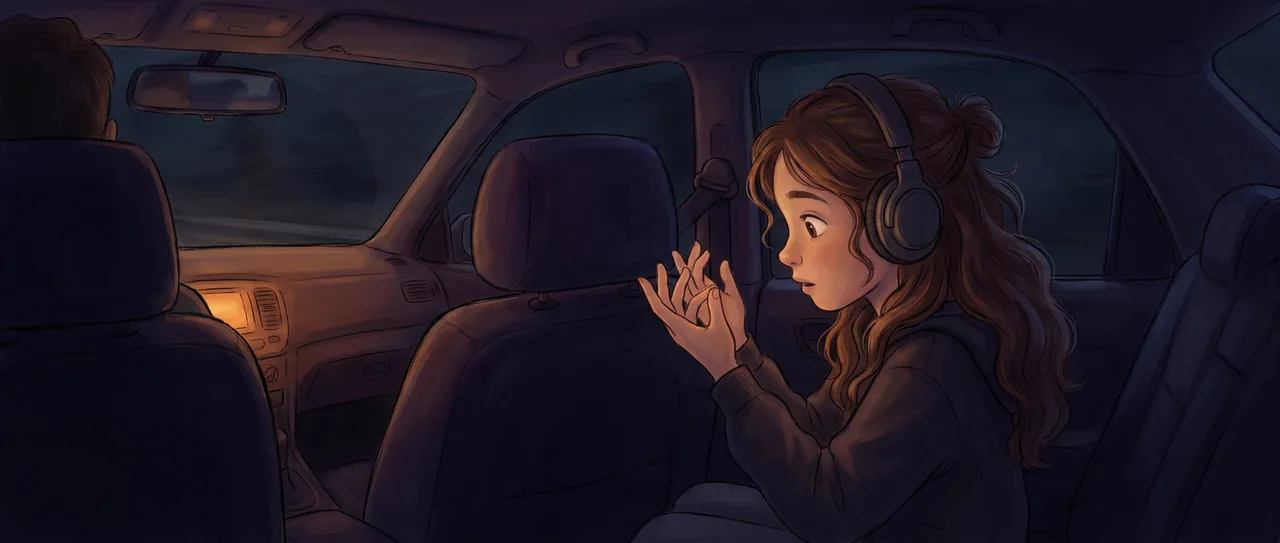
The car smelled like cold fries and rain. Maya had her dad's old headphones on, the big ones, and the podcast was the boring kind where two people talked very slowly about space.
Then one of them said a number, and Maya sat up.
Seven hundred and sixteen times a second.
"Dad," she said. "Pause your driving a second."
"I can't pause my driving, Maya."
She pulled one headphone off her ear. "There's a star that spins seven hundred and sixteen times every second."
"Mm," said her dad, which was his word for I am watching the road and not really here.
Maya put the headphone back. She tried to spin her finger in a circle seven hundred and sixteen times in one second. She couldn't even do it three times. The blender at home, the one that turned ice into snow, the one she was not allowed to touch, topped out somewhere around three hundred times a second and it screamed the whole time.
This star spun more than twice as fast as the blender. And it was not a thing the size of a blender. The podcast voice said it was a city. A whole city, the size of one packed-tight town, heavier than the sun, turning seven hundred and sixteen times while you said the word once.
Maya breathed out slow and watched her breath not fog the window, because the heater was on.
She started keeping the list in her head. The list of things that didn't fit yet.
One. A city cannot spin that fast without flying apart. So what is holding it together.
The podcast answered before she finished the thought, almost like it had heard her. Gravity, the voice said. Gravity so strong that a teaspoon of the star weighed as much as a mountain. The star wanted to fly apart and gravity simply would not let it. The two things pulled against each other, screaming, for ten thousand years, and the star just kept turning.
Two, Maya thought. There was a worse one. The voice was talking about a different kind of these stars now. Magnetars.
The magnetic field, the voice said, was a trillion times stronger than Earth's.
Maya knew about Earth's magnetic field. It was the thing that turned a compass needle. A small thing. A polite thing. It nudged.
A trillion. She tried to feel the size of a trillion and couldn't, the same way she couldn't feel the spin. A million seconds was about eleven days. A trillion seconds was longer than there had been people.
And this was not seconds. This was how much harder the magnet pulled.
The voice said the next part quietly, the way you say the most important thing.
At that strength, the voice said, the magnetic field is strong enough to distort the atoms themselves. The electron clouds around the atoms, normally round, get squeezed. They stretch into thin needles, all pointing the same way.
Maya stopped moving.
She knew what atoms were supposed to be. She had drawn them. Round. A little center, and a fuzzy round cloud of electrons around it, like a dandelion gone to seed. Everything she had ever touched was made of those round fuzzy clouds. Her hand. The headphones. Her dad. The fries.
Round was just what atoms were. Round was the rule.
And somewhere out there, near a thing the size of a town, the rule bent. Not the star. The atoms. The actual shape of matter, the round dandelion fuzz that everything was made of, got pulled long and thin like wet hair, all combed the same direction by a magnet so strong it reached down past everything she had ever seen and grabbed the smallest piece.
The roundness of atoms was not a law. It was just a habit. A habit you could break, if you pulled hard enough.
Maya looked at the back of her own hand in the dark.
"Dad," she said. "If you went near one. A magnetar."
"Mm."
"Your atoms wouldn't be round anymore."
Her dad glanced in the mirror at her. "That sounds bad for the atoms."
"It's not bad," Maya said. "It's just different. They'd be needles. All of them, lined up the same way." She turned her hand over. "I'd be a brush."
Her dad laughed, but Maya wasn't joking, and after a second he stopped, because he could hear that she wasn't.
The podcast had moved on. The two slow voices were talking about something else now, telescopes or funding, the way grown-ups always slid off the cliff edge and back onto the safe flat ground.
Maya did not slide off. She sat at the edge.
There was a real place, right now, tonight, while she was in a car that smelled like fries, where the thing every object was made of did not obey the shape she had always trusted it to keep. The atoms in her drawing were round because nothing near her was strong enough to argue with them. They were not round because round was true. They were round because here was gentle.
She had thought the rules of things were the floor. The thing you stand on. They were not the floor. They were just the part of the rule you could see from where she happened to be standing, in a warm car, on a small planet, with a weak and polite little magnet under her feet.
"What is it," her dad said, watching her in the mirror again.
Maya pressed the headphone tight to one ear to catch the spinning. The pulse of the star came through as a sound, a fast steady ticking the telescope had turned into noise. She counted, and lost count, and counted again, the ticks coming far too quick to follow, a whole city turning past her ear seven hundred and sixteen times before she could say the number once.
In the dark of the back seat she opened and closed her hand, slowly, watching her fingers, checking that they still bent the way fingers were allowed to bend tonight.
Read the interactive version, listen to the narration, and earn a gold star →
A science-verified short story for curious kids · Curiosity Land