More Than One of You
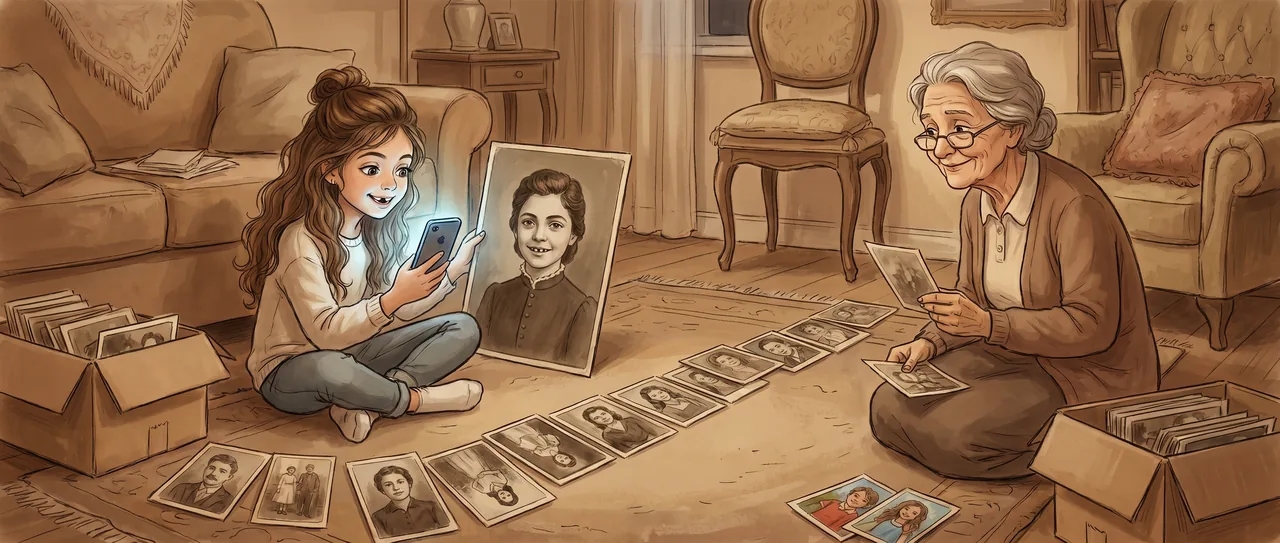
The photographs smelled like old paper and a little like Grandma's coffee, which had soaked into the bottom box years ago and never let go.
Maya sat cross-legged on the floor and made piles. One pile for people Grandma could name. One pile for people Grandma squinted at and said, maybe. One pile for the strangers, who were the most interesting, because nobody alive knew who they were.
"That's my mother," Grandma said, tapping a stiff square photo. "And that's her mother. And that little one is me."
Three women. Same chin, the kind that came to a soft point. Same gap between the front teeth. Same way of standing with one shoulder higher, like they were all bracing against the same wind in three different years.
Maya held the photo close to her face. Then she held up her own phone camera, flipped to selfie mode, and looked at the gap between her own front teeth.
Four.
"How does that work," Maya said. It was not really a question yet. It was the feeling before a question, the way the air feels heavy before it rains.
"What, the teeth?" Grandma laughed. "You got it from somewhere. Everybody gets everything from somewhere."
Maya kept sorting. But her hands had slowed down, because something was bothering her, and she had learned not to rush past the bother.
She lined up the three women on the rug. Then she found more. A great-uncle with the same gap. A cousin without it. A baby photo where you couldn't tell yet.
In school they had drawn the little ladder. A, T, C, G. They had colored in one rung the wrong color to make a mutation, one letter swapped, and the teacher said that was how things changed. One letter. Maya had colored hers and thought, that's it? One rung out of all those millions? It had seemed too small to make a whole gap in your teeth, too small to make a whole chin.
It had bothered her then too. She just hadn't had the photos.
"Grandma," Maya said. "How tall was your mother?"
"Tall. Taller than me. Why?"
"And her mother?"
"Short. Tiny."
Maya frowned at the photos. The features came and went like lights blinking on a string. On, off, on, on, off. Not a slow fade from one to the next. A blink. Here and then gone and then back.
A single swapped letter, she thought, would be a tiny change. A spelling error. A typo in one word of a very long book.
But the gap in the teeth was not a typo. It was the same word, sitting there, generation after generation, then missing entirely, then back.
Like a whole sentence that some copies of the book had twice, and some copies had once, and some copies didn't have at all. She pulled the science worksheet out of her backpack, the one with the ladder, because she wanted to look at it and be sure she remembered right. She read the line at the bottom. The smallest change is a single letter. She put her thumb over the word smallest.
Smallest meant there were bigger ones.
Not just one letter swapped for another. You could lose a whole chunk. You could keep a whole chunk twice. The book didn't only get typos. Sometimes the book got a page printed two times by accident, and that copy was a little different than all the others, in a big way, not a small way.
Maya laid the photos out in a long line across the rug, oldest at one end, herself at the phone-screen end. She made herself look only at the teeth. Gap. Gap. Gap. Then a face with no gap. Then a gap again, two photos later, in a child who never met the great-grandmother she matched.
That was not a thing that fades. That was a thing that copies. Present or absent. Here or not here. One copy of the page, or two, or none.
A single letter could not blink like that. A single letter was too small to carry a whole feature across eighty years and then drop it and then catch it again three faces down the line.
This was something with more weight. A duplicated piece. A deleted piece. Whole chunks of the book, present in some of them and gone in others, and the chunks were big enough to change the shape of a face.
Maya's skin went tight along her arms.
Because if the thing that copied was a whole chunk and not a single letter, then most of what made the women on her rug look like one another was not the tiny typos at all. It was the bigger thing. The duplicated pages. The missing pages. The reason her chin came to a soft point was not one rung colored wrong. It was a piece of the book she had two of, or one of, the same as the woman in the stiff photograph who died before Grandma could remember her voice.
"Maya," Grandma said. "You've gone somewhere."
"I have a piece of her," Maya said. "Not a little piece. A whole piece. The same piece."
Grandma picked up the oldest photo, the great-great-grandmother, and held it next to Maya's face, comparing, the way grandmothers do.
"You do," she said, not understanding, smiling anyway. "You really do."
Maya took the phone and held it up beside the stiff old photo, screen on, her own face glowing next to the woman who had been dead for a hundred years, and she counted the gap between the front teeth in each.
One in the photo.
One on the screen.
The same page, printed twice, a century apart, both of them sitting on the cold floor of the same small room.
Read the interactive version, listen to the narration, and earn a gold star →
A science-verified short story for curious kids · Curiosity Land