The Winter Inside the Seeds
Soren's grandmother kept beans in a jar older than she was. The glass had gone cloudy at the bottom, and the lid had a dent shaped like a thumb.
"These came down from my mother," she said, tipping a few into her palm. "And her mother before. We always keep some back. You never plant the whole packet."
Soren turned one over. It was small. Smaller than the beans at the store, wrinkled hard, the color of a bruise gone old.
"Why so small?" he asked.
"The hungry winter," she said, like it was a name everyone knew. "My mother was a girl during it. Months with almost nothing. She grew up small and stayed small. Her whole life she put food by. Cans in the cellar. Beans in this jar. She couldn't stop. Even when there was plenty."
Soren wrote the words hungry winter on the notebook page and the date she gave him, which was long before his mother was born.
"Did it make you small too?" he asked.
His grandmother laughed. "I was a big strong girl. Plenty to eat by my time." She held out her hand beside his. Wide, square, the knuckles like walnuts. "But." She paused over the word. "My doctor always said my body acted like it remembered being hungry. Even though it never was. Stored everything. Held on."
Soren looked at the beans in his palm and the beans in hers. The same beans. From the same jar. From the same winter she never lived through.
"The famine was in your grandmother," he said slowly. "Not in you."
"That's right."
"So how does your body remember a winter that happened before you?"
She shrugged the shrug adults use when a question is good and they have no use for it. "It just does. Bodies are funny." She went back to sorting, fast bean from slow bean, the way her mother had taught her. The matter was closed for her. It was wide open for him.
Soren laid four beans on the table in a row.
The great-great-grandmother. The one in the famine. Then her daughter, his grandmother's mother, the small one who couldn't stop saving food. Then his grandmother. Then his own mother, asleep upstairs with a cold.
The winter happened to the first bean. But the saving, the holding on, the storing of everything, that showed up in the beans that came after. In bodies that were never hungry a day in their lives.
He knew DNA. He knew it was the instructions, the long ladder copied into every cell. But the instructions hadn't changed in the famine. His grandmother had the same recipe in her as anyone. So it wasn't the recipe.
It was something on top of the recipe.
Like a note in a margin. Like someone had gone through the cookbook and underlined save everything, and the underlining got copied along with the words.
He stopped with his pencil up.
A recipe you don't change. But somebody writes in the margins. And the margins get handed down with the book.
"Grandma," he said. "When your mother saved the beans, she picked the ones that survived the worst, right? The toughest ones."
"The ones that grew when nothing grew."
"So the beans in this jar are the children of the hungry beans."
"Grandchildren by now. Great-grandchildren."
Soren pressed the wrinkled bean between two fingers. It was harder than it should be. Beans from the store were smooth and plump and confident. This one was clenched, like a fist that learned early to close.
"Could we plant some?" he asked. "And some store beans next to them? In the same dirt, same water?"
"In November?" She raised an eyebrow. "They'd want a sunny windowsill and patience."
"I have a windowsill."
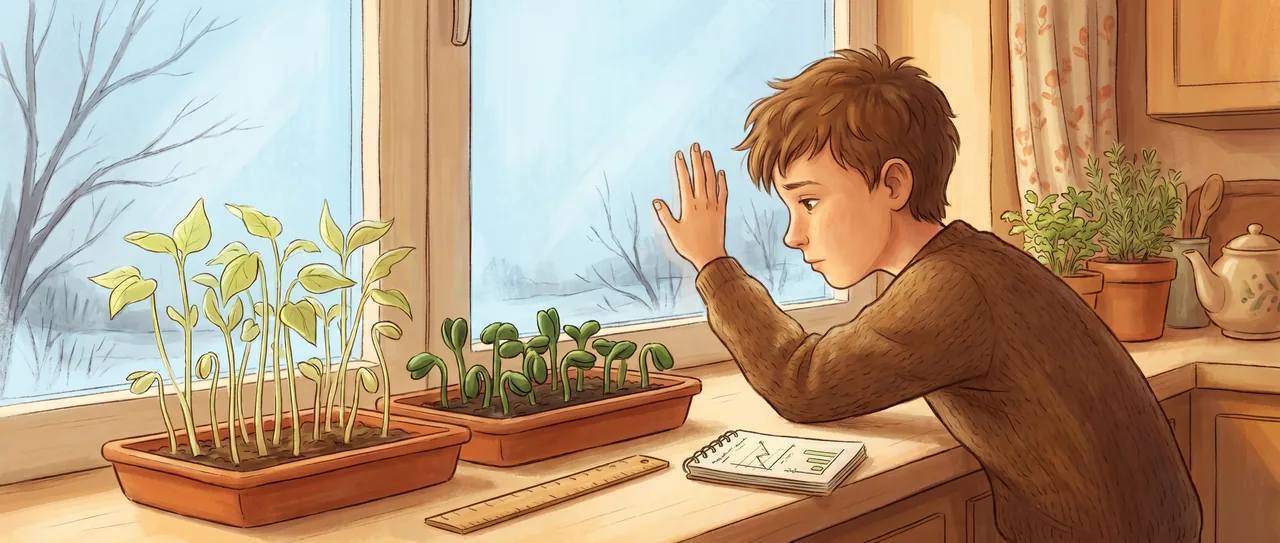
So they planted. Six from the jar, six from a fresh store packet, in two trays of the same soil, on the same sill, with the same light. He watered them the same. He measured them with the same ruler.
The store beans came up first, tall and pale green, throwing out big soft leaves like they had never doubted anything.
The jar beans came up slower. Shorter. Their leaves were smaller, thicker, a darker green. They grew like they were braced for something.
He wrote down every height every morning. By the second week the difference was plain enough that his hand slowed when he recorded it. Same soil. Same water. Same sun. Same instructions inside, more or less, the same kind of bean.
But one tray grew like the world was generous, and the other grew like the world might take it all back.
He sat with the ruler across his knees for a long time.
Nothing in the jar beans had been hungry. They had grown in good soil with all the water they wanted, exactly like the others. The winter was four lifetimes behind them. And they were still bracing for it. Still clenched. Still saving.
The margin note had outlived the winter. It had outlived everyone who lived through the winter. It had been copied down, and down, and down, into seeds that had never been cold a day in their lives, and the seeds were still listening to it.
Soren put his hand flat against the cool window glass behind the trays and felt the November chill on the other side of it, where the real winter waited, the one the jar beans seemed to already know.
He thought about his mother upstairs, and the bean in the row that was her, fourth from the famine. He thought about whoever came after him, fifth bean, sixth bean, a row stretching off the edge of the table into people who didn't exist yet.
He went up to check on his mother. She was awake, reading, her face pale.
"You okay?" he said.
"Just a cold," she said. "It'll pass. Things pass."
Soren sat on the edge of the bed. He thought about asking her whether things passed, really, or whether they just got written smaller and smaller in the margins and handed forward to people who would never know what the words were warning them about.
He didn't ask. He looked at her hands instead. Wide, square, the knuckles starting to go to walnuts.
The same hands.
Downstairs, on the windowsill, the jar beans stood a little shorter than the others, leaves dark and thick, waiting in the warm light for a winter that had ended ninety years before any of them were seeds.
Read the interactive version, listen to the narration, and earn a gold star →
A science-verified short story for curious kids · Curiosity Land