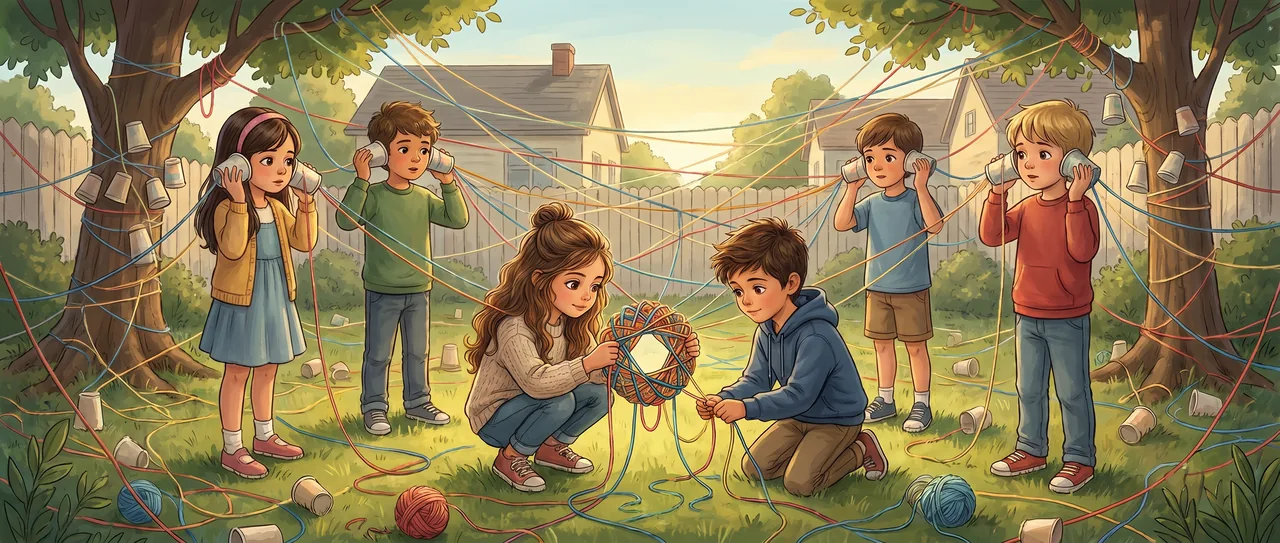
The Whisper Wall
"It's not working," Maya said. She held a paper cup to her ear. "Say something."
"I am saying something," said Soren, from across the yard. "You just can't hear it because the yarn is touching the fence."
They were building a cup telephone for the science fair, except they had gotten ambitious. Two cups was boring. Anybody could do two cups. So now there were five kids invited to come stand at five points around the yard, and the rule was simple: everybody had to be able to whisper to everybody.
"Okay," Soren said. He had his notebook open on the grass, weighted down with a rock. "Five people. How many strings?"
"One string each?"
"No. Everybody to everybody. So me to you, me to the other three, you to the other three."
Maya started laying yarn down on the grass between imaginary people. She walked it. One line. Then back, another line. Then another.
"That's a lot more than five," she said.
"Ten," said Soren, counting the lines on the grass. "Five people, ten strings."
"Huh." Maya stood in the middle, where all the yarn crossed. It was already a mess at her feet. "What if six people come?"
Soren drew six dots and connected them. His pencil went slow at the end because the middle was getting crowded. "Fifteen."
"Wait. One more person and it jumps by five strings?"
"Because the new person has to connect to everybody who's already there." He tapped the dot. "Each new kid brings as many new strings as there are old kids."
Maya was quiet, looking at the yarn crossing over yarn. "So it doesn't grow like the people grow."
"What do you mean?"
"People go one, two, three, four. Plus one each time. The strings don't." She crouched. "The strings go ten, fifteen. Jumping bigger jumps."
Soren wrote the numbers in a column. Two people, one string. Three people, three strings. Four, six. Five, ten. Six, fifteen.
"The jumps get bigger every time," he said. "One, then two, then three, then four, then five."
"That's the thing that doesn't fit yet," Maya said. It was her phrase for the list she kept in her head, the things that weren't solved. "More people is friendly. More strings is the opposite of friendly. They're the same thing and they're nothing alike."
The other kids started arriving. Priya, then the twins, then Marcus. Maya handed out cups. Soren tried to keep the yarn untangled and failed completely. By the time six of them stood in a ragged circle, the middle of the yard was a knot you could have caught a fish in.
"This is the worst telephone in history," said Marcus, holding up four cups in one hand, because four strings ran to him.
"Try doubling it," Soren said suddenly. He was looking at his column of numbers. "Maya. We have six. What if we had twelve?"
Maya did it in her head, but slow. "Twelve people. Each one connects to eleven others." She frowned. "Sixty-six strings."
"We doubled the people," Soren said. "Six to twelve. But the strings went from fifteen to sixty-six. That's more than four times."
"Double the people, quadruple the strings," Maya said. She said it slowly, tasting it. "Roughly. The strings don't double when the people double. They explode."
Priya, who had been standing patiently holding three cups, said, "Can we just talk normally? You're all right next to each other."
And that was the thing. They were. Six kids standing close enough to hear each other breathe, drowning in yarn, because they had insisted that every single person be perfectly connected to every single other person at the same time.
Maya looked at the knot. Then she looked up, past the fence, at nothing, working something out.
"That's the problem with the big computers," she said.
"What computers?" said Soren.
"The ones my cousin works on. The ones you type a question into and they write you a whole answer back." Maya was talking faster now. "She told me they read every word and check it against every other word. Like, each word looks at all the other words to figure out what it means in the sentence."
Soren looked down at the yarn. At the strings, where each cup connected to every other cup. "Each word is a person at a cup."
"And every word has a string to every other word." Maya turned in a circle, taking in the whole tangled yard. "So a short sentence is easy. Six words, fifteen strings. But a long one."
"You double the words," Soren said, and his pencil was already moving, "and you quadruple the strings." He stared at the number. "A page isn't twice as hard as half a page. It's four times as hard."
"And a book?" Maya said.
Nobody answered. The number was too big to say out loud while standing in a backyard.
"That's why my cousin always looks tired," Maya said softly. "She said the hard part isn't teaching it to think. It's that thinking about more things at once costs so much more than you'd ever guess. She said a whole team of people are trying to figure out how to let it read something long without it choking on all the strings."
Soren looked at the knot at his feet, six kids and fifteen strings, and tried to imagine a sentence with a thousand words. A million strings, crossing and crossing, every word holding a cup to its ear, listening to every other word at the same time.
"They haven't fully solved it," Maya said. "That's the part I like. Grown-up scientists, the smartest ones, and the thing they're stuck on is the same thing tangled around our ankles right now."
Priya tugged her string and a cup popped out of Marcus's hand on the far side. The whole web shivered.
"So how do we fix the fair project?" Marcus asked.
Maya didn't answer right away. She crouched and picked up two crossing strands of yarn, one in each hand, and held them apart so the X between them opened into a clean diamond of empty air.
"What if not everybody needs to hear everybody," she said. "What if you only really need the ones close to you, and you pass the important stuff along."
Soren looked at the strands she was holding, then started lifting strings off the grass, one at a time, deciding which ones to keep.
Read the interactive version, listen to the narration, and earn a gold star →
A science-verified short story for curious kids · Curiosity Land