The Weight of the Ocean
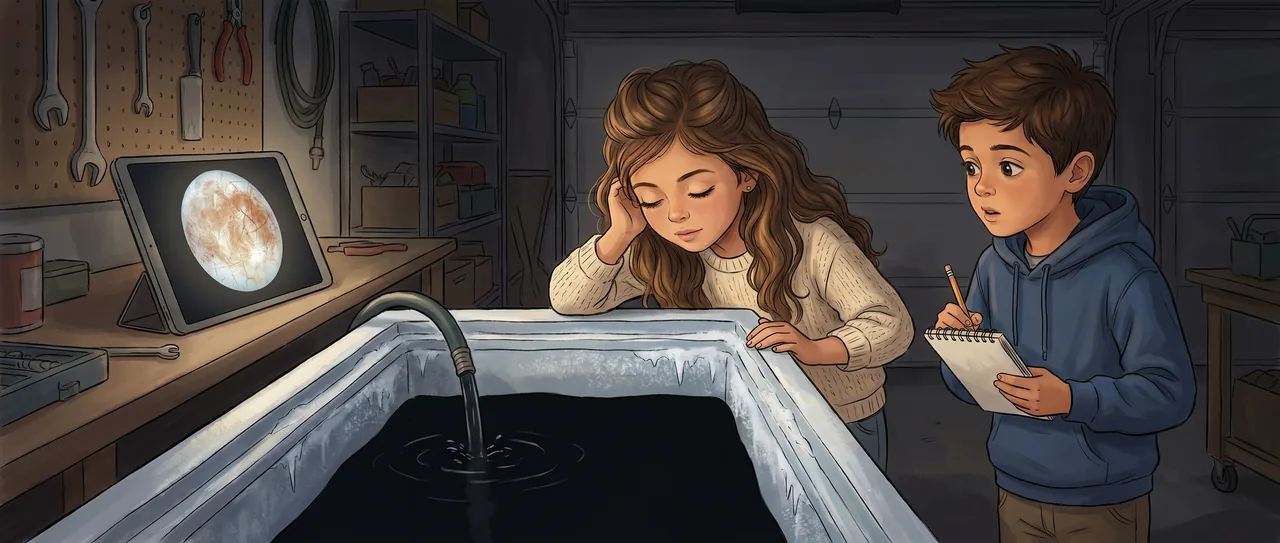
The garage smelled like cold rubber and pennies. Soren had a hose running into the old chest freezer they had dragged out of the basement, and the water was climbing slow up the inside walls.
"Tell me again why we're flooding your dad's freezer," Maya said. She was sitting on the lid of the working one, knees up.
"Pressure sensor," Soren said. "It only reads right when there's real depth on top of it. A glass of water isn't enough. I need a column."
On the propped tablet, a woman with a quiet voice was talking about a spacecraft named Clipper, and a moon named Europa, and a picture turned slow on the screen: a white marble, scratched all over with rust-colored cracks.
Maya pointed at it with her foot. "That's smaller than our moon."
"A little smaller, yeah."
"So it's tiny." She tilted her head. "And they keep saying ocean."
The water in the freezer reached the sensor. Soren's little screen blinked a number, then settled. He wrote it down with a stub of pencil, the page already curling from the damp.
"Listen to this part," he said. He thumbed the volume up.
The quiet woman said it plainly. Beneath the ice, Europa holds more liquid water than all the oceans of Earth combined. Maybe two times more. Maybe three.
Maya's foot stopped swinging.
"Back that up," she said.
Soren backed it up. The woman said it again. More water than all the oceans of Earth. Combined.
"That's wrong," Maya said. Not angry. Just sure, the way she got. "It's smaller than the moon. You can't put a bigger ocean inside a smaller thing. There's no room."
"That's what I thought too," Soren said. He looked at his own freezer, half full, water trembling at the edge of the sensor. "But our oceans are thin."
"Thin?"
"Like." He held his thumb and finger almost together. "Earth's huge, right? But the ocean is just this skin on top. The deepest part is what, eleven kilometers? Earth is twelve thousand kilometers across. The water's a wet paper on a basketball."
Maya slid off the lid. She came over and looked into the freezer, at how the water only counted along the bottom and not in all the empty cold air above it.
"Spread it out, it looks like a lot," she said slowly. "But it's flat. It's nothing tall."
"Right."
"So Europa." She put both hands up, like she was holding a melon that wasn't there. "Europa isn't a basketball with wet paper on it."
"No."
"It's." She turned her hands. "It's water all the way down. Real deep. Not a skin. A whole thick layer."
Soren grabbed the pencil again. "The ice on top is maybe fifteen, twenty kilometers. And under that the ocean might be a hundred kilometers deep. A hundred. Earth's deepest is eleven, and only in one trench."
Maya was quiet. Then: "Fill it up. All the way. To the top."
"The sensor's already reading."
"No, I want to see it." She turned the hose handle herself. "You said a column. I want a real column."
The water climbed. They watched it climb. It went past the sensor, past the frost line on the old white wall, up and up, and the whole thing got heavier, you could feel it, the freezer settling on its feet, the floor taking the weight.
"That's only this deep," Maya said, holding her flat hand at the rim. "And it already feels like too much."
"Now imagine a hundred kilometers of it."
"On a moon you could fit inside our moon."
"On a moon you could fit inside our moon," Soren said.
Maya didn't say anything for a second. The hose hissed. On the tablet the white marble kept turning, all those rust-colored cracks, and Maya leaned in close to it like she could see down through the ice.
"The cracks," she said. "Why is it cracked like that?"
Soren checked his memory. "Jupiter pulls on it. Squeezes it and lets go, squeezes and lets go, every time it goes around. That flexing makes heat. That's part of why the ocean stays liquid. So far from the sun, frozen everywhere else, but Jupiter keeps kneading it warm."
"So it's warm down there."
"Could be. Warm and dark and salty and deeper than anything we have."
Maya put her finger on one of the cracks on the screen. "Nobody's seen the bottom."
"Nobody's seen any of it. It's under twenty kilometers of ice. We've never touched it. We just know it's there from the way the moon wobbles, and the way the cracks move."
"So," Maya said. "There's a thing the size of all our oceans, plus all our oceans again, maybe a third time, and it's warm, and it's dark, and it's been there for billions of years, and nobody has ever once looked at it."
"Yeah."
"And we found out about it because the moon wiggles wrong."
"Yeah."
Maya sat back down on the working freezer. The full one ticked and groaned beside her, holding its little column, every drop pressing down on the drop below it.
"I thought it didn't fit," she said. "I thought there was no room. But there was room the whole time. I just kept imagining it flat."
Soren wrote one more line. Then he capped the pencil and looked at her.
"What are you thinking."
"That every ocean I ever pictured was flat," Maya said. "And the biggest one in the whole solar system isn't on the planet with all the water on the postcards. It's hiding inside a little frozen moon. Under a lid."
She looked at the chest freezer she was sitting on. The closed one.
Then she got up, slow, and lifted the lid of the full one, and looked down into all that black water standing taller than any water she had ever poured, and she put her ear to the rim instead of her hand, the way you do with a shell.
Water moved against the metal walls, deep and close, and somewhere four hundred million miles out a moon the size of nothing held an ocean that no one had ever heard.
Read the interactive version, listen to the narration, and earn a gold star →
A science-verified short story for curious kids · Curiosity Land