The Rust Layer
The rock was warm on one side and cold on the other, and that was the first thing Soren noticed when he put both hands flat against it.
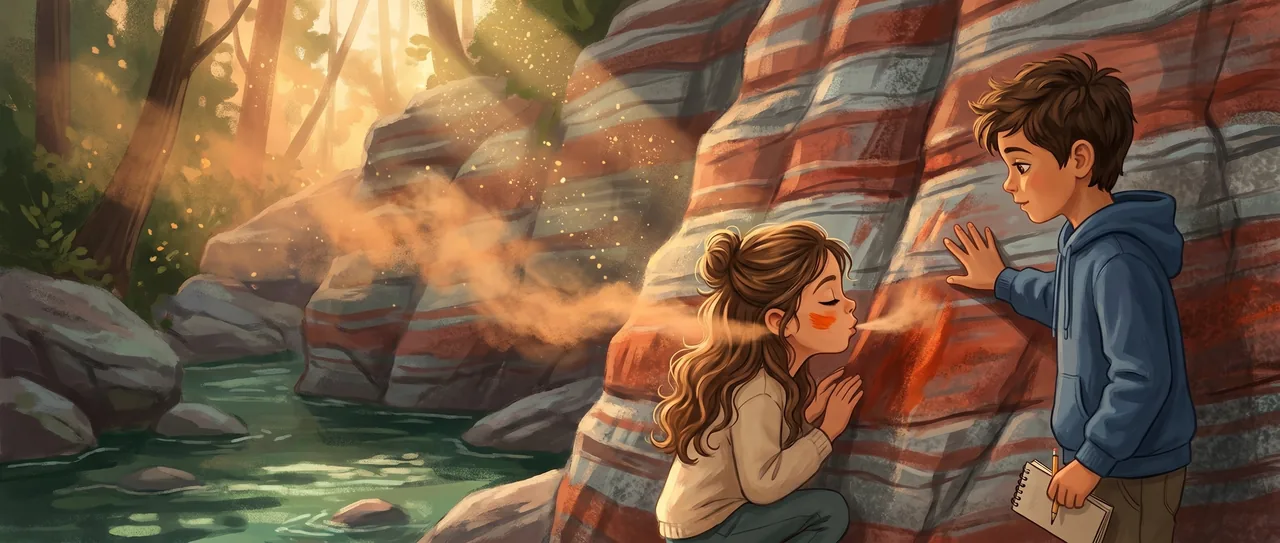
The sun had only reached the top half of the cut where the creek had sliced the hill open. Below his right hand the stone was striped. Red band, gray band, red band, gray band, all the way down past his knees, thin as the pages of a closed book seen edge-on.
"Maya. Come feel this."
She slid down the bank, gravel hissing under her sneakers, and pressed her thumbnail into a red stripe. It came away orange. She rubbed it on her shorts and looked at the smear.
"Rust," she said. "It's rust."
She said it Then she went quiet and started counting the stripes with one finger, not touching, just hovering down the rock.
"There's hundreds," she said. "Soren, there's hundreds."
The smell of the creek came up cool and green. Somewhere uphill his mom was setting up the tent and getting the poles wrong and not asking for help. Soren crouched and put his face close to the stone. The red bands and the gray bands were not painted on. They went in. Whatever made the red went all the way through the rock and then stopped, and then the gray, and then the red came back.
"Rust needs oxygen," he said slowly. "Iron plus oxygen plus water. That's what rust is."
"So there was oxygen here." Maya pressed her palm flat against a gray band, then a red one, feeling for a difference her skin couldn't find. "And then there wasn't. And then there was again."
"Off and on." He took the notebook out of his back pocket. His pencil drew the stripes, thick, thin, thick, thin, and then his hand stopped over the page because the stripes were too small to draw all of them and the real rock had so many more than the paper could hold.
Maya had gone down on her knees in the creek mud. "Where does the iron come from? To rust?"
"Water, I guess. Iron in the water."
"In the ocean?" She frowned at the creek, which was not an ocean. "You can't have iron just floating in the ocean. It would rust."
"Only if there's oxygen."
They looked at each other. The creek talked over its stones.
"So before the oxygen," Maya said, slow now, the words arriving one at a time, "the ocean was full of iron. Just full of it. Dissolved. Because there was nothing to rust it."
Soren felt the cold side of the rock under his left hand and the warm side under his right and the thing started to turn over in his chest. "Then something made oxygen. And all the iron in the whole ocean rusted at once and fell down. That's a red band."
"That's a red band," Maya whispered.
The water ran clear over her fingers. She lifted them out and watched it drip.
"But it stops," Soren said. "The red stops. Then gray. Then red again. Why would oxygen come and go?"
Maya sat back on her heels. Her eyes moved along the bands the way they moved when she was reading something nobody had written down. "Because whatever made the oxygen," she said, "kept dying."
The creek seemed very loud.
"Little things," she said. "In the water. Making oxygen. And the oxygen rusted out all the iron, and the iron fell, red band, and then maybe there was too much oxygen, and it was poison, and the little things died, and the oxygen stopped, gray band, and then they came back and started over." She wiped her hand down her face and left a streak of orange on her cheek. "Over and over. For how long?"
Soren counted what he could see and could not finish counting. "There's hundreds of bands just here. And this is one rock."
"How long is a band?"
He didn't know. He wrote the question down. His pencil pressed hard enough to dent the next page. A hundred years? A thousand? If each thin gray line was a thousand years of a creature breathing out a poison that killed almost everything, including itself, and then a red line where the poison won and the whole ocean turned to rust and sank, and there were hundreds of lines in this one piece of hillside, and this hillside was one hillside on a planet covered in them.
"Soren." Maya's voice had gone strange. "The oxygen. The poison." She breathed in, on purpose, loud, through her nose. Held it. Let it out. "It's this. It's the air. The thing that killed almost everything is the thing we breathe."
She breathed in again, slower, like she was tasting it.
Soren stood up too fast and the blood went out of his head and the striped rock swam. He put his hand back on it to steady himself, the warm side, and the warmth was the sun, and the sun was the same sun, and underneath his hand were the dead and the not dead pressed into layers thinner than his fingernail.
"It was the worst thing that ever happened," he said. "It was the biggest dying there ever was. And we couldn't be alive without it."
"Everything big," Maya said. "Everything that isn't a tiny thing in the water. Us. Trees. Fish. The deer this morning." She put her open hand against the red band, over the rust, over the oldest catastrophe in the world. "We're the leftover. We're what got through."
Uphill, Soren's mom called that the tent was up, mostly, and did anybody want to help with the part that fell down.
Neither of them moved.
Maya leaned in until her nose nearly touched the stone and breathed out, one long warm breath, against the rust. The orange dust lifted off the rock in a thin cloud and hung there, caught in the slant of sun, and then drifted sideways on the creek air and was gone.
Read the interactive version, listen to the narration, and earn a gold star →
A science-verified short story for curious kids · Curiosity Land