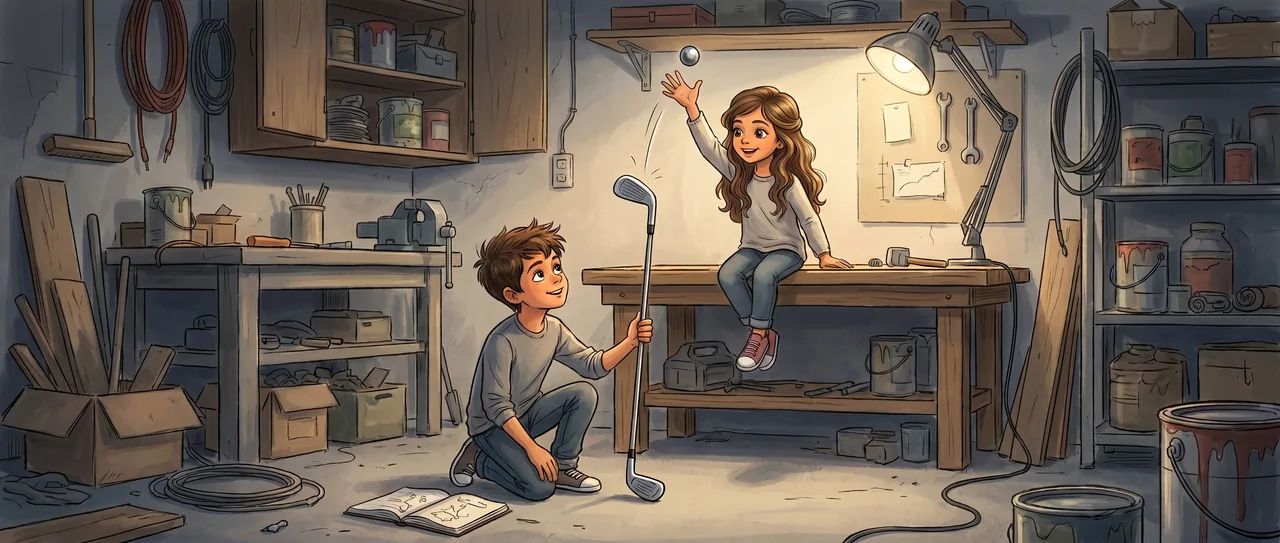
The Marble That Wouldn't Stop
The marble run kept failing at the bottom.
"It dies," Maya said. She let the steel ball go from the top of the cardboard track. It rolled, dropped, hit the wooden ramp at the floor, and stopped almost dead. "Every time. It just gives up at the wood."
"The wood's eating it," said Soren. He was lying on his stomach watching the ball at eye level. "Watch the bounce. There isn't one."
"We need a springier floor."
"We need a floor that gives the energy back." He rolled onto his side. "The ball pushes on the wood, the wood squishes a tiny bit, and the wood keeps the squish. It doesn't push back. So the ball's done."
Maya was already digging through the bin of scavenged things. Spoon. Spring. A roof tile. She set the ball on the spoon's bowl and dropped a second ball on top of it. The bottom ball barely twitched.
"Metal," she said. "It should be metal."
"Metal dents."
"Then a metal that doesn't dent."
Soren got up and went to the corner where the long bag leaned. His grandfather's golf clubs. Nobody played them anymore. He pulled one out, a driver with a big silver head, and there was a sticker on the head, half peeled, that he had never read until now.
"Liquidmetal," he read. "That's a weird name for a club."
Maya took it. She tapped the silver head with the steel ball, just a little tap. The sound that came back was high and long, a clean ring that hung in the garage longer than it should have.
They both went quiet.
"Do that again," Soren said.
She did. Same ring. The wooden ramp had made a thud. This made a note.
"Hold it flat," Maya said. "Like a floor."
Soren wedged the club head against the concrete so the silver face pointed up. Maya climbed onto the workbench and held the steel ball over it.
"From here?"
"From there."
She dropped it.
The ball hit the silver face and came back up almost to her hand. She caught it on the way down with a small surprised noise.
"Again," said Soren, and he had his notebook open now, the pencil moving.
Drop. Bounce. Nearly to her fingers. Drop. Bounce. The same height, again and again, like the ball had forgotten how to lose.
"The wood took the energy," Soren said slowly. "This gives it all back. Almost all of it."
"Why this and not the wood?"
"I don't know yet." He flipped the club over, looking for more sticker. "It's metal but it doesn't act like the spoon. The spoon dents. This doesn't dent at all. It bends and then it's exactly the same."
Maya climbed down and they put their heads near the silver face. There was nothing to see. Just smooth gray.
"Okay," Maya said. "My dad's got the magnet thing. The one that shows the grains in metal." She meant the little USB microscope. They'd looked at a broken bolt with it once. The bolt had been full of tiny shapes, little crystal tiles all packed together, grain after grain, like a wall.
She got it. They scratched a hidden corner of the club head, polished it, and put the lens against it on the screen.
The bolt had been a wall of tiles.
This was nothing. Smooth. No tiles. No grains. No little packed shapes at all, just gray going on and on at every zoom.
"It's broken," Maya said. "The microscope."
Soren put the bolt back under. Tiles. Put the club head back under. Smooth.
"It's not broken," he said. "The metal's broken. I mean it's not a normal metal. Normal metal lines its atoms up. Rows. That's the tiles. This one" He stopped. "This one didn't line up. It's frozen all jumbled. Like glass."
Maya stared at the gray screen.
"Glass," she said. "Like a window."
"Glass is a liquid that got stuck before it could line up. The atoms froze mid-stir." He looked at the silver head. "This is metal that froze mid-stir. A glass made of metal."
"That's what the sticker meant." Maya's voice had gone small and fast. "Liquid metal. It's metal that's secretly liquid-shaped inside."
"Solid," Soren said. "But shaped like a liquid. No rows. No grains."
They looked at each other.
"That's why," Maya said. "That's why the ball comes back. The wood has grains and the metal bolt has grains, and grains have edges, and edges slide and stick and grind, and that's where the energy goes. It goes into the grains shoving each other." She was talking with her hands now. "But this has no edges. Nothing slides. Nothing grinds. There's nowhere for the energy to go. So it bends and snaps back and gives the whole thing back to the ball."
Soren was already nodding, already writing. "Push it, it bends. Let go, it's exactly the same. Perfect. Nothing lost." He underlined something twice. "That's why they make club heads out of it. The whole bend goes back into the ball. And surgery knives, I bet, because no grains means no edges to chip."
"Hold it flat again," Maya said.
He braced the silver face against the concrete. Maya found the steel ball, climbed back onto the bench, and held it as high as her arm could reach.
"Ready," she said.
She let go. The ball fell the whole height of the bench, struck the frozen-liquid metal, and came back up singing, all the way back up, into the dark above the workbench light, and for a second at the very top it hung there, weightless, having lost almost nothing, before it fell to be thrown back up again.
Soren held the club steady and watched it go. "It doesn't want to stop," he said.
Maya caught it, and dropped it, and the ball climbed the air a third time, ringing, while the gray smooth metal that was secretly mid-stir gave back everything it was given.
Read the interactive version, listen to the narration, and earn a gold star →
A science-verified short story for curious kids · Curiosity Land