The Layer with Nothing In It
The rock wall was warm. Maya pressed her ear to it without knowing why, the way you might check if something was sleeping. It smelled like baked dust and old rain.
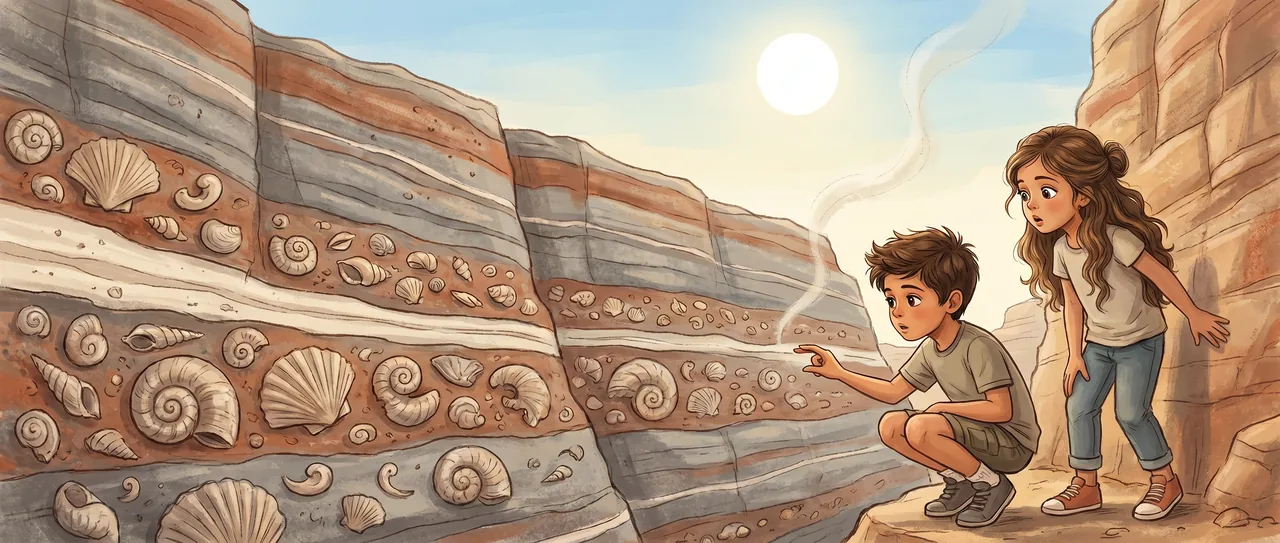
The highway had a cut in the hill where the road sliced through, and the slice showed everything inside. Stripes. Bands of gray and rust and cream, stacked like the pages of a book that had been left open too long and gone stiff.
"Look at this one," Soren said. He was crouched lower, running his thumb along a band crowded with little curls and ridges. Shells, packed so thick they touched. "It's full. Look how full it is."
Maya looked. The band was busy. Tiny spirals, fans, things shaped like commas, all crammed together in the gray.
Then she looked at the layer right above it.
Nothing.
Not empty like clean. Empty like quiet. The rock there was a pale flat tan, fine as flour, and it held no shells, no curls, no commas. Just thin and smooth and silent, a finger's width of nothing sitting on top of all that crowding.
"This one's dead," she said.
Soren stood up. The desert wind pushed grit against their legs. Far off, the adults leaned on the car, talking, holding paper cups, not looking at the wall at all.
"What do you mean, dead?"
Maya put her finger on the crowded band, then dragged it up a half inch onto the pale empty one. "Here, everything's alive. All these." She tapped the shells. "Then here." She held her finger flat against the tan. "Nobody."
Soren bent close. He licked his thumb, the way his grandfather did to test stone, and touched the pale layer, and tasted it, and made a face. He did it again to be sure. Fine. No grit. Almost like ash, almost like clay, ground down to powder and pressed flat.
"It's not just missing the shells," he said slowly. "It's a different kind of rock. Like something changed. Like the whole place changed."
"For how long?"
He measured the pale band with two fingers. Then he measured the crowded band below it, which was much thicker, dense with life. Then the layers above the pale one, where shells started to come back, but different shells. Smaller. Stranger. Not the same commas. New shapes feeling their way back into the rock.
Maya watched his fingers move and felt the wall under her palm go cold, even in the sun. Because the shells above didn't pick up where the shells below left off. They started over. The crowding came back, but it came back as strangers.
"It's not a year," Soren said. His voice had gone careful. "You don't put down rock that fine in a year. This thin little layer, the dead one." He held his fingers a hair apart. "This is a long time. This is so much time that the rock barely had anything to settle into it."
Maya did the thing she did when an answer was coming up underneath her like a fish coming up out of dark water. "The thin one is the longest," she said.
"What?"
"The crowded layers are fast. Lots of stuff, lots of living, piling up." She moved her hand down the busy band. "This thin dead one. Nothing living means nothing piling up. So it's thin because it's empty. But empty took the longest." She turned to him. "How long does empty take?"
Soren looked at the wall. At the half inch of pale flour-fine nothing. He thought about how slow rock was, how a fingernail of it could be ten thousand years, a hundred thousand, more.
"Millions," he said. "To go from all of that." He pointed down at the crowding. "To even start coming back. Up there." He pointed at the new strange shells above. "Millions of years of almost no one."
The wind dropped. For a second the desert was completely still, and the wall was just stripes again, just rock by a road where cars went by at seventy and nobody slowed down.
Maya counted. She found another pale band lower in the wall, below the crowded one, fainter but there, another stretch of fine and quiet with strangeness above it. And below that, hard to see, maybe a third.
"It happened more than once," she said. "It's not one dead line. There's a bunch of them."
Soren crouched and found them with her. One. Two. The third he wasn't sure about. But the pattern was the pattern: crowding, then a thin quiet, then crowding again that didn't match the crowding before.
"Each line is everybody almost gone," he said. "And then the rock has to learn how to be full again from almost nothing. And it takes so long that the long part is the part you can barely see."
Maya stood back from the wall. The whole cut was taller than the car, taller than the adults, and most of what was written in it was crowding, life on life on life. But threaded through it, thin as breath, were these pale lines where the planet had nearly emptied out.
And here was the thing that made her arms cold. Every crowded band above a pale line was the strangers. The come-back. Things that only got their turn because the things before them were gone. The shells she liked best, the little commas, lived above a dead line. Something had to end for the commas to begin.
"We're in one of the crowded parts," she said. "Right now. Us. We're a layer."
Soren put his hand flat on the highest band, the top of the wall, where it ran out and became sky.
"Somebody could read us," he said. "Like we're reading these."
Maya looked up past his hand at the open top of the cut, where there was no more rock yet, just air and the white sun and the road going on.
The wind came back and pulled a thin sheet of pale dust off the dead layer and carried it up the wall, past Soren's fingers, past the crowded bands, out over the top into nothing, and was gone.
Read the interactive version, listen to the narration, and earn a gold star →
A science-verified short story for curious kids · Curiosity Land