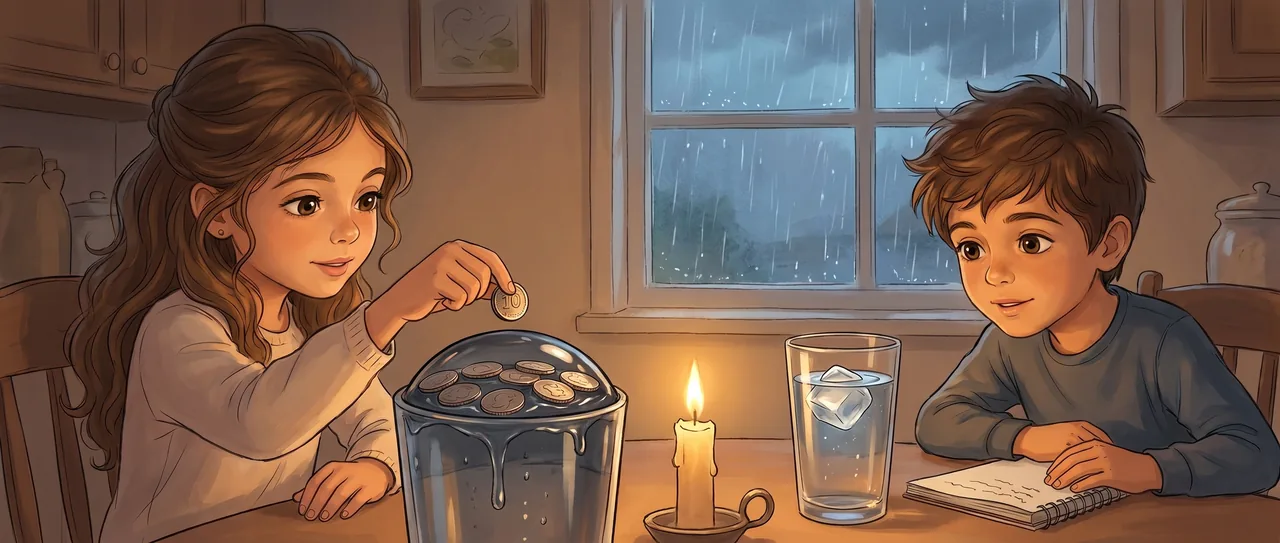
The Cup That Wouldn't Spill
The lights had been out for an hour, and the storm was throwing rain at the kitchen window in handfuls.
Maya's grandmother had given them a candle and told them not to touch the gas stove, then gone to find more candles. So Maya and Soren were doing the thing she had told them not to do, which was experiments.
"Watch," Maya said. She was filling a glass from the tap, slow, slower, until the water reached the rim. Then she didn't stop.
"It's going to spill," Soren said.
"It isn't."
It didn't. The water rose above the rim of the glass and stayed there, curved, a little dome of water sitting higher than the glass that held it.
Soren leaned down until his eye was level with the counter. "That's a hill of water. It's standing up over the edge."
"How is it doing that?"
"It's holding onto itself." He said it slowly. "Something is holding the top layer down. Like a skin."
Maya touched the dome with one fingertip. It trembled and held. "It's not a skin. There's nothing on top of it. It's just water touching water."
"Then water sticks to water."
"Why would it."
The candle leaned in the draft. Outside, the rain kept coming.
"Get a coin," Soren said. "Let's find out how strong it is."
Maya found a coin in the jar by the door. She laid it flat on the surface of the water, expecting it to break the dome and send a flood across the counter. It didn't. The dome bowed under it, deeper, deeper, and held.
"Another," she said.
They put coins on the water one at a time. Three. Five. Eight. The water bulged up higher than they would have believed, dark and shining over the rim, refusing to let go.
"It is a skin," Soren said. "I take it back. There's something pulling the surface tight."
"Pulling it with what," said Maya. "There are no hands in water."
Her grandmother came back with two candles and a flashlight that didn't work. She looked at the glass, the coins, the trembling dome.
"You'll have that over in a minute," she said. "Don't blame me for the mop." And she went to sit by the window, because she liked storms and didn't like science the way they did.
The ninth coin went on. The dome shivered and held.
"Okay," Maya said. "Each little bit of water is grabbing the bits next to it. At the top, there's nothing above to grab, so they all grab sideways and down. That's the skin. It's water holding water's hands."
"With what hands," Soren said again, but quietly now, because he was thinking about it.
He got up and opened the freezer. The light inside was off, but the cold rolled out anyway, and the ice tray was there. He pulled out a cube and brought it back.
"Here's the thing that never made sense to me," he said. He dropped the cube into a second glass of water. It bobbed up and floated, the way ice always does.
"So?" said Maya. "Ice floats. Everybody knows that."
"Everybody knows it. Nobody thinks it's weird. It's completely weird." He pointed at the floating cube. "When you cool almost anything down, it gets smaller and heavier and it sinks. Cold things sink. But water freezes and gets bigger and lighter and floats. Why would water do the opposite of everything?"
Maya looked at the floating cube. She looked at the dome of water with nine coins drowning in it.
"Same thing," she said.
"What's the same thing."
"The hands. The grabbing. It's the same hands." She was talking fast now, the way she did when the answer was arriving before the words. "In the water, all the bits are grabbing each other, sliding around, grabbing and letting go, grabbing and letting go. That's why the surface pulls tight. But when it gets cold enough, they stop sliding. They all grab and hold on and won't let go. And when they lock in place, they have to hold each other at arm's length. So they take up more room than when they were sliding around loose."
Soren stared at the cube. "Arm's length. So frozen water is more spread out than liquid water."
"More spread out means lighter for its size. Lighter for its size means it floats."
"It's the same hands." He said it like he was setting something down very carefully. "The thing that makes the dome stand up is the thing that makes ice float."
Maya nodded, then stopped nodding. "Then it's in everything that's made of water."
"We're made of water."
Neither of them said anything for a second. The rain filled the silence.
Soren reached for his notebook and the candlelight moved with his hand across the page. He wrote a word, crossed it out, wrote another. "There are pictures of DNA," he said. "The twisted ladder. The two sides of the ladder are held together in the middle by something. They always say weak attractions. Weak little grabs. The two halves hold hands all the way up."
"The same hands?"
"I think it has to be. The same kind. Little grabs, easy to break, easy to make again. Strong enough to build a ladder out of. Weak enough to come apart when your body needs to read it."
Maya looked at her own hand in the candlelight, opening and closing.
"So the reason the cup won't spill," she said, "and the reason the ice floats, and the reason I'm holding together right now instead of running across the floor like the storm out there. It's all the same little grab. Happening everywhere. Trillions of times. In me."
Her grandmother, by the window, said the storm was easing.
Maya didn't answer. She set the tenth coin on the water and watched the dome rise to meet it.
Read the interactive version, listen to the narration, and earn a gold star →
A science-verified short story for curious kids · Curiosity Land