The Color of Letting Go
The substitute had left a tray of little plastic vials on the counter, plus a sign that said DO NOT POUR DOWN SINK and nothing else.
"It's not real blood," Soren said. He held a vial up to the window. "Says simulated on the label."
"I know it's not real," Maya said. "Real wouldn't be that color."
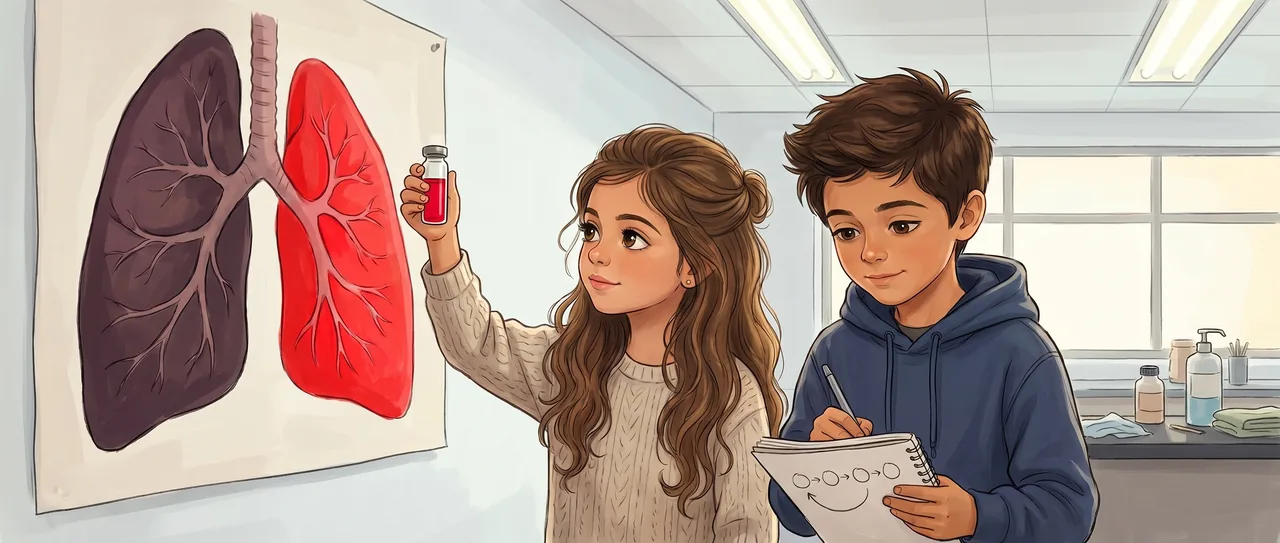
Soren looked again. The fake blood was a flat, even red, the red of a marker. He set it down next to a poster on the wall, the kind with a giant cross-section of a lung, and he stopped.
"The poster's two reds," he said.
Maya came over. The poster showed blood going into the lungs as one color and coming back out as another. One side was dark, almost purple-brown. The other side was bright.
"Same blood," she said. "Two colors."
"Going in dark. Coming out bright." Soren tapped the bright side. "It picks up oxygen here and turns red."
"Why would picking something up change your color?"
That was the thing about Maya's questions. They sounded simple until you tried to answer one.
"Paint doesn't change color when you carry it," she said. "A truck doesn't change color when it loads up."
Soren pulled his notebook out of his bag and drew a little circle. "The thing that carries the oxygen is called hemoglobin. It's a protein. It lives inside the red cells."
"And it changes color."
"It changes shape." He stopped, because he wasn't sure where he'd gotten that, only that he'd read it once and it had stuck. "I think it actually changes shape. When it grabs oxygen it sort of clenches different."
Maya picked up the vial of fake blood and turned it slowly. "So the color is the shape."
"Maybe the color comes from the shape."
"Try it." She set the vial down hard. "We can't try it. It's fake."
They stood there. The lung poster glowed under the fluorescent light, dark on one side, bright on the other.
"Okay," Soren said slowly. "Forget color for a second. Think about the job. The hemoglobin has to do two opposite things. Grab oxygen in your lungs. Let go of it in your foot."
"Grab and let go."
"Right. And here's the part that always bugged me. How does it know? Your lung and your toe are made of the same stuff. How does the hemoglobin know to hold on in one place and open its hand in the other?"
Maya went quiet. Not the polite kind.
"Because it's not one hand," she said. "You said grabs different. You said it clenches."
"It's got four spots. Four places it can hold an oxygen."
"So what happens when the first one grabs?"
Soren looked at his circle. He drew three more next to it. "I don't know. It just holds one oxygen."
"No." Maya leaned over the notebook. "Think about your hand. When you make a fist, your pinky doesn't decide on its own. The whole hand moves together."
"You're saying the four spots are connected."
"I'm saying the first grab changes the others. Like, the first oxygen pulls the shape tighter, and the tighter shape is better at grabbing, so the second one's easier, and the third's easier than that." She was talking fast now. "It's a snowball. One grab makes the next grab easier."
Soren stared at her. "That's actually how it works. I think that's actually how it works. It's got a name, even, the way the parts talk to each other."
"Then run it backward." Maya straightened up. "In your toe. The first one lets go."
"And the shape loosens."
"And the loose shape is worse at holding, so the next one lets go easier, and the next, and the next." She snapped her fingers four times, fast, getting faster. "It's not deciding anything. It can't decide. It just feels how much oxygen is around it and changes shape to match."
Soren was writing as fast as he could, the pen scratching, four circles becoming four circles with little tails, an arrow looping back.
"So in the lungs there's tons of oxygen," he said, "so it fills up and clenches tight and holds on hard."
"And in your toe there's hardly any, because your toe used it all up living, so it opens up and dumps everything right where you need it."
They both looked at the poster again. Dark side, bright side.
"The color's the same trick," Maya said quietly. "It's not two bloods. It's the same hemoglobin in two shapes. Clenched is bright. Open is dark."
"You can see the shape," Soren said. "That's what the color is. You're looking at the shape of a thing too small to see."
Maya didn't say anything. She picked up the fake vial one more time, the flat marker red, and held it next to the bright side of the poster.
"This is dead," she said. "It can't change. That's why it's the wrong color. It's only ever one shape."
Soren wrote that down too.
"There's something in your blood right now," Maya said, "and it's clenching and opening, clenching and opening, billions of times, in your lungs and your hands and behind your eyes, all the time, and you never feel it."
"Every breath you take, it changes shape," Soren said. "Right now. While we're standing here."
Maya pressed two fingers against the inside of her own wrist, the way you do to find a pulse, and held still, counting under her breath.
Soren watched her lips move. Then he put his own fingers to his neck, found the beat, and felt the dark blood going out and the bright blood coming back, the tiny opening and closing happening somewhere under his skin where no one would ever see it, once for every count.
Read the interactive version, listen to the narration, and earn a gold star →
A science-verified short story for curious kids · Curiosity Land