The Animal That Forgot to Die
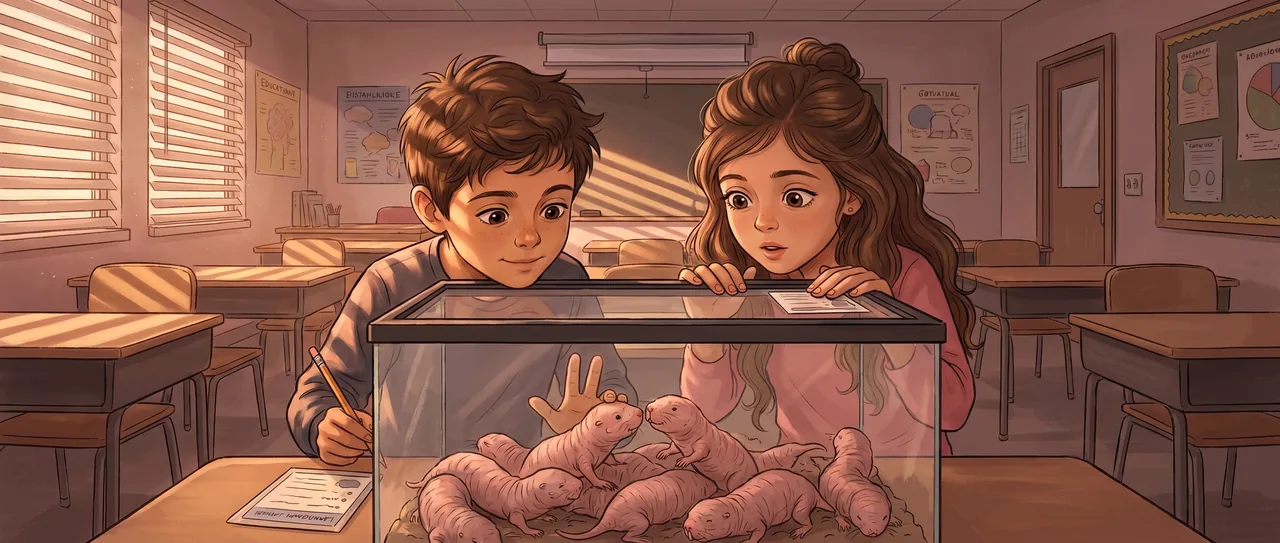
The tank smelled like warm dirt and old pennies. Inside, a tangle of pink animals pushed through plastic tubes, blind and wrinkled, looking like thumbs that had decided to become a country.
Maya had her face an inch from the glass. Soren had the laminated card the old teacher had left taped to the lid.
"It says they live thirty years," Soren said. "A mouse lives two."
"Same size, though," said Maya. "Roughly. Mouse, mole rat. Both could fit in your hand."
"Roughly."
"So why does one get fifteen times longer?"
Soren turned the card over. There was more on the back, in tiny print, the kind adults write when they assume nobody will read it.
"They almost never get cancer," he read. "Like, scientists have looked, and they basically can't find it."
Maya pulled back from the glass. "Find me an animal that doesn't get cancer."
"It's right here."
"No, I mean that's the weird thing. Everything gets cancer. Whales should get loads, they have a billion times more cells than us. They don't. Elephants barely do. And now these." She tapped the glass. One mole rat stopped, considered the vibration, and kept tunneling. "It's like the bigger and weirder you are, the better you've figured something out."
Soren was already writing. His pencil moved down the page in short strokes. He underlined the word hyaluronan twice because he had no idea how to say it.
"There's a sugar," he said. "A long sugar chain in their bodies. Theirs is a different kind than ours. Longer. Gummier. The card says when their cells get too crowded, the goo tells them to stop. Stop growing. Stop dividing."
"And cancer is just cells that won't stop," Maya said slowly.
"Right."
"So they made a stop sign out of goo." She laughed . "That's it? That's the whole superpower? Better goo?"
"It's not the whole thing." Soren flipped back to the front. "There's two more."
Maya took the card. She read fast, lips moving.
Then she stopped.
"They don't feel acid," she said.
"What?"
"Acid pain. The sting. You know when you scrape your knee and it burns? That's your nerves shouting about acid. They don't get the shout. Lemon juice, the gas down in their tunnels, all of it. Nothing. The wire that carries that one specific pain is just, like, unplugged."
Soren reached past her and put two fingers flat against the glass. A mole rat bumped its nose into the spot from the inside, unbothered, blind, alive in a way that did not care what he thought of it.
"Why would you turn off pain," he said. It wasn't quite a question.
"Tunnels," Maya said. "They live packed underground. Hundreds of them. Bad air. The air goes sour, fills up with the gas that turns your sweat to acid on your skin. If you felt that, you'd panic. You'd claw out. You'd die in the rush."
"But if you don't feel it."
"You just keep digging." She set the card down on the lid, very carefully, like it had gotten heavier. "You stay calm in the thing that should be killing you."
Soren looked at the last line of the card. He read it twice before he said it out loud, because he wanted to be sure.
"Eighteen minutes," he said. "With no oxygen at all. A person has, what, three? Four? Brain damage after that." He swallowed. "These can go eighteen minutes with nothing and just wake back up."
"How." Maya wasn't asking him. She was asking the tank.
"When the oxygen runs out, they stop running on it. They switch fuel. They start burning fructose instead. Sugar. The same trick a plant uses." He stopped. "A mammal running on plant chemistry. That shouldn't be allowed."
The classroom was empty except for them. Lunch was happening somewhere far off, a roar through two walls. The afternoon light came through the blinds in stripes and lay across the tank, and the mole rats moved through the stripes, pink, blind, indifferent, thirty years old some of them, older than Maya and Soren put together.
"Soren." Maya's voice had gone quiet. "Three powers. Don't feel acid. Don't get cancer. Don't need air. They're not three things."
"What do you mean."
"They're one thing. They're all the same thing wearing three coats." She was talking with her hands now, fast. "It's all the same answer. The thing that should hurt you, they don't react to. The cells that should run wild, they tell to stop. The air everyone needs, they learned to skip. Every single rule that kills the rest of us, they just stepped around it. Quietly. Underground. While nobody was watching."
Soren's pencil had stopped moving.
"So the rules aren't rules," he said.
"The rules are habits." Maya pressed both hands flat on the lid of the tank. "Everybody thinks getting old and getting sick and needing to breathe, that's just what bodies are. That's just the deal. And this thumb the size of my finger looked at the deal and went, no thanks, I'll be doing it differently."
"And it's not magic," Soren said. "That's the part. It's a sugar. It's a fuel switch. It's a missing wire. We can find those. People are finding those. Right now."
"Someone is studying that goo so a person could maybe never get cancer."
"Someone is."
They stood there. Below them, a mole rat had climbed onto the back of another and gone still, the whole pile breathing slow in the warm dark they'd built for themselves.
Maya finally said, "There are eight million kinds of animal. We named, like, a tenth of them."
"Less."
"And we found this one. By accident. Some scientist just happened to look." She turned to him. "What's in the ones nobody's looked at yet."
Soren didn't answer. He couldn't. There wasn't a number for it.
He leaned down until his eye was level with the glass, and watched the smallest one push into a tube and disappear, going somewhere only it could see.
Read the interactive version, listen to the narration, and earn a gold star →
A science-verified short story for curious kids · Curiosity Land