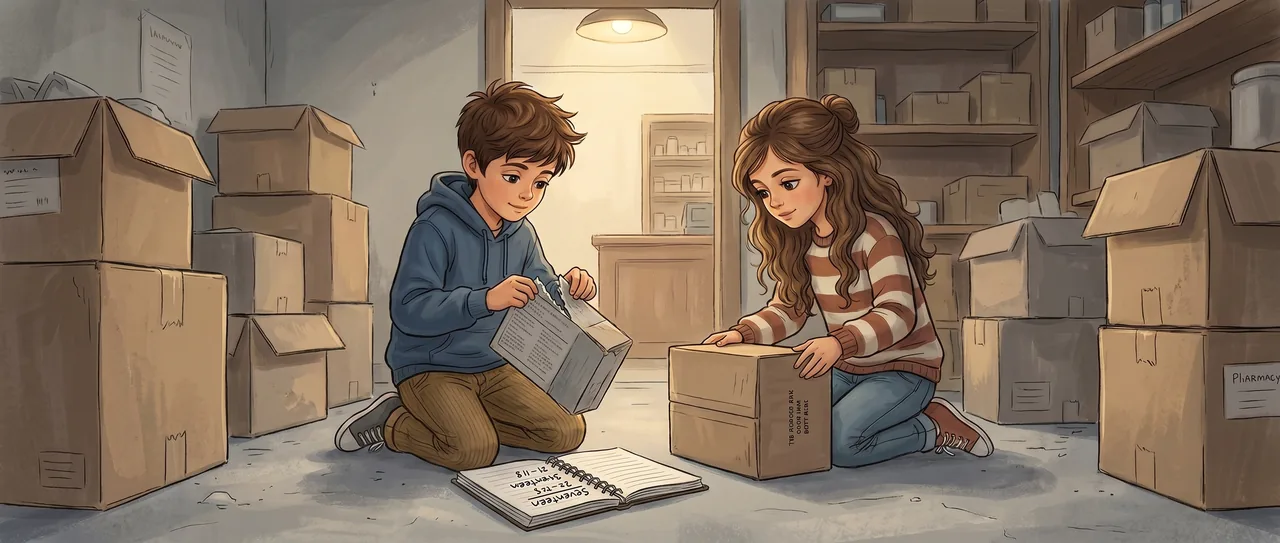
Seventeen Years
The storeroom smelled like cardboard and cold floor wax. Soren's aunt had given them one job: pull every box past its expiration date and stack it by the door. She was up front counting pills into little orange bottles and could not be interrupted, she said, unless something was actually on fire.
"This one expired before we were born," Maya said, holding up a flat box. She turned it over. "Almost."
Soren took it. There was small print on the side panel, a gray paragraph nobody reads.
"It says here some people can't break this drug down," he said. "Their bodies don't have the right enzyme. It says a gene test can tell you before you take it."
"So they test everybody?"
Soren went up front and asked. His aunt did not look up from the pill tray.
"We don't do that test here," she said. "Nobody around here does. You just start the medicine and watch how the person does. If they react bad, we switch them."
"But the box says there's a test."
"Box has said that for years, sweetheart. Doctors go by what they were taught."
Soren came back and sat down on the cold floor.
"The knowledge is right there," he said. "Printed on the box. And nobody uses it."
"How old is the box?" Maya asked.
He checked the lot date. They did the subtraction out loud, together, the way they always did, each catching the other's borrow.
"Seventeen years," Soren said.
Maya stopped with a box halfway to the stack. "Say that again."
"Seventeen."
"That's not nothing. That's a specific number." She set the box down slow. "Find another one. Something that talks about a gene. I want to see the date."
They went through the whole expired pile. Soren read the gray paragraphs out loud and Maya did the dates in her head.
"This one's twelve," she said. "This enzyme thing is sixteen. This one, the gene that changes the dose, that one's like nine."
"They're all old," Soren said. "But the part about the gene is always the newest thing on the box. Like it got added on at the bottom after everything else."
"Because it did," Maya said. "Somebody discovered it. Then they had to print it. Then somebody has to actually read it and change what they do."
"And that last part is the slow part."
They were quiet. Up front a bottle rattled and a register beeped.
"Try it like this," Maya said. "The discovery happens fast. One lab. One paper. Done. But the discovery isn't in a lab, it's in here." She knocked her knuckle on the box. "It has to get out to every doctor in every town, including this one, and every one of them has to stop doing the thing they were taught and start doing the new thing."
"That's thousands of people," Soren said. "All deciding separately."
"And nobody's job is to make them."
Soren pulled out his notebook and wrote the three dates, and the word seventeen, and underlined it twice.
"Okay," he said. "So why seventeen and not five? What's the actual hold-up? Is it the doctors being stubborn?"
"Some," Maya said. "But not all. Think about your aunt. She's not stubborn. She just doesn't have the test machine. The test isn't in this building. The discovery is real, the test is real, and the machine is two hundred miles away."
"So even if she wanted to, she couldn't."
"Right. And the doctor who sends people here, does he even know to ask for it? Did anyone tell him? Is it on the form he fills out?" Maya was counting on her fingers now. "Test machine. Doctor knowing. The form. Who pays for it. Whether the computer reminds anyone. That's five separate broken things and the discovery only fixed one of them."
Soren looked at his list of dates.
"So the seventeen years isn't science being slow," he said. "The science was done in year one. The seventeen years is all the boring stuff after. The forms and the machines and the reminders."
"The boring stuff is the actual thing," Maya said. "That's what I keep thinking. Everybody wants to be the one who discovers. Nobody wants to be the one who drives the machine to the small town."
"But that person saves exactly as many people."
"Maybe more. The discovery saves zero people until the boring person shows up."
Soren wrote that down too. His hand was fast.
"Here's the part I can't get rid of," Maya said. "This box. This exact box. It's been sitting in this room for seventeen years saying there's a test. People came in. Took the medicine. Some of them probably couldn't break it down and got sick, and the answer was right here on the side of the box the whole time, and nobody read it because reading it wasn't anybody's job."
Soren stopped writing.
"That's a horrible thought," he said.
"It is. But flip it." Maya leaned forward. "That means the slow part is the fixable part. You can't make discovery faster, that's the hard human-brain part. But forms? Machines? Reminders on a screen? Somebody could fix those tomorrow. Somebody our age could grow up and decide that's the job."
"The job of carrying the discovery the last two hundred miles."
"And cutting seventeen down to two. Or one."
Soren looked at the stack of expired boxes by the door, all of them carrying a piece of true knowledge nobody had picked up.
"It's weird," he said. "I always thought the smart part was finding it out. But finding it out and then leaving it on a box for seventeen years, that's not smart. That's just half."
"The other half doesn't have a name," Maya said. "That's why nobody fights to do it. There's no prize for it."
"There should be."
Up front, Soren's aunt called that she was almost done and did they want a ride home.
Neither of them got up. Soren tore the side panel off the oldest box, the gray paragraph with the test on it, and folded it into his notebook. Maya pulled the next box off the stack and turned it over to read the bottom.
Read the interactive version, listen to the narration, and earn a gold star →
A science-verified short story for curious kids · Curiosity Land