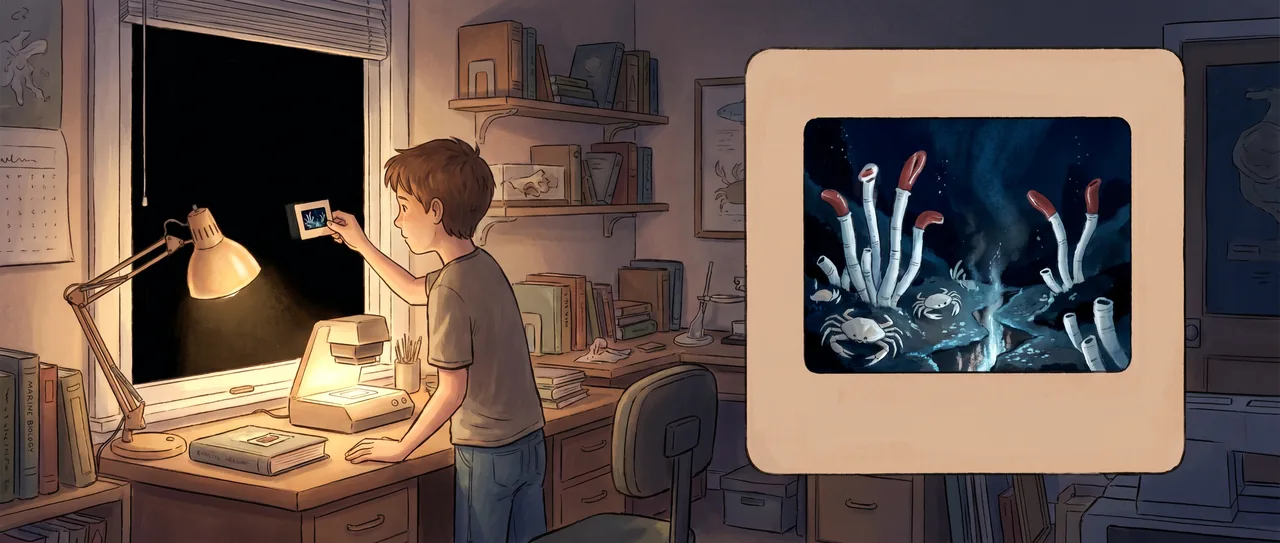
The Wrong Question
Aunt Reza had given Soren the boring job on purpose. He could tell because she said it was important.
"Scan everything in the box," she said, already pulling her coat on. "Both sides if there's writing. I'll be back by nine."
The box was full of slides. Not the computer kind. The little cardboard squares with film in the middle that you held up to the light. Hundreds of them, smelling like a closet, labeled in faded pen.
Soren set up the scanner and started feeding them in. Coral. Coral. A fish nobody had bothered to name. A research ship with people on it wearing the wrong haircuts. He scanned and he waited and he scanned.
Then he held one up to the desk lamp and stopped.
It was a photograph of the bottom of the ocean, and the bottom of the ocean was crowded.
White tubes taller than a person, with red tops, leaning together like a field of strange flowers. Crabs the color of bone. The water around the tubes was shimmering and wrong, the way air shimmers over hot pavement. The label on the cardboard said GALAPAGOS RIFT 1977, 2500m.
Soren did the math in his head. Twenty-five hundred meters. That was deeper than sunlight goes. Everyone knew sunlight ran out somewhere around a thousand meters, and below that the ocean was black, and below that it stayed black forever.
So the picture was wrong.
He scanned the next slide to give himself time. It was the same field of tubes, closer. He could see the crabs were eating something. He could see the tubes were alive.
He had a rule about pictures that were wrong. The rule was that they usually weren't. Usually he was the one missing something.
He reached for his notebook and wrote down two facts and put them next to each other. Sunlight stops near a thousand meters. These animals live at two thousand five hundred. He looked at the two facts for a while. They sat there refusing to agree.
Every living thing he had ever learned about ran on the sun. The grass ran on the sun. The cow ran on the grass. He ran on the cow, more or less. Even the fish in the dark ate other fish that ate other fish that, somewhere far above, ate something green that had eaten light. The whole world was a chain, and the first link was always the sun. His teacher had drawn it on the board with an arrow. Everything started with the arrow.
But you could not draw that arrow down to two thousand five hundred meters. There was no light to start it.
So either the picture was fake, or the chain was wrong, or there was a different arrow. Maybe the tubes were dead things that drifted down. No. Dead things didn't crowd. Dead things didn't have crabs farming them. Maybe a current carried food from somewhere sunlit. But this many animals, this packed together, would strip a drifting meal in a day. Something here was feeding all of them, constantly, from the bottom up. Something was the new first link.
He went back to the shimmering water around the tubes. That was the part the rest of his brain had been skipping past. The water was shimmering because it was hot. The bottom of the ocean was supposed to be near freezing. This water was hot, pouring up out of the seafloor, and the animals were not scattered randomly across the dark plain. They were gathered around the hot water. Every single one of them. Crowded against it the exact way moths crowded a porch light.
They were crowded around the vent the way living things crowd around the thing that feeds them.
Soren put the slide down.
The heat was not the food. Heat alone didn't build a crab. But the heat was coming up out of the rock, and it was carrying something up with it, something dissolved out of the deep earth, and down here in the永 dark there were things alive that could take what the rock gave them and build their bodies out of it. No sun anywhere in the chain. The first link was not light. The first link was the planet itself, leaking warmth and chemistry through a crack in its own floor, and life had simply moved in.
He had asked the wrong question. He had spent the whole evening asking how these animals got around the missing sunlight. The animals were not getting around anything. They had never needed the sun. They had built an entire crowded country in the dark and the only strange thing about it was that he had assumed it couldn't exist.
Which meant the rule everyone drew on the board, the arrow that started with the sun, was not a rule about life. It was a rule about the part of life that happened to live up in the light. The part that included Soren. He had thought that part was all of it. He had thought wrong, the way you can think the whole house is just the room you're standing in.
He pulled the desk lamp closer and looked at the slide again, at the field of white tubes leaning into water that no person had warmed and no sun had touched.
If life didn't need the sun, then the question he'd been told the answer to his whole life cracked open. Where else was there warm rock and water and a planet leaking chemistry into the dark. There were moons for that. He had seen pictures of them. Moons with ice on the outside and oceans underneath, oceans no light would ever reach, oceans with the planet's own heat seeping up from below.
The same setup. The exact same setup as the slide in his hand.
Soren heard the door downstairs. Aunt Reza, back early, calling up that she'd grabbed dinner. He didn't answer yet. He was still holding the slide up to the lamp, turning it slowly, looking at the crowd of animals that had been down there in 1977, that were down there right now, in the dark, not waiting for anyone, not needing the light he was using to see them.
He carried the slide to the window and held it up against the black glass, where there was no light behind it at all, and the animals were still there.
Read the interactive version, listen to the narration, and earn a gold star →
A science-verified short story for curious kids · Curiosity Land