The Word Everyone Got Wrong
The rain had locked them in the library, so Maya was reading the worst book she could find.
"Listen to this," she said. "It says the noble gases are inert. Completely inert. They never react with anything. Ever."
"That's just true," Soren said. He was sorting fair ideas into a column of yes and a column of no. "Helium, neon, argon. Full outer shells. Nothing to give, nothing to grab. They keep to themselves."
"How old is this book?"
He checked the spine. "Nineteen fifty-eight."
Maya put her finger on the word inert and held it there like she could feel a temperature through it.
"Say it again," she said. "The thing about full shells."
"A full outer shell is stable. The atom is happy. It doesn't want anything." He shrugged. "That's why they call them noble. Too good to mix."
"Happy," Maya repeated. "Who decided they were happy?"
"It's chemistry, not a mood."
"No, but somebody wrote happy in a book and then everybody copied it for sixty years." She slid the book across the table. "Inert means nothing can touch them. That's a really big word. That's a word that means never, anywhere, in the whole universe, no exceptions."
Soren stopped sorting. He did not like words that big. They were the kind that broke.
"Okay," he said slowly. "So to be inert, the atom has to hold onto its electrons no matter what comes at it."
"Right."
"But holding on takes a grip. The grip has to be stronger than whatever's pulling."
"Right."
He reached for the notebook and drew a small circle and a fence of dots around it. "Here's the part nobody mentions. The bigger the atom, the farther the outer electrons sit from the middle. Far away, the grip gets weak."
Maya leaned in. "So a little one like neon, tiny, electrons held tight. Inert, fine."
"But go down the column. Argon, krypton, xenon. They get fatter every step." He tapped the bottom of his drawn fence. "Xenon is huge. Its outer electrons are way out at the edge."
"Hanging on by their fingernails," Maya said.
"By their fingernails," he agreed, and then he looked up, because they had both heard it at the same time.
"So you'd just need something greedy enough," Maya said.
"Greedy enough to rip an electron off a noble gas." Soren said it like he was checking whether the floor was real. "Something that wants electrons more than xenon can refuse."
"Does that exist?"
They looked at the book. The book said inert. The book said never.
Maya was already at the shelf, pulling the new chemistry text, the fat one from this year. She flipped to the same column, the far right edge of the periodic table, and read with her lips moving.
"Soren."
"What."
"In nineteen sixty-two." She stopped. She started again. "There was a man named Neil Bartlett. He had this orange-red stuff, platinum and fluorine together, and it was so greedy it could pull an electron off oxygen. Off oxygen, Soren, which never gives anything up."
"And he had it sitting in glass."
"And he had it sitting in glass, and he opened the valve and let xenon in." She looked up. "The book says the gas was colorless and the orange stuff was orange, and when they met it turned yellow. Yellow. A new color. Because something happened that the old book swore could never happen."
Soren put down his pen.
"He bonded xenon," he said.
"He bonded the thing that couldn't be bonded. Four years after they printed never."
For a second neither of them said anything. The rain kept going at the window. Soren was thinking about how many people had read the word inert and felt the door close. How a whole shelf of books had agreed, politely, nobly, that this corner of the table was finished. Solved. Don't look here.
And one man had looked anyway, because the rule was a sentence and not a law, and sentences can be wrong.
"They had to rewrite the textbooks," Maya said. She sounded almost angry, in the good way. "All of them. Because one guy didn't believe a word that everybody believed."
"It wasn't that he didn't believe it," Soren said. "He just asked the same thing you asked. Who decided. He noticed the greedy stuff could even bite oxygen, and he thought, well, if it can take from oxygen, why am I so sure it can't take from xenon."
"And he was right."
"And he was right." Soren opened the new book wider. "Krypton too. Look. And radon. The whole bottom of the column. Not noble. Not too good to mix. Just hard to convince."
Maya sat down on the floor with the book in her lap, right there in the aisle.
"So inert was never a fact," she said. "It was just a thing nobody had pushed hard enough yet."
"It was a thing that was true until somebody was greedy enough." Soren came and sat next to her. "That's different from true."
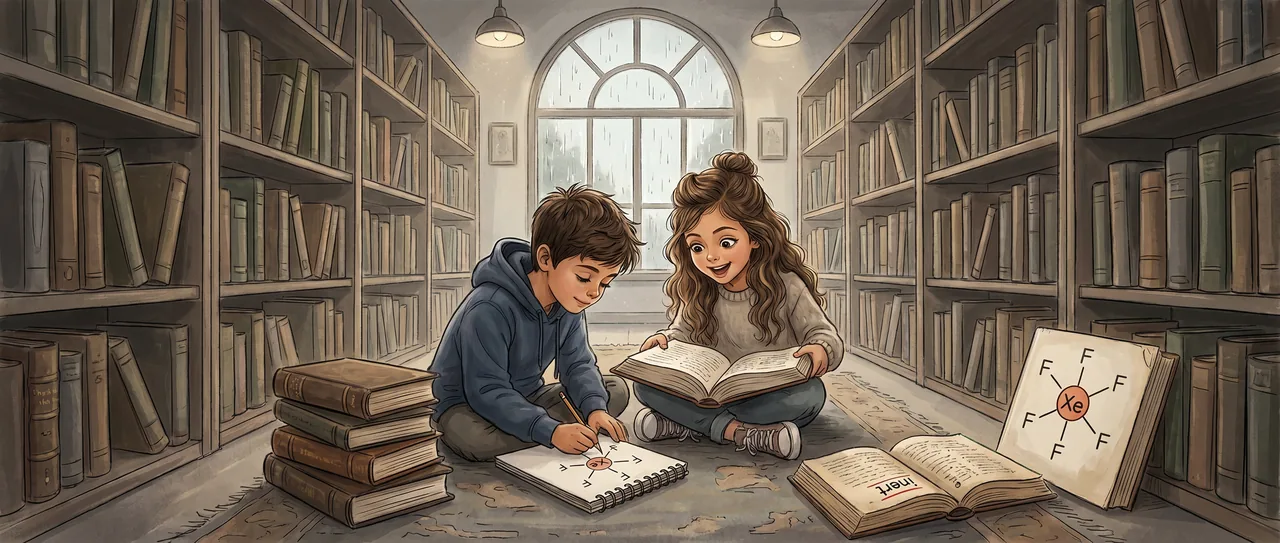
Maya turned the page and found the picture, the diagram of the xenon compound, the impossible molecule drawn in plain black lines like it was nothing, like it had always been allowed.
"There's a whole edge of the table everyone called finished," she said quietly. "And it wasn't finished. It just had the most stubborn door."
Soren got the notebook back and copied the molecule, the central atom and the fluorines arranged around it, his pencil pressing careful and slow because he wanted the angles right.
"Maya."
"Yeah."
"Every book on this shelf agreed." He looked down the long row of spines, the confident ones, the old ones, the ones that said never in print. "Every single one. And they were all repeating the same mistake."
"Which means," Maya said, and stopped, because they both knew which means.
They looked up at the shelf together, the whole wall of certain books, and Maya reached out and pulled down the next one, and the next, and stacked them on the floor between them to start checking every word that sounded too much like never.
Outside, the rain thinned to nothing, and neither of them noticed, because Soren had just opened a chapter that began with the sentence This cannot occur, and Maya had taken the pencil out of his hand to underline it.
Read the interactive version, listen to the narration, and earn a gold star →
A science-verified short story for curious kids · Curiosity Land