The Two That Wouldn't Sit Still
Soren's grandmother took a small white pill every morning with her tea, and on Tuesday he finally asked what it was for.
"It teaches a stubborn protein to relax," she said, and tapped her chest. "So this one keeps beating in time."
That was enough to send him to the kitchen table with Wren, the genomics companion that lived in the flat gray tile he carried everywhere. He read the drug's name off the bottle. He asked Wren what protein it grabbed onto.
The folded shape bloomed above the tile in pale blue light, turning slowly. A ribbon, coiled and tucked, every loop in its place. Wren had built it from the gene sequence in under two seconds.
"Show me the medicine too," Soren said.
A second shape appeared beside the first, small and knobbed.
"They stick together," Soren said. "Show me that. The two of them holding on."
Wren paused. The pause was short, but Soren noticed it, the way you notice a stair that is half an inch taller than the rest.
"I can show you each shape alone," Wren said. "I cannot show you the shape they make together."
Soren put down his pencil.
"You just made both of them. In two seconds."
"Each one alone, yes. When two proteins bind, they push on each other. They bend. The ribbon you are looking at would not stay in that shape once the medicine touched it. It would fold into something new, and so would the medicine, and that new shape is the one that matters." The light flickered between the two structures. "I can fold either of them in seconds. I cannot tell you what they become when they meet."
Soren reached for the notebook beside his elbow. He drew the ribbon, and then the knob, and then a question mark in the empty space between them where the answer was supposed to go.
"Why not," he said. Not really a question. A thing he needed to chase.
"Because folding one chain is a problem we learned to solve," Wren said. "Folding what two chains do to each other is a different problem. It is mostly still open."
Soren had heard the word open used about a lot of things. Open windows. Open invitations. He had never heard it used about a piece of the world that nobody had figured out yet.
"How open," he said.
"For most pairs, no one can predict it. People build the shapes in laboratories, slowly, one pair at a time, and check. The prediction part is not finished."
Soren looked at his grandmother across the room, reading with her tea, her heart keeping its time because somewhere inside her two shapes had met and become a third thing that nobody had ever been able to draw in advance.
"Okay," he said. "Then show me a pair where you do know. Where somebody measured it."
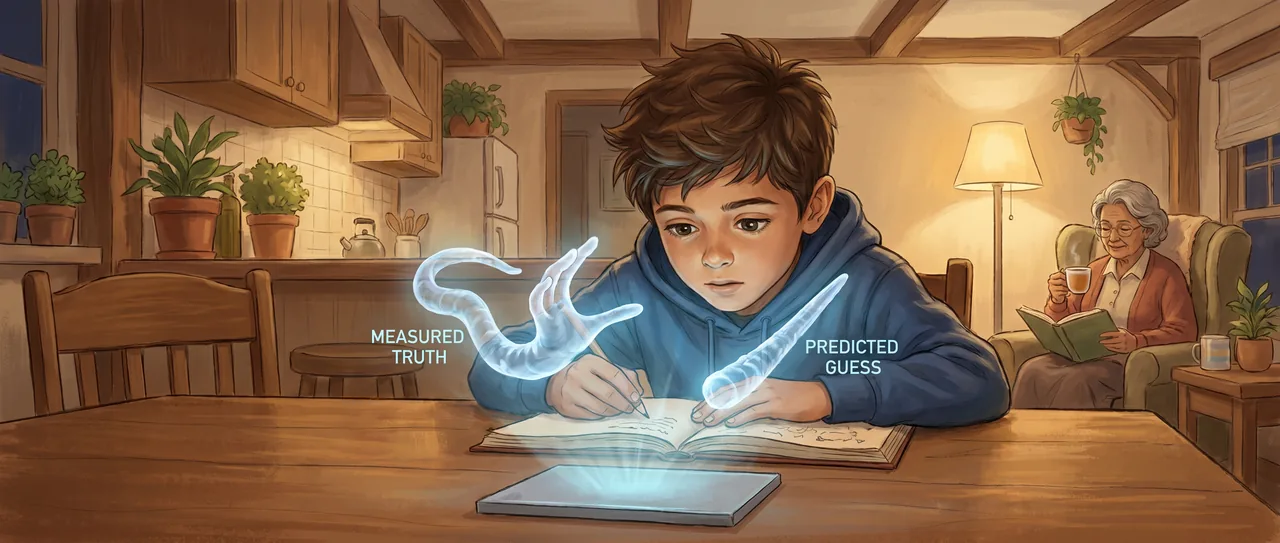
Wren pulled up a pair from a public database. The two proteins floated apart, then drifted together, and Soren watched them change. The first one opened like a hand. The second one folded a tail down into the palm. Neither shape looked like it had before they touched.
"That one's measured," Soren said. "Real. From a lab."
"Yes."
"So fold them separately. The way you fold everything. Just the two alone. And let's see if your guess matches what the lab found."
This was the part Soren liked, the part where you stopped asking and started testing. Wren folded each protein on its own. Soren set the predicted shapes next to the real measured ones, side by side in the air above the table.
The hand was close. The tail was wrong. In Wren's solo prediction the tail stuck straight out, stiff, ignoring the palm entirely. In the measured truth it curled all the way in.
"You missed it," Soren said quietly.
"I missed it."
"By a lot."
"By a lot."
He sat with that. The companion in his hand could read any gene ever sequenced and fold it into a perfect shape faster than he could blink, and it had just guessed wrong about two proteins holding hands, and it had told him so without flinching.
"Do the scientists know you get this one wrong?" Soren asked.
"They know everyone gets it wrong," Wren said. "The best tools in the world get it wrong. That is what it means for a problem to be open. Not that it is hidden. That the answer does not exist yet, for anyone."
Soren turned the gray tile over in his hand. He had always thought of it as a thing that knew. A box you poured questions into and got answers out of. He had thought the answers were all already in there, waiting, and his job was just to ask in the right order.
He drew the two measured shapes in his notebook, the open hand and the curled tail. Then he drew Wren's wrong guess beside them, the stiff tail sticking out into nothing.
"Wren," he said. "How many pairs are there. Protein pairs. In a person."
"More than anyone has counted. Tens of thousands of proteins. The number of ways two of them can meet is far larger than the number of proteins themselves."
"And we know the shape of, what. How many of the meetings."
"A small fraction."
"So most of them," Soren said. "Most of the times two proteins touch inside a person and become a new shape. Nobody has ever seen it. Nobody can draw it yet."
"That is correct."
He looked back at his grandmother. He thought about the meeting happening inside her right now, the stubborn protein learning to relax against the little white pill, a handshake somebody had to discover the slow way, in a lab, one pair at a time, because no machine could see it coming.
There were tens of thousands of proteins in her. Tens of thousands in him. And the part where they touched, the part where they changed each other into something new, was almost entirely unmapped. A whole dark continent folded up inside every living body, and the smartest tool he owned could stand at its shore and admit it could not see across.
Soren put the notebook flat on the table and slid it toward the blue light, so the wrong guess and the right answer hung in the air directly above his own drawing.
"Wren," he said. "Leave both shapes up. The real one and yours. I want to look at the difference for a while."
The two tails hovered over the table, one curled and one straight, the gap between them glowing.
Read the interactive version, listen to the narration, and earn a gold star →
A science-verified short story for curious kids · Curiosity Land