The Two Pictures
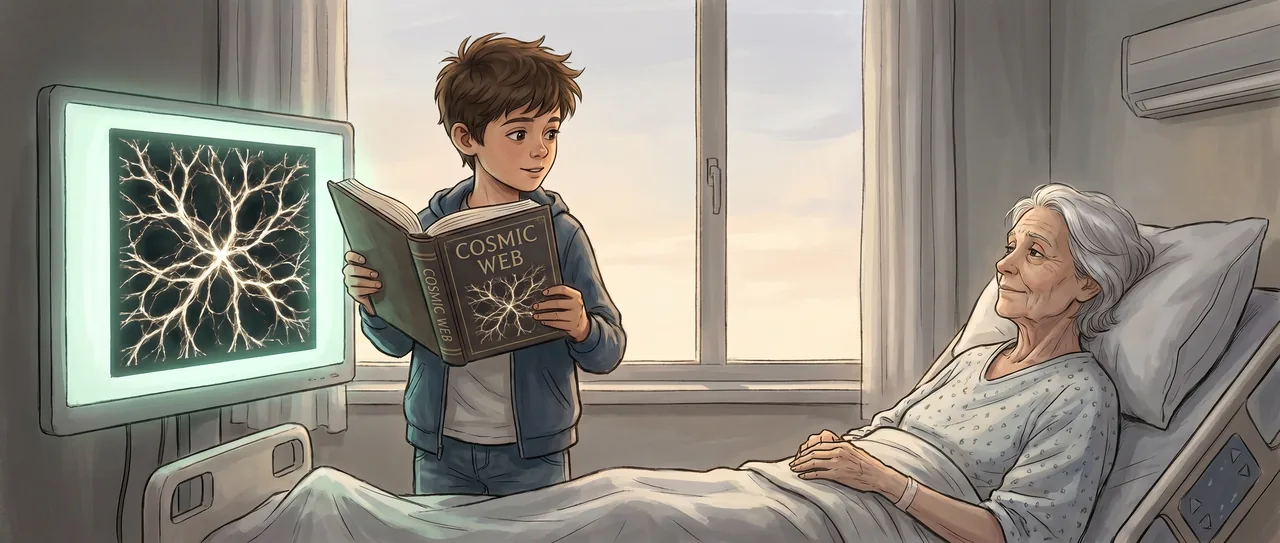
The doctor had left the scan up on the screen because Grandma Esme liked to look at it. She said it was the most interesting picture anyone had ever taken of her, and she was eighty-one, so that was saying something.
Soren sat in the plastic chair by the window with a library book open on his knees. The book was about telescopes. Grandma Esme was asleep, breathing slow, the machine beside her ticking out a quiet green line.
He had reached a page near the back. It showed a black square scattered with thin bright threads, like cracks in ice, like frost on a car window in the worst of February. The threads tangled and branched and left huge dark gaps between them. The caption said it was a map of the universe. Not a picture taken by a camera. A simulation. Each bright point was a galaxy, and the threads were galaxies strung along something invisible, and the dark gaps were called voids, and some of them were so empty that light would cross them for hundreds of millions of years and touch nothing.
Soren looked at the threads. Then he looked up at the screen above Grandma Esme's bed.
The scan showed the inside of her head in pale gray. And running through it were thin bright threads, tangled and branching, leaving darker gaps between them.
He looked back at the book. Up at the screen. Book. Screen.
They were the same picture.
Not almost the same. The same. If someone had cut the caption off both and handed them to him mixed up, he could not have told which was the brain and which was the universe.
He pulled the notebook out of his jacket and drew the threads from the book on one half of the page and the threads from the screen on the other half. His hand was not steady. When he finished he could not tell his own two drawings apart either.
A nurse came in to check the machine. Her name tag said Priya. She wrote a number on a clipboard.
"Why are they the same?" Soren said. He held the book up next to the screen so she could see both at once.
Priya looked. She tilted her head. For a moment she did not say anything, and Soren liked her for that, because it meant she was actually looking and not just answering.
"Huh," she said. "That's the brain. That's the. what is that?"
"The universe," Soren said. "All of it. The big threads are galaxies."
"Those threads in your grandmother's head are neurons," Priya said. "Brain cells. They pass signals to each other. There are about as many of them in there as." She stopped. "A lot."
"How many?"
"Eighty-six billion or so."
Soren wrote it down. Then he found the number in the telescope book and underlined it twice. The visible universe held something like two trillion galaxies, but the part the simulation showed, the part in the picture, the threads and the voids, that part counted out to roughly a hundred billion clumps of matter.
Eighty-six billion. A hundred billion. Close enough that you would say them in the same breath.
"That can't be a coincidence," Priya said, and she said it the way a person says something they are surprised to be saying out loud at work.
"It might be," Soren said. He was being honest. He did not want to be right by cheating. "The shapes could match for boring reasons. Like how rivers and lightning and the cracks in dry mud all branch the same way. They aren't related. They just all branch."
Priya frowned at that, the way you frown when somebody hands you a better idea than the one you had.
"So which is it," she said.
Soren did not know. That was the part that made his chest feel tight and enormous at the same time.
He thought about it carefully. A neuron in Grandma Esme's head was a few thousandths of a millimeter across. A filament of the cosmic web was so long that you would need a number with twenty zeroes to write its length in those same millimeters. The two pictures were the same shape across a difference in size so large that he could not hold it in his head. He tried. It slid out, too big, like trying to carry water in his hands.
The same pattern. At the smallest scale a thinking thing was built on, and at the largest scale anything was built on at all. Nothing in between looked like this. Not rivers, not trees, not him. Only the two ends. The brain and the everything.
"It's not that the universe is a brain," Soren said slowly, working it out as he said it. "Nobody's saying it thinks. The galaxies aren't passing signals to each other."
"Okay," Priya said.
"It's that whatever rule makes threads and gaps. it's the same rule both times. The thing that decides where to put the galaxies and the thing that decides where to put the neurons. it might be one thing." He looked at his two drawings. "And nobody knows what it is."
Priya was quiet. The machine ticked. Grandma Esme breathed.
"You should be a scientist," Priya said finally.
"People keep telling me that," Soren said. "I think it just means I ask too many questions."
"It means you noticed," Priya said. "I've stood in this room for six years and I never put the two pictures next to each other."
She touched the clipboard to her chest and went out.
Grandma Esme's eyes were open. Soren did not know how long she had been awake.
"Show me," she said.
He held the book up next to the screen. The threads of the universe beside the threads of her own mind, the dark voids in both, the branching that could not tell itself apart.
Grandma Esme looked at the picture of all the galaxies there are. Then she looked at the picture of the inside of her head, where a granddaughter was once a thought, where every name she knew still hung on those bright threads.
"Well," she said. "I always knew there was a lot going on up there."
Soren laughed and he kept holding the two pictures side by side, looking from one to the other, his thumb pressed flat against the page so it would not turn.
Read the interactive version, listen to the narration, and earn a gold star →
A science-verified short story for curious kids · Curiosity Land