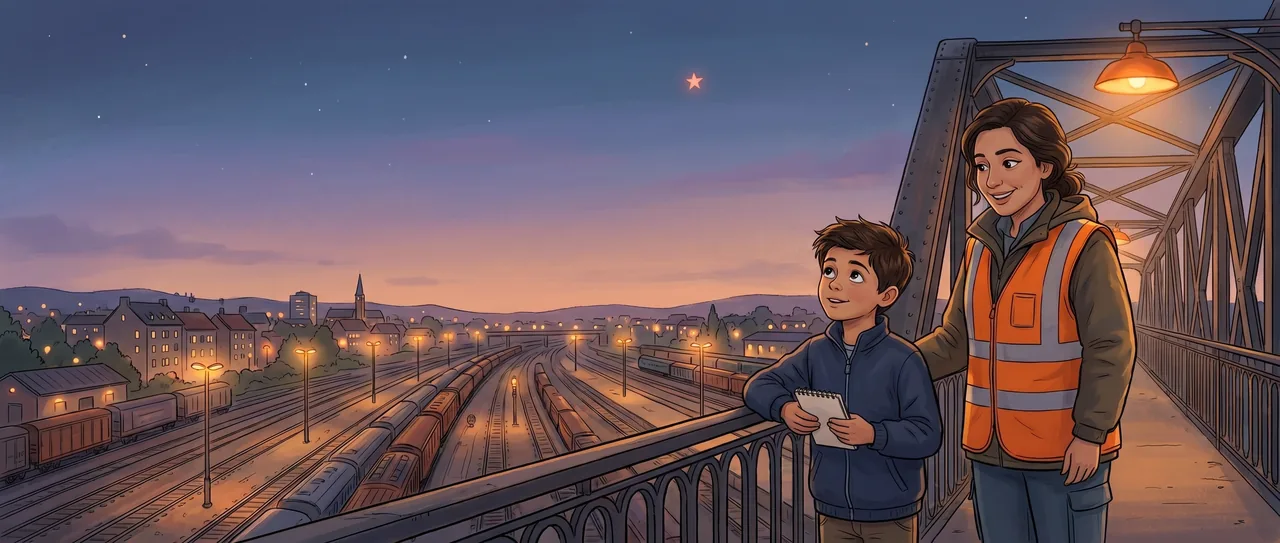
The Train That Never Came Back
The horn started high and ended low. Soren felt it before he understood it, the sound climbing as the train rushed toward the overpass, then dropping the instant it passed beneath his sneakers and tore away into the dark.
He gripped the cold railing and waited for the next one. His aunt Ipek worked the late freight desk, and on nights like this he walked out to the overpass to wait for her shift to end, because the trains came every few minutes and the air smelled like iron and rain.
High, then low. Every time. The horn was never lower when the train approached. It was never higher when it left. The change happened in one slice of a second, right under his feet, like a switch being thrown.
Ipek had explained it once, on another cold night, leaning on the railing beside him. The sound waves bunch up in front of a thing that's coming toward you, she said. Squished together. That's the high part. Then they stretch out behind it when it's going away. Stretched out is low. The horn never changes. Only where you're standing changes.
Soren liked that. The horn stayed the same. The whole difference lived in him, in the spot he was standing, in the gap between the train coming and the train gone.
A cargo train rolled under. High, then low. He counted the seconds of the drop. He was thinking about the stretching part. Stretched out behind the thing that's leaving. He kept turning that over, the way you turn a stone to find the wet side.
If sound did that, what else came in waves.
He pulled the small notebook from his jacket and wrote, under the orange smear of the overpass light, light is a wave. The pencil tip almost tore the paper because his hand was cold and going fast.
Light is a wave. He had read that in a library book about the sun, a sentence he had not done anything with until right now. Light is a wave, and the train's sound stretched when it left, so.
He looked up at the sky past the orange light. There were only a few stars over the rail yard, dim through the town glow. But he was not really looking at them. He was looking at the idea standing next to them.
If a star were a train. If a star were rushing away from him the way the cargo train had just torn off into the dark. Then its light would stretch the same way the horn stretched. Stretched out behind the thing that's leaving.
Stretched light. He sat with that, cold all the way through, and tried to remember what stretching did to light. Sound stretched went low. Low was deeper. For light, what was the deep end.
He knew this one. He had a chart of it taped inside his closet door, the rainbow strip, the order of the colors. Blue and violet bunched up at the short end. Red stretched long at the other.
Red was the low note.
The wind came up under the overpass and he did not feel it. A star rushing away would have its light stretched toward red. It would look redder than it really was. Not because the star changed. Because of where he was standing. The whole difference would live in the gap between him and the star, the same as the horn.
He wrote redder means going away. The letters came out crooked.
Then the next thing arrived, and it was bigger than the overpass, bigger than the rail yard, and it pushed all the air out of him.
When the scientists looked out at the far galaxies, the ones so distant they were only smudges, what color were they. He did not know for certain. But he knew which way to bet. If almost every one of them were rushing away, then almost every one of them would be stretched toward red. A whole sky of low notes. A whole sky of horns that had already passed beneath everyone's feet and were tearing off into the dark.
And if everything were rushing away from everywhere, then the dark itself was getting bigger. The gap between the trains and the standing place was stretching, all of it, all at once, in every direction.
Soren stood very still and let that be true.
A train came toward the overpass. High note climbing. He did not look down at it. He kept his eyes on the dim red-tinged star he had picked, the one over the signal tower, and he held the climbing horn in his ears and the stretching red in his eyes at the same time, the same fact wearing two coats.
The horn passed under him and dropped. Low. Gone into the dark.
Footsteps on the metal stairs. Ipek, coat zipped to her chin, keys jingling. She came and leaned on the railing in her usual spot and looked at him looking up.
The galaxies, Soren said. The far ones. Are they red.
Ipek raised her eyebrows. She worked freight, not telescopes. Most of them, she said slowly, like she was finding the memory in a drawer. Redshifted. That's the word they use. I don't remember why.
Because they're leaving, Soren said. All of them. Like the train.
Ipek looked at him for a long moment. Then she looked up at the sky over the rail yard, the dim few stars, the orange glow, and she did not say anything, because she was seeing it too, the whole thing pulling apart slow and quiet over their heads.
Who stretched it, she said finally. Quiet. The light, I mean. Who did the stretching.
Soren opened his mouth and found he had no answer in it. The space did. The space between him and the smudge did the stretching, the space getting longer while the light was still inside it, traveling. The light left one color and arrived another because the road underneath it grew.
The road grew while the traveler was still on it.
He did not know how long a road could keep growing. He did not know if it would ever stop. Another train was coming, far off, its horn just starting to climb, and he turned to face the sound and let it come toward him through the dark that was, he now knew, very slowly and in every direction, getting wider.
Read the interactive version, listen to the narration, and earn a gold star →
A science-verified short story for curious kids · Curiosity Land