The Slowest Crash
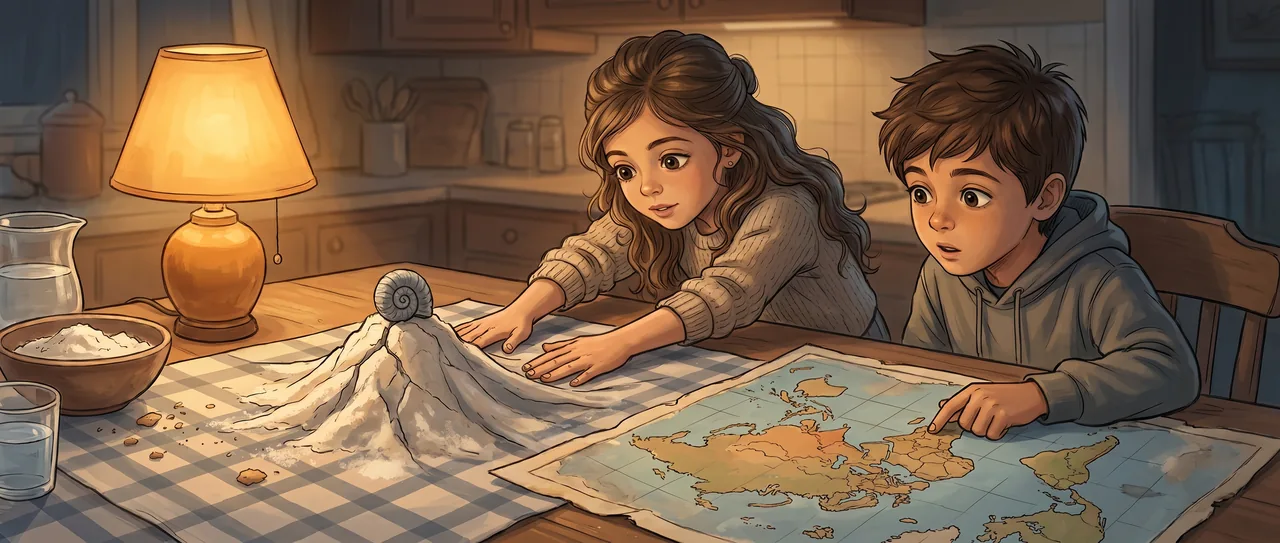
The shell was the size of Soren's thumbnail, spiraled, gray, pressed flat into a piece of pale rock. Their grandmother had set it on the table next to the flour-and-water mountains they were building.
"It's a sea snail," she said. "I bought it from a man in Tibet. He had a whole basket of them."
"A sea snail," Maya said.
"From the top of the world," their grandmother said, pleased, and went to answer the phone.
Maya picked it up. She turned it over. She set it down. She picked it up again.
"You're doing the thing," Soren said.
"There's no sea on top of the world," Maya said. "That's the whole point of the top of the world. It's the part farthest from the sea."
"Maybe she got it from a beach and mixed up the story."
"She didn't mix it up." Maya tapped the rock. "Look how flat it is. It got squished. Beaches don't squish things into rock."
Soren took it and held it under the lamp. He had a notebook open beside the map. He drew the spiral, then drew the lines of the flat rock around it.
"Okay," he said. "So a sea animal that died in the sea, in mud, and the mud turned to rock. That's how you get fossils. That part's normal."
"In the sea," Maya said.
"In the sea."
They both looked at the relief map. The mountains were drying in lumpy ridges. The tallest one had cracked across the top.
"So either the sea went up there," Maya said slowly, "or up there used to be down here."
Soren put his pencil down.
"Say that again," he said.
"The mountain. The top of the world. It used to be a sea floor." Maya's hands were starting to move the way they did. "The bottom of the ocean got picked up and shoved into the sky."
"That's not possible."
"The snail says it's possible."
Soren looked at the snail. The snail had been a sea floor for sixty million years and said nothing.
"Okay," he said. "Wait. If you push a rug, it bunches up. It makes ridges."
He put both hands flat on the tablecloth and pushed them toward each other. The cloth wrinkled into a long fold in the middle.
"Do it slower," Maya said.
He slowed down. The fold rose anyway, a little ridge of cloth climbing up between his hands, and the snail-rock that had been sitting on the cloth lifted with it, riding up the fold, going higher.
They both stared at the snail, now sitting half an inch higher than it had been.
"That," Maya said. "That's what happened. Something pushed."
"Something the size of a country," Soren said. He was already flipping his notebook to where they'd printed a map of the world for the project. He put his finger on India, the big diamond hanging down off the bottom of Asia. "What if this is the hand."
Maya leaned over. "India pushed up the mountains?"
"It's pointing right at them. Look. The mountains are exactly where India runs into the rest of it." He traced the line where the diamond met the continent. The tallest mountains in the world sat in a wrinkle along that exact seam.
"So India crashed into Asia," Maya said. "And the sea that used to be between them got squeezed." She picked up the snail. "And the bottom of that sea is what we're holding."
Neither of them said anything for a second. The flour mountains dried on the table.
"When," Soren said. "When did it crash."
"It would have to be slow," Maya said. "Countries don't move fast."
"How slow, though." Soren chewed his pencil. "Rugs stop bunching when you stop pushing." "What if it didn't stop," she said.
Soren looked at her.
"What if India is still pushing," Maya said. "Right now. While we're sitting here."
"Then the mountains are still going up."
"Still going up," Maya said. "The snail is still going up."
Their grandmother came back in, dropping her phone in her pocket. "You two look like you've seen a ghost."
"How fast do mountains grow?" Soren asked.
"Mountains don't grow, sweetheart, they're mountains."
"They do, though," Maya said. "Yours is from the sea. The sea floor is on top of the world. It got pushed there. It's still getting pushed."
Her grandmother laughed and shook her head and started clearing the dried flour scraps, and that was fine, because Maya wasn't really talking to her grandmother anymore.
"How fast," Soren said again, to Maya this time. "Slow enough that nobody feels it. But it never stops."
Maya held her hand up flat in the lamplight. She looked at her own fingernails.
"My mom cuts my nails every couple weeks," she said. "They just keep coming. You never see them move. But they're always moving."
Soren held his own hand up next to hers.
"That slow," he said.
"That slow," Maya said. "India's been doing that for fifty million years. Coming at Asia about as fast as our fingernails grow. And it's never stopped once."
Soren looked at the seam on the map where the diamond met the land. He pressed his fingernail into the paper right on the line, soft, just to feel it there.
"It's happening right now," he said. "In real time. The most enormous crash in the world, and it's slower than us sitting here."
Maya turned the snail over in her fingers. The little spiral that had lived on a sea floor, and then climbed five miles into the sky, one fingernail at a time, and was still climbing, even now, even on this table.
She set it on the very top of the cracked flour mountain.
Then she put her hands flat on the tablecloth, on either side of the map, and pushed them slowly toward each other until the snail began to rise.
Read the interactive version, listen to the narration, and earn a gold star →
A science-verified short story for curious kids · Curiosity Land