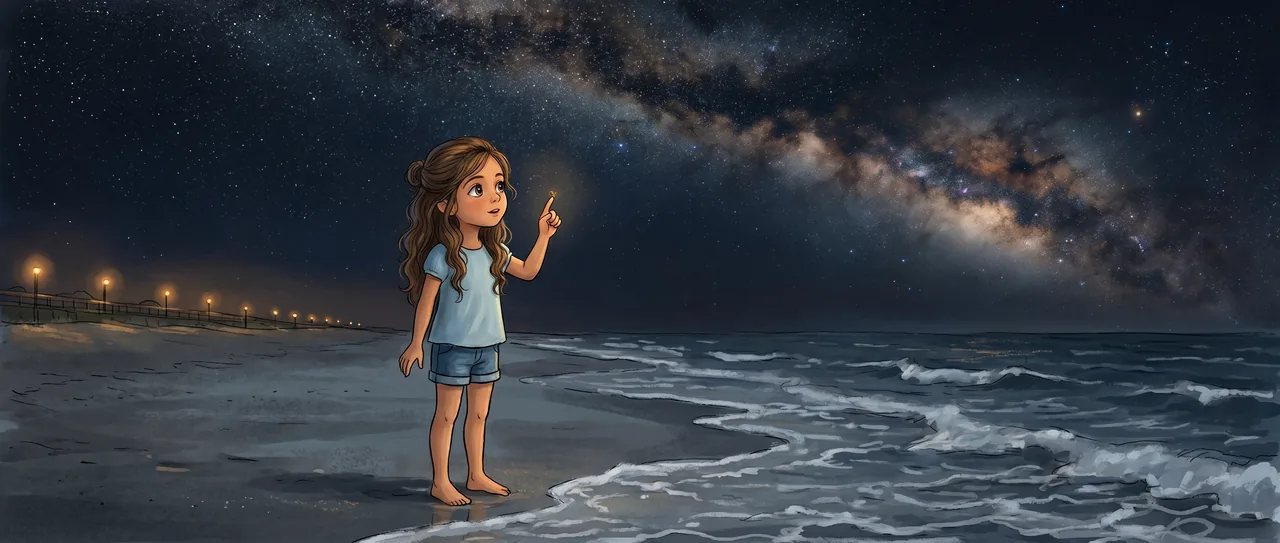
The Sand Count
The sand was cold now that the sun had gone. Maya dug her hand in past the dry top layer to the wet part underneath, where it packed against her fingers and held the shape of her knuckles.
Her cousin wanted one more bucket. Always one more bucket. The castle had three towers and a moat that kept drinking the sea.
Maya let a fistful run out slowly between her fingers and watched it stream down. The grains caught the light from the boardwalk lamps, each one a tiny bright fleck, and there were so many of them in just one fist that she stopped pouring and held the rest.
How many, she thought.
Not in the fist. In the whole beach. She turned her head and the beach went on past the lamps into the dark, and she could hear it going on, the sea breaking against sand she couldn't see, north and south, further than the sound carried.
And this was one beach.
She poured the fist out and dug both hands in this time and lifted, and the sand was heavier than it looked, dense and grainy and uncountable, sliding and reorganizing itself in her palms. You could spend your whole life on one handful and never reach the bottom of the number.
Her uncle had said it once, driving home from somewhere, the radio low. There are more stars than all the grains of sand on every beach on Earth. He'd said it the way grown-ups say things, like it was a nice fact, like it was finished.
Maya had not been able to finish it. It had been sitting in the back of her head for two years, in the list of things that did not make sense yet.
She looked up.
The sky over the water was the dark you only get away from the city, and the stars were thick across it, more than she could pull apart with her eyes, a haze of them low near the horizon where they ran together into something like spilled milk.
Maya looked down at her two hands full of sand. Then up at the spilled-milk band. Then down again.
More up there than down here. Than down here, and down the whole beach, and every beach.
She tried to feel it and couldn't. The sky just looked crowded. The stars looked packed in tight, shoulder to shoulder, like the grains in her hands, like there was no room between them at all.
That was the part that wouldn't sit still.
Because she also knew, from the same uncle, from a different drive, that the nearest star after the sun was four years away at the speed of light. Light. The fastest thing. Four years of it, just to get there.
Maya let the sand fall and sat back on her heels.
Four years of light to the next one. And the next one past that, about the same. And the same again. The sky looked packed only because she was looking at it flat, the way you look at a crowd from far away and everyone seems to be touching, when really each person has room to turn around.
She held one grain of sand on the tip of her wet finger. One single grain, separate from all the others.
If this grain was the sun, where was the next star?
Not the next grain over. Not in this bucket. Not on this beach.
She stood up and walked, counting steps, away from the castle, past the lamps, until the light gave out and there was only the sound of the water and the sand going gray and then black in front of her.
Four light-years. She tried to scale it down. If the sun were a grain of sand here, on her finger, the next grain, the next star, would be somewhere down the beach in the dark. Far down. So far she'd have to walk past the lamps and past the next lamps and keep going, the whole grain-sized sun behind her and nothing, nothing, nothing in between but empty cold dark, until finally, miles away, one more grain.
Two grains of sand. Miles of nothing between them.
That was a star and its neighbor.
Maya stood very still in the dark with the sea pulling at her ankles.
The number flipped over inside her, the way a picture flips when you finally see the second thing hiding in it. More stars than all this sand. She had been holding the sand wrong the whole time. She'd been imagining the stars packed like grains, a beach of them, shoulder to shoulder.
But they weren't packed. Each one was alone. Each one had miles, had years of empty around it.
So to have more stars than sand, you didn't need a beach of stars.
You needed a beach so enormous that even with every single grain set miles apart from every other grain, alone in the cold, four years of dark between each one and the next, there were still more grains than all the touching, crowded sand on every shore on Earth.
Maya put her hand to her mouth. The space. It wasn't that there were so many stars. It was that there was so much room, and the stars still won.
She turned around. Behind her the boardwalk lamps were small now, and her cousin was a tiny shape beside a castle the size of her thumbnail, and the beach between them was just sand, ordinary sand, that she could no longer look at the same way.
She looked up one more time.
The spilled-milk band wasn't crowded anymore. She could feel the gaps now, the real ones, between every point of light, the dark doing its enormous patient work of keeping each star alone.
Down the beach her cousin called her name and held up the empty bucket, waving it against the lamplight.
Read the interactive version, listen to the narration, and earn a gold star →
A science-verified short story for curious kids · Curiosity Land