The Numbers That Wouldn't Settle
The cabin belonged to Soren's great-uncle Aldo, who taught at a university and never married and left a chalkboard nailed to the wall above the woodstove. The storm had knocked the road out. Maya and Soren had nothing to do for two days but feed the fire and look at the board.
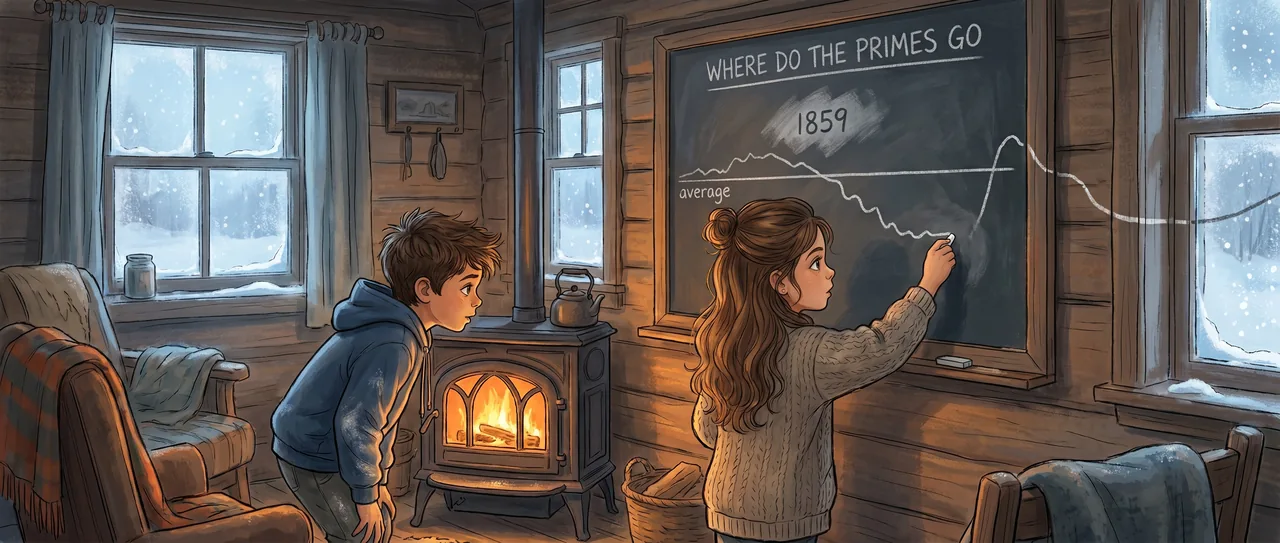
"Somebody started writing and quit," Maya said. Half the chalk was smeared by a thumb. At the top, in tidy handwriting, were the words: WHERE DO THE PRIMES GO?
"Primes are the numbers you can't break," Soren said. "Two, three, five, seven. You can't make them by multiplying smaller numbers. Everything else is built out of them."
"Like ingredients," Maya said.
"Like the only ingredients. Twelve is two times two times three. Every number is a recipe of primes, and there's only one recipe for each."
Maya picked up the chalk. "So write them. Let's see where they go."
They wrote. Two, three, five, seven, eleven, thirteen. Maya put a dash between each.
"Look," she said. "Two to three is one step. Then a two. Then a two. Then a four. Then a two."
"Twenty-three to twenty-nine is six," Soren said, counting on the board. "Then twenty-nine to thirty-one is two. Right next to each other again."
"That's weird." Maya tapped the board. "They bunch up and then they spread out. There's no rule."
"There has to be a rule."
"Why?"
"Because there's a rule for everything else." Soren took the chalk from her and wrote out the numbers up to a hundred, crossing off everything that wasn't prime. The crossed-off ones made a pattern, neat columns of multiples of two and three and five. The primes were what survived. And what survived was a mess.
"Ninety to ninety-seven," Maya said. "Seven whole numbers with no prime at all. Then ninety-seven and a hundred-one are both prime and a hundred and three."
"So they thin out as they get bigger," Soren said. "That part's a rule. The bigger the numbers, the rarer the primes."
"Okay. That's a rule." Maya stepped back. "But it doesn't tell you where the next one is. You know they're getting rarer but you can't say which number is the prime."
They stood there. The fire popped.
"That's the thing that's bugging me," Maya said slowly. "It's both. They're regular and they're not. On average they thin out, smooth as anything. But up close, one at a time, you can't ever guess. It's like a coastline that's straight from far away and jagged when you walk it."
Soren went very quiet Two, two, four, two, four, two, four, six, two, six. He stared at the line of numbers.
"There's no pattern in the gaps," he said. "I keep wanting one. There isn't one."
"But there's a pattern in how many there are," Maya said. "That's the part that's smooth."
"How can the count be smooth if the spacing is random?"
Maya didn't answer right away. She picked the chalk back up and under WHERE DO THE PRIMES GO she drew a long wavy line, then a straight line through the middle of it.
"Like this," she said. "The straight line is the average. The waves are the real primes, bouncing above and below it. And the question isn't where each prime is. The question is, do the waves ever go crazy? Do they ever run off and leave the straight line behind?"
Soren looked up. "And if they don't. If the waves always stay tight to the line."
"Then the primes are wild and tame at the same time," Maya said. "You can never name the next one. But you can always trust how many there'll be."
They both looked at the board for a long moment. There was something in the smeared half of it, under the thumb-marks. Soren leaned in and breathed on the chalk dust and rubbed it gently with his sleeve.
Underneath, in the great-uncle's hand, was a single line. It said: If the waves stay on the line, everything holds. Nobody has shown they do. 1859.
"Eighteen fifty-nine," Soren read.
Maya did the math on her fingers, then stopped doing it on her fingers. "That's a hundred and sixty-five years ago."
"He wrote the date of the question," Soren said. "Not the date he wrote it."
Maya sat down on the woodbox. "A hundred and sixty-five years. People have been staring at this exact thing. The waves staying near the line. And nobody's been able to prove they always do."
"Maybe they don't always," Soren said. "Maybe somewhere out past the numbers anybody's ever checked, the waves jump the rails."
"They've checked a lot of numbers." Maya pointed at the date. "Computers have checked further than you can write down. The waves stay on the line every single time they look."
"But checking isn't proving," Soren said, and Maya nodded, because that was the whole thing, that was the bottom of it.
"You could check a billion," she said. "You could check a billion billion. There's always one more number after that. There's always more numbers than you've checked. There's always more numbers than anybody will ever check."
The fire had burned low. Neither of them got up to feed it.
"So this could be true," Soren said. "Every prime that will ever exist, all the way out forever, lining up along that wavy line, behaving. And we'd just, never know for sure."
"Or somebody proves it," Maya said. "Somebody writes the reason. And then we know it about every number there is and every number there ever could be, all at once, without checking them."
Soren wrote that down too. One reason. Every number forever.
Maya stood up and looked at the wavy line and the straight line through it. She put her finger near the start, on the small numbers, where she could see the primes really did wobble close to the line.
"Somebody started this and quit," she said. "On the board, I mean. Uncle Aldo."
"He didn't quit," Soren said. "Look. He erased his work. He left the question."
Maya picked up the chalk, found a clean corner of the board, and drew the wavy line again, longer this time, running it right off the edge of the slate and onto the bare wood of the wall, where it kept going past where the board could hold it.
Read the interactive version, listen to the narration, and earn a gold star →
A science-verified short story for curious kids · Curiosity Land