The Night That Sings
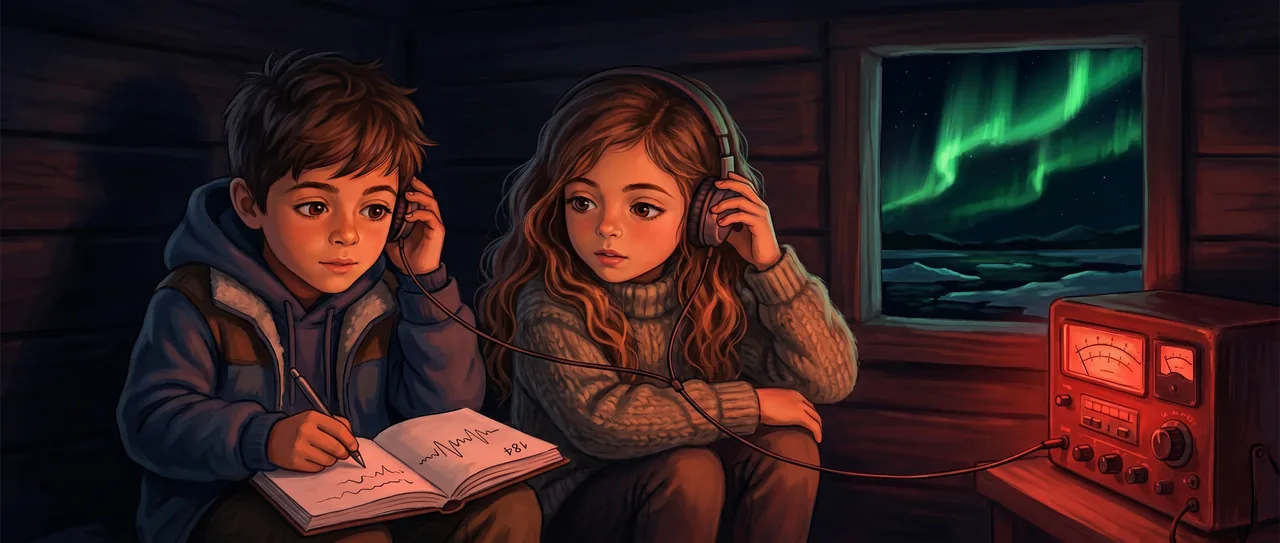
The polar night had been going for three weeks, and it was about to go for three more. Outside the cabin the inlet was black ice and blacker water, and the only light came from the green ribbon of aurora and the little red glow on Aunt Briar's recording rig.
Maya pressed the headphones hard against her ears. The sound coming up from under the ice was not what she expected. She had expected something slow and sad, the way whales sounded in documentaries. This was not slow. This was a creak that climbed into a moan that broke apart into a sound like a rusty gate, like a trumpet underwater, like somebody learning to whistle and getting better as you listened.
"It keeps changing," she said.
"Let me," Soren said.
She handed him the headphones. He closed his eyes. The cold made his breath hang in the cabin air. He listened the way he listened to everything, waiting for the part that did not fit.
"It's not repeating," he said. "A bird repeats. This one starts something and then doesn't finish it the same way."
Aunt Briar was at the table with three mugs of cocoa going cold, scrolling through sound files. "Bowheads," she said, not looking up. "They sing all winter. All of it. The whole dark."
"While it's dark out the whole time?" Maya asked.
"Four months of dark. They never stop." Briar tapped the screen. "I have years of this. I keep meaning to sort it."
Maya took the second pair of headphones and plugged in beside Soren so they were both hearing it at once, tethered to the same wire, their shoulders touching to stay warm. The song poured into both their heads, the same instant, the same low groan rising.
Soren reached for his notebook and drew a wobbling line, up and down, the shape of the sound.
"Play last year," Maya said suddenly. "This same night. Last winter."
Briar raised an eyebrow but found the file. She had the dates labeled. She put it on the cabin speaker so they could compare, one ear of headphone off.
Last winter's song filled the room. It was a bowhead, no question, same deep engine of a voice. But it was a different song. Not a different note here or there. A different shape entirely. Where this winter climbed, last winter dove. Where this winter broke into that rusty-gate sound, last winter held one long pure tone like a finger circling the rim of a glass.
"That's a whole other song," Maya said.
"Same whales?" Soren asked.
"Probably some of the same ones. They live longer than us. Longer than my grandmother." Briar shrugged. "Nobody fully knows why they change it."
Soren stopped drawing. He looked at his line for this year and tried to imagine drawing last year's beside it, and they would not lay on top of each other no matter how he turned the page.
"A mating call is the same every year," he said slowly. "A frog says the same thing its whole life. Crickets. They're born knowing it."
"So this isn't that," Maya said.
"This isn't that." He pressed the headphone back to his ear. The song had moved on again, into a new phrase, something it had not done five minutes ago. "They're making it up. They're making it up as the winter goes."
Maya felt the cold of the floor through her socks and did not move. Under the ice, in water with no light at all, in the longest dark on Earth, the whales were composing. Not remembering. Composing. Trying new things. Keeping the ones that worked and carrying them forward and dropping the ones that didn't.
"How many," she said. "How many different songs."
Briar scrolled and scrolled. "In a population they've counted up to a hundred and eighty-four. Distinct ones. In a single winter."
Maya did the thing she did when a number was too big for the room. She went quiet. "That's not one whale's voice," she said. "That's a hundred and eighty-four ideas. Going around. They're hearing each other and taking it and changing it."
Soren wrote the number down. Then he wrote, under it: passed along. He sat with the pen not moving.
Because here was the part that did not fit, and it did not fit in the best way. He had always been told songs like this were instinct, hardwired, a thing the animal could not help. A whale singing because its body made it sing, the way a kettle whistles. But a kettle whistles the same every time. A kettle does not invent a better whistle in February and teach it to the kettle next to it.
"It's not built into them," he said. "It's learned. They're learning it from each other. That's a hundred and eighty-four songs nobody is born knowing."
"Which means somebody made each one up," Maya said. "On purpose. In the dark. Because they wanted to."
The two of them looked at each other in the red light of the rig. Maya, who could never leave a sound alone, who took every song apart to see what was inside it. Soren, who kept a paper notebook full of shapes nobody asked him to draw. Down under four months of night, the biggest singers in the ocean were doing the exact same thing they did. Hearing something. Changing it. Trying it out loud to see if it was better.
"They're like us," Maya said, very quietly, and she did not mean it as a small thing.
Briar leaned back. "I've recorded a thousand hours," she said, "and I never once thought of it that way."
Soren put one headphone back to his ear and Maya put one to hers, the wire stretched between them, both of them leaning in toward the dark water. The song climbed. It reached the rusty-gate part and then, instead of breaking the way it had before, it held. It held and it bent the note upward into something neither of them had heard it do yet, a sound being born in real time, right then, in the water under their feet.
Maya's pen hovered over Soren's open page. Neither of them wrote it down. They just listened to the new part arrive.
Read the interactive version, listen to the narration, and earn a gold star →
A science-verified short story for curious kids · Curiosity Land