The Long Straw
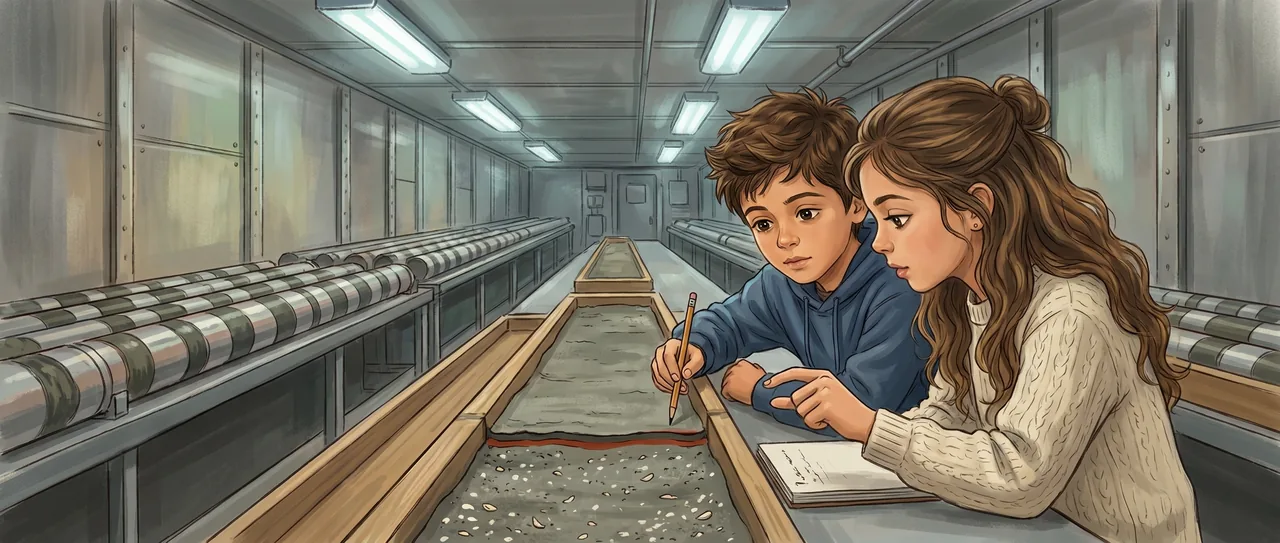
Maya's aunt had told them not to touch anything, then disappeared into an office with a coffee and a stack of forms, which meant the long room full of plastic tubes belonged to Maya and Soren now.
The tubes lay in trays, sliced lengthwise, each one as long as a kayak. Mud. That was all Soren could see at first. Gray mud, brown mud, a band of greenish mud.
"It's just dirt," he said.
"It's not just anything," said Maya. She was already walking the length of one, following something with her eyes. "Look. The stripes change."
Soren looked. Near one end the layers were thin and pale, packed tight as the pages of a book. Further along they went dark, then pale again, then a strange rust color.
"Why would mud have stripes?" he asked.
"Because it didn't all land at once." Maya crouched. "It fell. Slowly. A little every year."
"Mud falls?"
"Dead things fall. Little shells, dust, whatever's floating, it sinks. Every year a tiny bit more." She held her finger a hair's width above the tube without touching. "So this line and this line. Those are different years."
Soren got out his notebook and drew the trays, the trays in rows, the rows running back toward the dark end of the room. His hand stopped.
"How many years is the whole tube?"
Maya didn't answer right away. She had found a little printed card taped to the tray. She read it twice.
"Soren." Her voice had gone careful. "This card says the bottom of this one is sixty-five million years old."
"That's not possible."
"It's mud that fell for sixty-five million years and nobody stirred it." She looked down the room. "That's why it stays in order. Nothing down there digs. Nothing rains on it. It just stacks."
Soren walked along the tube the other way, toward the young end, and counted out loud, slow, the way you count when you don't believe the number you're heading toward.
"So if every band is a year," he said, "then walking along this is walking through time."
"In order," said Maya. "Forward or back. Your pick."
He stopped. "Then where are we? Where's now?"
Maya pointed at the very top layer, soft and pale and barely a finger thick. "There. That's this century, probably. That little smear."
Soren put his pencil under it and slid backward, layer by layer, naming nothing, just moving. Pale. Pale. A wide gray stretch. Then a run of bands so thin and even they looked combed.
"These tight ones," he said. "Why are they all the same?"
Maya leaned in. "Cold, maybe. When it's cold, less stuff grows up top, so less falls. Thin quiet years." She frowned. "And the fat dark bands, those might be warm. More life, more falling."
"So the mud remembers the weather."
"The mud remembers everything." She was grinning now. "Ice ages. Warm spells. You could read which was which without anybody telling you."
Soren kept sliding back. The bands rolled by under his pencil, year stacked on year stacked on year, until the pale and dark rhythm broke.
There was a line.
Not a band. A line. A thin dark seam that cut clean across the whole tube, sharp as a pencil stroke, with something rust red just under it.
"Maya."
She came over.
Below the line, the mud was full of tiny pale flecks, thousands of them, packed and lively. Above the line, for a long stretch, the mud went almost empty. Plain. Bare.
Soren put his pencil tip right under the seam, not touching the plastic.
"The little shells stop," he said. "Right here. They're everywhere, and then they're just gone."
Maya read the card again. Her finger found a number. She didn't say it. She put her hand near the rust layer instead.
"This rusty part. That's not from a cold year or a warm year," she said slowly. "That came down all at once. One bad fall. The whole ocean, the same day."
"What's a bad fall?"
"Something big hit." She said it quietly, like she didn't want to wake the tube. "Big enough to throw dust over the whole planet. It rained back down everywhere at the same time. So everywhere in the world, there's one thin line, the same line, this line, in mud and rock both."
Soren looked at the flecks below the seam, the swarming healthy ones.
"And those."
"Those were alive before. Right up until the line." Maya straightened. "Under the line is the world with dinosaurs in it. Above the line is the world without them. And it's that thick." She held up two fingers a sliver apart.
Soren stared at the gap between her fingers.
"All of it," he said. "The whole change. Everything dying and everything that came after. It's that."
"That," said Maya.
He looked down the long room, all the trays, all the tubes laid end to end, the slow snow of millions of years sliced open and lying flat under the lights where two kids could walk along it.
"Maya. If you walked the whole thing." He swallowed. "Every line you crossed would be a year nobody saw. Real years. With real weather. And they're all still here. Just stacked up waiting."
"Nobody saw them," Maya said. "But somebody could read them." She looked at him sideways. "That's a weird kind of somebody. The kind who'd rather count mud than go outside."
Soren didn't look up from the seam. "Yeah," he said. "That somebody."
"I know," said Maya. "Me too."
The office door opened and Maya's aunt leaned out, phone against her shoulder. "You two breathing on my cores?"
"Just looking," Maya said.
"That one's the famous one," the aunt said, already turning back. "The boundary. People fly across the world to see that line." The door swung half shut. "Don't touch it."
They weren't touching it.
Soren moved his pencil tip back up across the seam, from the world with the flecks into the world without them, and held it there, in the gap no thicker than a fingernail, where one ordinary afternoon sixty-five million years ago had finished falling and settled and waited in the dark for somebody to come and read it.
The pencil sat over the line. Down the long room, tube after tube held its years in order, all the way to the door.
Read the interactive version, listen to the narration, and earn a gold star →
A science-verified short story for curious kids · Curiosity Land