The Half-Second Behind
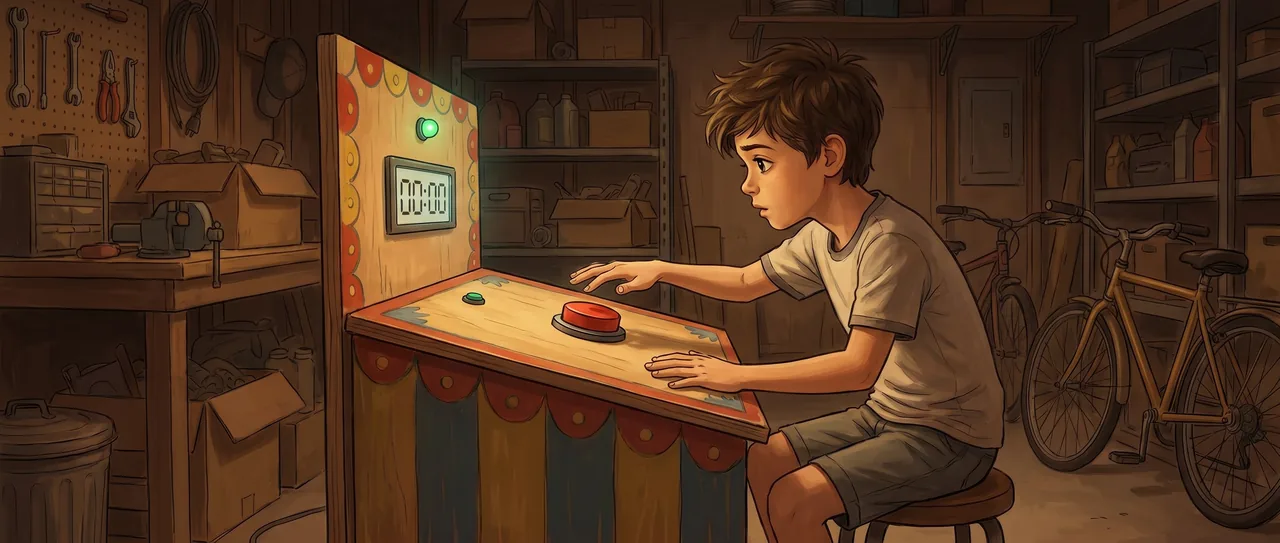
The reaction-timer game was simple. A light blinked green, and you slapped the big red button as fast as you could. Mr. Okafor had built it from a doorbell, a stopwatch chip, and a sheet of plywood painted like a carnival sign. He wanted it for the block fair on Saturday.
"It's reading slow," he told Soren. "Says people take a quarter second to hit it. Nobody's that slow. You're young. Your eyes are good. Sit here and tell me if it's lying."
Then his phone rang and he went inside to argue with somebody about folding tables, and Soren was alone in the garage with the machine.
He slapped the button when it went green. Two hundred and forty milliseconds. Again. Two-twenty. Again. Two-sixty. He could not get under two hundred no matter how ready he felt. And he felt ready. He felt like he was waiting at the exact front edge of himself, leaning into the green.
Soren wrote the numbers down. The pencil sat sideways in his hand because his palm was tired from slapping.
The thing was, the machine wasn't lying. The slow part was him. There was a gap between the green light hitting his eyes and his hand moving, and the gap would not close. He tried staring harder. He tried not blinking. The gap stayed.
So he tried cheating.
Mr. Okafor had wired the green light to a little timer that buzzed first, a soft click, half a second before green. A warning. Soren had heard it the whole time without listening to it. If he moved on the click instead of the green, he could beat the gap. He could hit the button before it was even time.
He tried it. The click came. He told his hand, now. His hand didn't go. Green came. Then his hand went. Two-thirty.
That was strange. He had decided on the click. He had heard himself decide. And his hand had waited anyway, like it was listening to someone else.
He tried again, paying attention to the exact moment he chose to move. Click. He felt the decision arrive, a small bright yes in his head. His hand moved a beat after the yes. Not with it. After it.
Soren stopped slapping and sat very still.
He had always thought it went like this: you decide, and then, in the same instant, you move. The deciding and the moving were the same event seen from two sides. That was obvious. That was just how a person worked.
But the click experiment kept showing him something else. The yes in his head and the go in his hand were not the same instant. There was a seam between them. And he could not tell, sitting there, which one came first.
He needed a way to catch the order. He set it up carefully. He put his free hand flat on the plywood so he could feel it. Then he watched for the click, and this time he did not try to move fast. He just waited to notice the very first thing that happened when he was about to press.
The first thing was not the decision.
The first thing was his arm. A tightening. A lean. His arm got ready to press, and then, a moment later, the bright yes showed up in his head like an announcement. Like a voice saying we are going to press, after the arm had already started getting ready to press.
Soren did it again to be sure. He did it six times.
Every time, the readiness came first. The body tilted toward the button. Then the feeling of choosing arrived, dressed up like the boss, taking credit for a thing that had already begun.
He put the pencil down and didn't pick it back up for a while.
Because here was the trembling part. If the getting-ready came before the deciding, then when he decided, he was not starting the movement. He was finding out about it. The decision felt like the first thing. It was actually the second thing. Something underneath had already leaned toward the button, and the part of him that says I, the part that felt like the whole of him, was getting the news a little late.
He thought about all day. Every choice all day. Reaching for the cereal. Saying a word. Turning his head when somebody said his name. He had spent eleven years feeling like the one at the front, the one who decided and then the body obeyed. And maybe the whole time he had been half a second behind himself, watching his own hand begin and calling it his idea.
It did not feel scary, exactly. It felt enormous. It felt like turning around in a room you thought was empty.
Mr. Okafor came back in, still holding the phone. "Well? Is it lying?"
"No," Soren said. "It's slow because we're slow. There's a gap. Light comes in, then a little while later the hand goes."
"Quarter second. Reaction time. Everybody's got it." Mr. Okafor was already looking at the folding-table situation in his head.
"It's not just that," Soren said. "I tried to move on the warning click instead of the green. And I could feel it. The getting-ready part of me starts before the deciding part. The deciding shows up late. It only feels like it's in charge."
Mr. Okafor looked at him properly now. "You felt that. On a doorbell rig."
"Six times," Soren said.
Mr. Okafor was quiet. Then he said, "There are scientists who measure that with electrodes. The brain lights up before the person says they've decided. Sometimes a long time before. Seconds. They argue about what it means. Nobody's finished arguing."
"Seconds," Soren said.
"Seconds."
Soren looked at the red button. He thought about a version of himself sitting in a lab with wires on his scalp, choosing to lift a finger, and a screen across the room already knowing, glowing, leaning toward the choice, ten whole seconds before the part that says I felt anything at all.
Ten seconds was so much longer than a click. Ten seconds was enough time to feel completely, absolutely certain that you had not decided anything yet.
"Try it," he said to Mr. Okafor. "Move on the click. Then watch which happens first. Your arm or your yes."
Mr. Okafor set the phone down on the workbench. He put his hand near the button, the way Soren showed him, and waited for the soft click in the quiet garage, watching himself, trying to catch the moment he chose.
Read the interactive version, listen to the narration, and earn a gold star →
A science-verified short story for curious kids · Curiosity Land