The Forest That Walks Into the Sea
The mud sucked at Maya's ankles like it wanted to keep her.
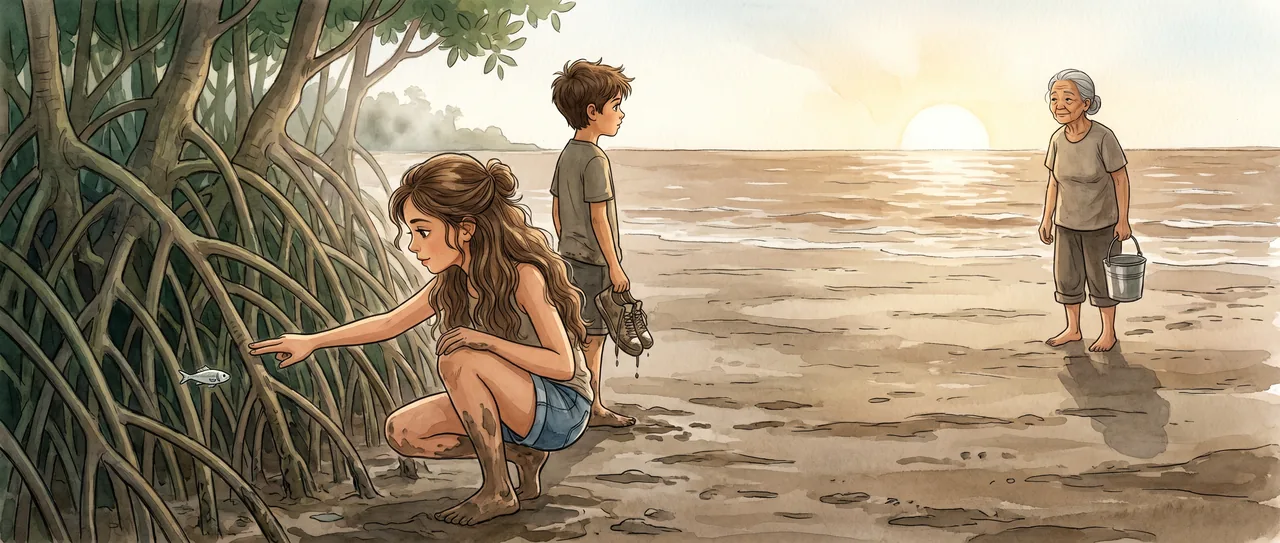
Low tide had pulled the sea back a long way, and the whole flat steamed under the morning sun, smelling of salt and rot and something green underneath. Soren stood beside her with one shoe already lost, holding it dripping in his hand and refusing to be embarrassed about it.
Ahead of them the mangroves began. Not like normal trees. These trees stood up out of the water on bent legs, hundreds of arched roots, like the whole forest had waded in from the shore and frozen mid-step.
"They're walking," Maya said.
"They're not walking," said Soren.
"I didn't say now."
Grandmother Lin moved ahead of them with her bucket, bare feet sure on the mud, fingers reading the surface for the little breathing holes where the clams hid. She had dug here when she was eleven. She said that without looking back, the way she said most things.
Maya crouched at the edge of the roots. The water trapped between them was warmer than the open flat and full of motion. She put her face close. The shallows boiled with tiny fish, hundreds of them, silver flecks no longer than her fingernail, darting in and out of the dark tangle.
"Soren. Come look at how many."
He waded over, careful, and went still over the water. Then he started counting under his breath and gave up at forty in one handful of shadow.
"They're babies," he said. "All of them. Where are the big ones?"
"Out there." Grandmother Lin tipped her head toward the open sea. "The big ones live out there. They come in here to be small."
Maya rocked back on her heels. The roots made a fence the size of her hand, a fence the size of a maze, a fence that went on under the trees farther than she could see into the green dark. A big fish could not fit. A bird could not dive in. Only something tiny could move in there, and only something tiny needed to.
"It's a nursery," she said. "The whole forest is a nursery."
Soren looked at the roots differently after that. He reached into the mud below the water and his fingers came up black and stinking, slick all the way to the wrist.
"Smell it," he said, and held it out.
Maya made a face. It smelled like eggs gone wrong, like the bottom of everything.
"That's no air in there," Soren said. "Nothing rots properly with no air. Leaves fall in, and they just. Stay." He turned his black hand in the light. "How long do they stay?"
Grandmother Lin straightened up with a clam in her fingers. "Longer than me. Longer than my grandmother. The mud keeps everything that falls into it."
Soren went quiet, and the quiet had weight. He scraped his hand on a root and the smell stayed on him.
Maya was already somewhere else, looking back the way they had come. Behind the mudflat, behind the road, the town sat low and flat against the sky. She remembered the storm two seasons ago, the one that flooded the market and lifted boats into the street.
"The water didn't reach Lin's house," she said slowly. "It reached everywhere else. Not hers."
Grandmother Lin's house sat just behind the trees.
Maya stood and pushed two fingers into the wall of roots, and the roots did not give. She pushed harder. They flexed and held, bent legs braced into the mud, thousands of them, a whole army standing with its knees locked against the sea. A wave coming in would have to climb through all of it. The roots would take the wave apart, strand by strand, and lay it down gentle on the far side.
"That's why," she said. "That's why the water stopped. The forest ate the wave."
Soren waded out past her to the seaward edge, where the roots thinned and then stopped and the open flat began. He stood at the line between forest and not-forest. On his side, the maze. On the other side, bare mud, flat and empty all the way to the brown water.
"It used to be bigger," he called back. "Didn't it."
Grandmother Lin did not answer right away. She picked up her bucket. "To there." She pointed far out, past where Soren stood, past the open flat, almost to the line of the sea itself. "When I was your age. To there."
Maya looked at the distance between where the forest ended now and where Grandmother Lin was pointing. It was most of the way to the water. It was half the world.
It was gone in one lifetime. In one grandmother.
Soren came back fast, the mud not slowing him now. "It pulls the carbon down," he said, the words tumbling. "Into the mud, where nothing rots, and it holds it, for hundreds of years, more than the forests on land, this little muddy strip does it better than a rainforest, and it stops the waves, and it grows the fish, all three, all at once, the same trees."
"And we cut half of it," Maya said.
The two of them stood at the edge of the roots. The tide had turned. Maya felt it before she saw it, a coolness sliding back across her feet, the sea coming home through the maze. The trapped pools stirred. The silver babies scattered and regrouped.
"Half," Soren said again, like the word would not fit in his mouth.
Maya knelt one more time at the root wall. The water was rising through it now, threading between the bent legs, carrying the small fish deeper into the dark where nothing big could follow. She watched a single fingernail of silver swim in past her hand, into the green .
"That one," she said. "That one's going to be big."
Grandmother Lin stood waiting on the shore side with her bucket, and the water kept rising, and Soren pulled his lost shoe back onto his foot without bothering to empty the mud out of it, his eyes still fixed on the line where the forest stopped and the bare flat began.
Read the interactive version, listen to the narration, and earn a gold star →
A science-verified short story for curious kids · Curiosity Land