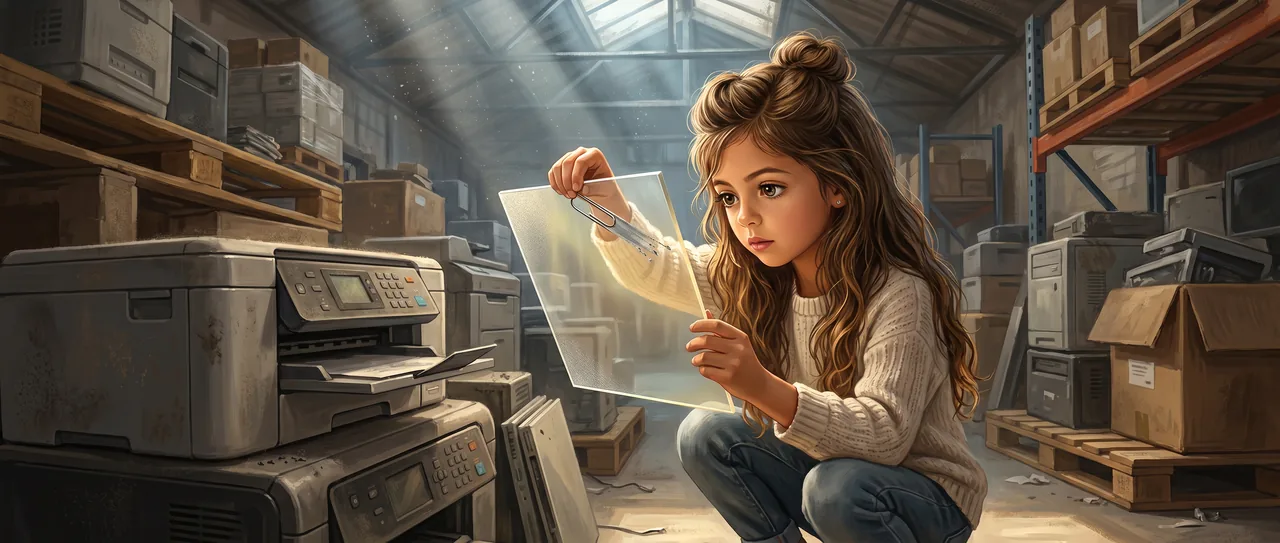
The Window That Wasn't Glass
The panel was leaning against a pallet of dead printers, and Maya stopped because it caught the light wrong.
Glass throws light back at you in a thin shine, a skin on the surface. This panel did something deeper. The afternoon coming through the warehouse skylight went into it and seemed to hesitate, like the light had to walk through something thicker than air before it came out the other side. Maya put her thumbnail against the edge and dragged it. No scratch. No click of nail on glass either. A dull, dense sound, more like tapping a plate than a window.
"Don't go selling that one cheap," Aunt Reza called from across the aisle, not looking up from a crate of cables. "It came in a crate stamped Air Force. Probably worth something. Probably worth nothing. Everything here is one or the other."
Maya crouched. The panel was maybe the size of a cookie sheet and surprisingly thin, thinner than a windowpane. She lifted it with both hands, braced for the heavy slosh of thick glass.
It was light. Wrongly light. The kind of light where her arms had guessed one weight and her hands reported another, and for a second her whole body disagreed with itself.
She set it down and just looked.
The surface had a faint warmth to the eye, a yellow ghost at the edges where it went from clear to almost gold. When she pressed her fingertip flat against it, her fingerprint did not smear and slide the way it would on glass. It sat there crisp, like the surface was harder than her skin and her skin knew it.
Maya found a steel paperclip in the printer pile and dragged one straightened end across the corner of the panel, pressing hard.
The steel left a gray smear. She rubbed it with her thumb and the smear came off. The panel underneath was untouched. She tried again, leaning her whole shoulder into it. The steel gave way. Tiny flakes of metal peeled off the paperclip and left their color behind, and the clear surface took none of it.
She sat back on her heels. The thing was harder than the steel she was scratching it with. But it was clear. Glass was hard too, sort of, brittle hard, the kind of hard that shatters. This did not feel brittle. When she tapped it with her knuckle the sound stayed low and solid and did not ring like glass rings.
"Reza," she said. "What's harder than steel but you can see through it?"
"Diamond," Reza said, still inside her crate. "And diamonds don't come the size of cookie sheets, kiddo, so put it down."
Maya did not put it down. She had a list in her head of things that did not make sense yet, and this had just gone to the top.
Glass was made of melted sand. She knew that. Sand and heat and it cooled into something clear and breakable. But the heaviness of glass came from how packed it was, and this was lighter than glass and harder than steel, and those two things did not belong in the same object. Hard usually meant heavy. Clear usually meant breakable. This panel was breaking the rules in both directions at once, and doing it quietly, leaning on a pallet, priced at nothing.
She held it up to the skylight again and tilted it slowly.
The gold tint moved through it like the panel was deciding how much of each color to let pass. And there, near one edge, she found what she'd been half looking for. A faint pattern, the surface texture not perfectly smooth but made of tiny grains, like the panel was a crowd of microscopic pieces fused into one. Glass had no grains. Glass was a smooth nothing all the way through. This had structure.
That was the thing that turned the warehouse strange around her.
It wasn't glass at all. It only looked like glass because she had a box in her head labeled clear things you can see through and only one thing had ever been in that box. But this had grains like a stone. This was a stone you could see through. Somebody had taken something that wanted to be a rock, an opaque powdery solid, and forced it to grow so even and so pure that light went straight through it as if the rock weren't there.
Maya's hands felt cold. Not afraid cold. The cold of standing somewhere bigger than she'd been standing a minute ago.
Because if you could make a rock clear, then maybe glass was never the only window. Maybe every solid thing, every metal and mineral and ceramic, was opaque only because of how its insides were arranged, not because of what it was. Maybe see-through and you-can't-see-through were not two kinds of material. Maybe they were two kinds of order, and somewhere there were people who knew how to choose.
She thought about that. People who had looked at a dull gray powder and decided it could be a window. Who had not accepted the box. Who had a list like hers, of things that didn't make sense yet, and had done the work of pulling this one off the list and into the world, and then crated it and stamped it and forgotten it on a pallet next to dead printers.
Maya scratched the panel one more time with the paperclip, hard, watching the steel lose and the clear surface win.
"It's not glass," she said.
"Then what is it?" Reza had finally stood up, wiping her hands, looking over.
"It's a rock," Maya said. "Somebody made a rock you can see through. They made it so clean inside that the light just walks out the other side."
Reza came over and picked it up, and Maya watched her aunt's arms do the same thing hers had done, brace for heavy and find light, the small stumble of a body whose guess was wrong.
"Huh," Reza said quietly. She turned it in the skylight, and the gold ghost slid across her face.
Maya took the paperclip and pressed the gray streak of steel onto the panel again, and again wiped it away to nothing, watching the softer metal lose to the clear stone every single time.
Read the interactive version, listen to the narration, and earn a gold star →
A science-verified short story for curious kids · Curiosity Land