The Spare Letters
Soren wanted a code his sister could not crack.
He had tried letters before. The trouble with letters was that there were too many of them, twenty-six, and his sister knew all the tricks. Shift them by three. Swap vowels. She broke those at the breakfast table while eating cereal.
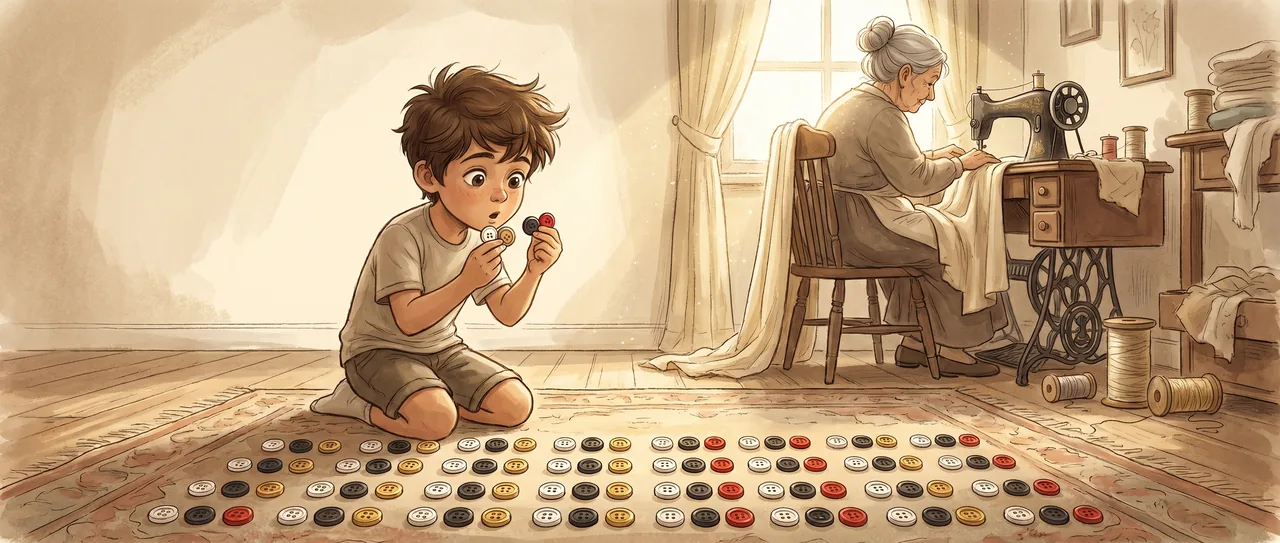
So he came to his grandmother's sewing room, where it was quiet and smelled like old thread, and he dumped out the button tin on the rug.
There were only four kinds of buttons in any number. Round white ones. Square black ones. Little gold shanks. Flat red ones with two holes. He decided that was the point. Fewer kinds meant fewer things to guess.
His grandmother was at the machine, hemming a curtain, not really watching him. She fed cloth under the needle in long slow pushes.
"Four buttons," Soren said. "That's all I get."
"That's all you need to sew anything shut," she said, not turning around.
He lined the buttons up. White, black, gold, red. Four signals. He wanted each one to stand for a different letter. But four buttons could only ever stand for four letters, and his name alone needed five. The code was already too small.
He sat with that. The needle clicked. Outside a dog barked twice and gave up.
Then he tried pairs. White then black. Black then white. White then white. If he used two buttons together as one signal, he had more signals. He counted them out on the rug, laying down little couples. Four times four. Sixteen pairs.
Sixteen was better than four. But the alphabet was twenty-six. Sixteen still came up short, and it bothered him the way a shoe with a pebble in it bothered him, low and constant.
"Grandma. How many things can you make from four buttons if you take them three at a time?"
"Ask the buttons," she said. "Don't ask me."
So he did. He started laying down threes. White white white. White white black. White white gold. White white red. Then white black white, and on, and on. He was careful. He did not want to count one twice or skip one. He kept the first button steady and ran the other two through every change before he moved the first.
The rug filled up with little rows of three. His knees ached. He kept going because stopping in the middle would ruin the count.
When he finished he counted the rows. Sixty-four.
Sixty-four triplets from four buttons. He sat back. Sixty-four was huge. Sixty-four was more than the alphabet twice over. He could spell anything. He could give every letter its own triplet and still have spares. He could even make a few triplets mean stop, here, this is the end of the word, and still have leftovers he did not know what to do with.
He was pleased for about four seconds.
Then something turned over in him, slow, like the cloth under the needle.
Four signals. Read three at a time. Sixty-four meanings. Spare ones left over.
He had heard this before. Not in a sewing room. In a video he had watched twice because it would not sit still in his head. A man with a model made of colored sticks had said that the instructions for building a person were written in four letters, A and T and G and C, and that the cell read them three at a time.
Three at a time.
Soren did not move. The needle clicked on without him.
Four letters. Triplets. Sixty-four possible triplets. And the man had said something that had not made sense at the time, that there were only twenty things to spell, twenty amino acids, the beads life strings together to make everything that is alive. Twenty things to spell. Sixty-four ways to spell them.
That left spares. The same spares that were sitting on the rug in front of him right now. More triplets than meanings. More ways to say a thing than there were things to say.
He pulled three buttons toward him. White, white, gold. Then he changed the last one. White, white, red. In his code those were different letters. But life, he thought, sometimes did not bother. Life sometimes let two different triplets mean the very same amino acid, the way you could spell a sound two ways and land on the same word.
He checked it against himself, slowly, the way he checked everything. If there were sixty-four triplets and only twenty amino acids and three or so stop signals, then most amino acids had to answer to more than one triplet. There was no way around the arithmetic. The leftovers were not waste. The leftovers were backups.
He thought about his sister breaking his codes at the breakfast table. A good code, she always said, was hard to mess up. If one button slipped, the message still arrived. He looked at the white, white, gold and the white, white, red sitting side by side meaning the same thing, and he understood that this was a code built so that a slip in the last button might change nothing at all. A letter could change and the word would hold.
He had been trying to invent a code all afternoon. The code was already inside his own hands. It was inside the hand holding the buttons. It had been running in there, three letters at a time, since before he was born, with spares, so that small mistakes would not ruin the message that was him.
"Grandma," he said. His voice came out smaller than he meant. "There's a code in me right now. Writing me. While I'm sitting here."
"Mm," she said. "Hand me the red one with two holes."
He found it in the pile and gave it to her. She did not look at it. She found the holes by feel, threaded it, and sewed it to the curtain in four quick crosses without slowing the machine.
Soren looked back at the rug. Sixty-four little rows of buttons, three to a row, more meanings than there were things to mean.
He gathered the white-white-gold and the white-white-red into his fist and shook them like dice, and listened to two different words that the world might read as one.
Read the interactive version, listen to the narration, and earn a gold star →
A science-verified short story for curious kids · Curiosity Land