The Same Warning
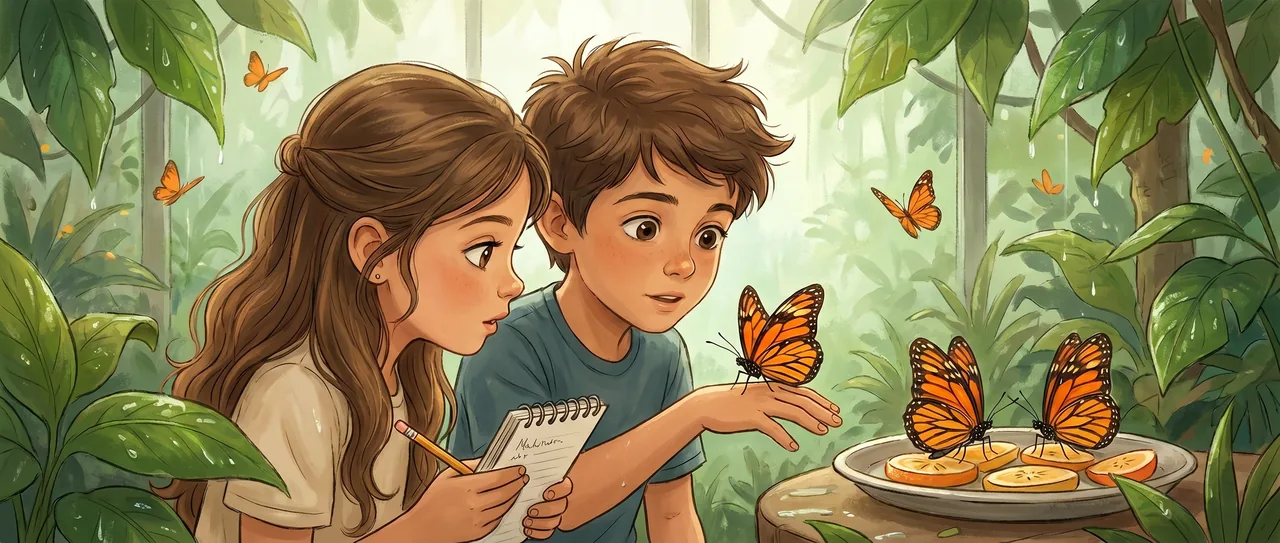
The rain had chased everyone inside, so the butterfly house was crowded and damp and smelled like wet leaves and sugar water. Maya stopped in front of a feeding plate, where four butterflies sat with their wings open.
"These two are the same," she said.
Soren leaned in. "They're not, though. Look at the body on that one. It's longer."
"The wings are the same. Orange, black bars, those white spots at the top. Exactly the same."
They found the little placard bolted to the rail. It named six species in the enclosure. Maya read the names twice and frowned.
"Three of these have basically the same description," she said. "Tiger-striped. Orange and black. But they're listed as different species. Different genus, even. Look, this word is different from this word."
Soren got out his notebook and copied the three names down, his pencil pressing little dents into the page. He drew the wing pattern next to each one. The same drawing, three times.
"That's wrong," he said. "If they're different species they shouldn't look identical. Things that aren't related don't usually match by accident."
"Unless matching helps them," Maya said.
"Helps them how?"
She didn't answer right away. A butterfly lifted off the plate, drifted, and landed on the back of Soren's hand. He held very still. It was orange and black with the white spots, and up close the orange was almost the color of a traffic sign.
"It's a warning color," Maya said. "Right? Bright like that. It's telling birds don't eat me."
"Telling them it tastes bad."
"Or worse than bad. Poison, maybe." She watched it fan its wings. "So if this one's poisonous, and a bird tries it once and gets sick, the bird learns this exact pattern means sick."
Soren nodded slowly. "And then it never eats this pattern again."
"But it's three species," Maya said. "Not one."
That was the part that wouldn't sit flat. They both stared at the feeding plate.
"Okay," Soren said. "Say a bird eats one. Just one. Which species does it eat?"
"It doesn't know they're different species. It just sees orange and black bars."
"Right. The bird doesn't read placards." He almost laughed. "So the bird gets sick off any one of them. And then it avoids all three. Because to the bird they're the same thing."
Maya's eyes went wide. "So they share it."
"Share what?"
"The lesson. The being-avoided. One bird gets sick on species number one, and species number two and three never even get tasted. They get protected for free."
Soren was writing fast now, the pencil scratching. "But it goes both ways. The first species gets protected when a bird gets sick on the second one. Every bird that learns from any of them protects all of them."
"So the more of them that look the same, the safer all of them are."
They stopped. A keeper in a green apron walked past with a misting bottle, said "don't touch the wings, the scales rub off," and kept going without looking at what they were looking at. Soren waited until she was gone.
"That's why they look the same," he said. "It's not a copy. It's not one faking the other. They're all telling the truth. They're all actually poisonous."
"And they all picked the same way to say it."
"Not picked." He shook his head. "They didn't pick. Nobody got them together. There's no meeting."
Maya laughed at the idea of a meeting, three kinds of butterfly agreeing on a uniform. Then she stopped laughing, because the real version was stranger.
"So how does it happen with no meeting?"
Soren chewed his pencil. "The ones that looked a little like a dangerous pattern got eaten less. So they had more babies. The babies looked even more like it. Over and over, for a really long time, until they all drifted into the exact same orange."
"Three different species drifting toward the same picture," Maya said. "From three different starting places."
"Because the same picture worked for all of them."
She pressed her lips together. "That's the part that gets me. They never decided anything. Not one of them is helping the others on purpose. There's no friendship in it. But it comes out looking exactly like cooperation."
"It is cooperation," Soren said. "It's just cooperation that nobody chose."
Maya looked at the feeding plate, where two of the three sat side by side, identical strangers. "A bird in here, right now, is learning. It tries one. It gets sick. And without knowing it, it just made every single one of these safer."
"All of them at once," Soren said. "From one mistake. The whole pattern gets stronger every time anybody learns it."
Maya was quiet a second. "That's kind of how it feels," she said. "When you figure something out and then I get it too, even though I didn't do the figuring."
Soren glanced up from his notebook.
"The lesson lands on both of us," she said. "I get protected by your sick bird."
He grinned at that, a little crooked. "You're the second species."
"You're the first. You ate the bad one."
The butterfly on his hand opened and closed its wings, slow, in no hurry, completely unbothered by the people leaning over it. It had no idea it was part of anything. It just wore the same warning as two strangers and was kept alive by their poison as surely as its own.
Maya looked around the whole enclosure then, really looked, at all the orange flickering through the leaves. She couldn't tell anymore which species was which. None of the birds outside could either. That was the entire point.
"How many of these," she said slowly, "are wearing somebody else's warning right now and don't know it."
Soren followed her eyes up into the leaves, where a dozen identical strangers drifted through the green, each one saying the same true and borrowed thing.
The butterfly lifted off his hand and joined them, and the orange swallowed it, and it was gone.
Read the interactive version, listen to the narration, and earn a gold star →
A science-verified short story for curious kids · Curiosity Land