The Number That Hides
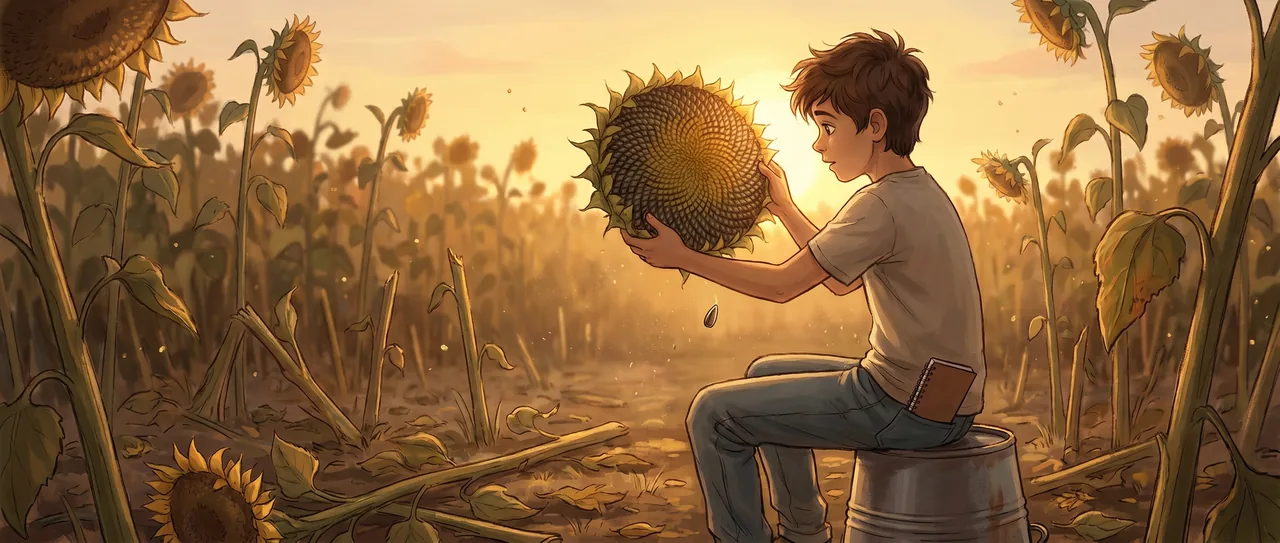
Aunt Reyes had a machine that counted seeds, and the machine was broken, which was how Soren ended up sitting on an overturned bucket with a sunflower head the size of a dinner plate balanced on his knees.
"Just count a row and multiply," she said, already walking back toward the barn with grease on her hands. "Botanists do it all the time. Find a line, count it, scale up."
Soren found a line. He started at the center and tried to follow seeds outward in a straight row.
There was no straight row.
He turned the flower. There was no row going the other way either. The seeds sat packed so tight there was no gap to slide a fingernail into, and every time he thought he had a line, it curved and handed him off to a different line, like a hallway that kept opening into other hallways.
He sat with it for a while. He did that with things that would not behave.
The curves, he saw, were spirals. They wound out from the middle and bent the same way a wave bends. And once he saw one spiral, he saw that it was crossed by another set of spirals going the opposite way. The whole face of the flower was two armies of spirals laced through each other.
So he counted spirals instead of seeds.
Going clockwise, he counted them around the edge. Thirty-four.
Going counterclockwise, fifty-five.
He wrote the two numbers in the corner of the notebook he kept in his back pocket, and looked at them, and something in the back of his head leaned forward. Thirty-four. Fifty-five. He had seen those somewhere. He added them, the way you do when two numbers are sitting next to each other being suspicious.
Thirty-four plus fifty-five was eighty-nine.
He went to find a second sunflower.
The second one was smaller. He counted twenty-one one way and thirty-four the other. Twenty-one plus thirty-four was fifty-five. The same numbers, moving. Each flower picked two neighbors out of one list, and the next flower up picked the next two.
Aunt Reyes came back to find him surrounded by cut flower heads.
"You were supposed to count one," she said.
"They all do the same thing," Soren said. "The spirals. The numbers go twenty-one, thirty-four, fifty-five. Each one is the two before it added up."
"Sure," she said, wiping her hands. "Fibonacci. It's in the pinecones too. Plants like those numbers." She said it the way you say something that has stopped being strange because you have known it too long.
That was the part Soren could not let sit. Liked them. A flower did not like a number. A flower grew. Something about growing came out as thirty-four and fifty-five and never came out as thirty-five.
He thought about how a flower grows. It does not lay all its seeds down at once. It pushes them out one at a time from the center, and each new seed has to find a spot, and every spot it does not take gets shoved outward by the next one. So the only real choice the flower makes, over and over, is the angle. How far around to turn before dropping the next seed.
He took a fresh page and drew a dot in the middle. Then he imagined turning a little and dropping the next dot. Turning the same little bit and dropping another.
If the turn was exactly half a circle, the third seed would land right behind the first. Two arms, a lot of wasted gaps. If the turn was a third of a circle, three arms, more gaps. Any turn that was a neat fraction of a circle made the seeds line up into spokes with empty wedges between them, and a flower with empty wedges was a flower wasting room it could have packed.
So the flower did not want a neat fraction. It wanted a turn that never lined back up. A turn so stubborn that no matter how many seeds you dropped, the next one always landed in the biggest gap left over.
Soren stopped drawing.
He knew, the way you know a step is missing in the dark, that there had to be one angle that was the most stubborn. The fraction that was hardest to sneak up on with any other fraction. The number that hid from every neat number you tried to pin it to.
He ran inside and asked Aunt Reyes for a calculator. He took his fifty-five and his thirty-four and divided one by the other. He got one point six and a tail of digits. He tried eighty-nine divided by fifty-five. Almost the same, the tail twitching. He tried it with bigger Fibonacci numbers he built right there on the page, adding pairs, dividing.
The answer kept circling a number and never landing on it. One point six one eight, and then more, and the digits after never settled into a loop he could catch.
"It doesn't stop," he said.
"Lots of numbers don't stop," Aunt Reyes said. "Pi doesn't stop."
"No," Soren said. "This one doesn't stop and it doesn't let you get close either." He was holding the calculator with both hands now. "Pi you can sneak up on. Twenty-two over seven gets you really close. This one, the best fractions are the worst. The flower's fractions are the closest anybody can ever get, and they're still wrong. On purpose."
He sat with that.
The most irrational number. Not the messiest. The most. There was an order to how badly numbers refused to be caught, and at the very far end of that order, the hardest one to corner, was the exact angle a sunflower turned to fit the most seeds into the least room. The flower had found the one number that hides from everything, and it found it without knowing what a number was, just by trying not to waste space, one seed at a time.
Soren went back outside. He picked up the big flower head, the thirty-four and the fifty-five, and held it up against the late sun so the seeds went edge-on and the spirals leapt out, both armies at once, winding and crossing and never once lining up into a row he could count straight.
A seed worked loose from the center and dropped into his lap, already turned at the angle no fraction could reach.
Read the interactive version, listen to the narration, and earn a gold star →
A science-verified short story for curious kids · Curiosity Land