The Most Boring Message in the World
The radio contest had one rule, and Maya had read it four times.
"Send us the shortest possible message that tells us which of the eight prize boxes you want," she read out loud. "Fewest letters wins. Boxes are numbered one through eight."
"So we just send the number," Soren said. "Box six. That's a five. F-I-V-E."
"That's four letters for box five. Box three is five letters. T-H-R-E-E." Maya tapped the table. "Different boxes cost different amounts. That's weird. They're all the same box."
Soren wrote the eight numbers in a column in his notebook and counted the letters beside each one. "One is three. Six is three. Seven is five."
"Spell them shorter," Maya said.
"You can't spell three shorter. It's already three."
"Then don't spell them at all." She leaned over his page. "There's eight boxes. We don't need words. We need yes and no."
Soren looked at her.
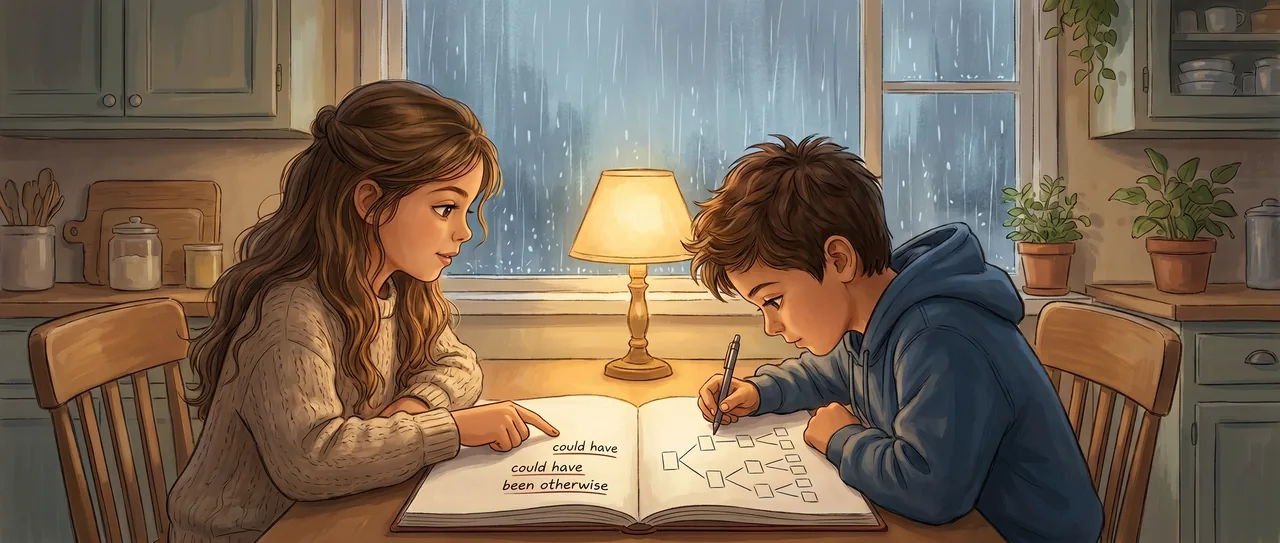
"Watch," she said, and took the pen. "Is it in the top four boxes? Yes or no. That cuts eight down to four. Then, is it in the top two of those? Yes or no. Down to two. Then one more yes or no. Done. Three answers and you've landed on exactly one box out of eight."
"Three questions," Soren said slowly. "Always three. For any of the eight."
"Yes. So a box is really just three yes-or-nos. Y-N-Y. Whatever it is. Three letters, every time. Even box seven."
Soren stared at the column of spelled-out numbers, then crossed the whole thing out. "That's better than the words. The words were lying about how big the boxes were."
"The words had extra junk in them," Maya said. "Letters that weren't doing any work."
They sent it in. Three letters. Y-N-Y for box six. The station read it on air and the host laughed and said, that's the cleverest one today, and Maya did a small fist in the air.
But Soren had gone quiet over his notebook, drawing the yes-and-no tree again, eight boxes splitting into four, into two, into one.
"What," Maya said.
"Why three," he said. "Why exactly three."
"Because eight boxes."
"But why does eight boxes mean three." He drew faster. "Two questions only reaches four boxes. Three reaches eight. Four would reach sixteen. Every time you add one question you double how many boxes you can tell apart."
Maya pulled the notebook toward her. "So the number of questions isn't the number of boxes. It's how many times you double to get there."
"Yeah."
"That's not how many boxes there are. That's how surprised you are when you find out which one."
Soren stopped drawing.
"Say it again," he said.
Maya was already somewhere ahead of herself. "Okay. If there's only one box. One. You don't even have to send anything, right? I tell you, you win the box, and you go, obviously, there was only one. Zero questions. Zero surprise. The message tells you nothing because you already knew."
"Right," Soren said. "No surprise, no message."
"But eight boxes, all equally likely, you've got no idea which. So finding out costs three yes-or-nos. The more boxes that could have been it, the more it costs to say which one really was." She looked up. "The message is worth more when you were more surprised."
Soren wrote down: information = surprise. Then he sat looking at it like it might move.
"Test it," he said. "What if the boxes aren't equal. What if the host already told us box six is the boring leftover sock box and almost nobody picks it, and box one is the good one and everybody picks it."
"Then box one is barely a surprise," Maya said. "Everybody's gonna say one. So when somebody says one, you go, yeah, of course. Costs almost nothing."
"And box six?"
"Box six is a shock. Nobody picks the sock box. So if somebody actually wants box six, that tells you a lot, because you'd never have guessed it." She grinned. "The boring box carries more information. Because it's the surprising choice."
Soren felt the back of his neck go cold in a good way. "That's backwards from everything. The thing nobody expects is worth the most to say."
"It's not backwards. It's the whole point." Maya was up out of her chair now, walking. "A message that just says what you already knew is empty. Y-Y-Y, everybody picks box one, who cares. But the one message nobody saw coming, that's the one that's actually carrying something."
They both looked at the rain on the window, which was making no pattern at all, just a wall of static, every drop unexpected.
"That's why rain hisses," Soren said suddenly. "On the radio. Between the stations. It's the loudest nothing. It's all surprise and no message, just pure could-be-anything."
"And a station coming in clear is the opposite," Maya said. "It's full of patterns. You can almost guess the next word before they say it. That's how you know it's a message and not noise. The guessable parts are the message holding still."
Soren turned to a fresh page and wrote, fast: a thing is only information if it could have been otherwise. He underlined could have been otherwise twice.
Maya read it over his shoulder. She got very still, and then she said the thing quietly. "So the questions I ask. The ones that bug me. The stuff that doesn't fit yet." She tapped the page. "Those aren't me being annoying. Those are the only parts that carry anything. The stuff everybody already agrees on is the Y-Y-Y. It's the empty boxes."
Soren looked at her, then back at the window.
"The whole world," he said. "Every clear voice, every photo, every word anybody bothers to send. It's all just somebody narrowing down which box, out of how-many-ever it could have been."
"How many boxes is everything, though," Maya said. "How many doublings to get to one actual sentence. One actual face."
Neither of them had a number for that.
The radio host read out three more winners. On the window, the rain kept coming down, every drop landing where no drop had been, none of them guessable, the loudest static in the room saying nothing at all and saying it perfectly.
Read the interactive version, listen to the narration, and earn a gold star →
A science-verified short story for curious kids · Curiosity Land