The Few That Light Up
His cousin Tariq had said don't touch it, then left for the train, which Soren considered an unfair thing to say to a person and a laptop in the same small room.
The program was learning to look at pictures. That was all Tariq had explained before he ran out the door, juggling a duffel bag and an umbrella he never opened. The screen showed a grid of tiny gray squares, hundreds of them, flickering. Some kind of progress. Soren pulled the chair closer and put his notebook beside the trackpad.
He did not touch it. He watched.
The grid was a layer of the network, Tariq had said, the part that looked at the photo first. Each little square was one artificial neuron deciding how excited to be. Right now they all looked like television static, every square gray and undecided, nothing won yet.
Soren found the window on the side of the screen that scrolled numbers. One number kept dropping. Another kept climbing toward something. He wrote both down and waited four minutes and wrote them again. Falling. Rising. The program was getting better at something, but the screen had not changed enough for him to see what.
Then he found a setting. A slider, labeled sparsity, sitting near the bottom at a value of zero. He hovered over it. Don't touch it sat in his ear like a fly.
He opened Tariq's note file instead. Three lines. Penalize active units. Force the network to use FEWER neurons per image. Should change the receptive fields, want to see what they look like.
Receptive fields. Soren wrote the words down because he liked the shape of them and did not yet know what they meant. He scrolled back to the static grid. Right now, to recognize a single photo of a face or a tree, the network was lighting up almost every neuron at once, all of them shouting a little. Everybody talking. Nobody saying much.
Fewer neurons per image. He looked at the slider again.
He decided that watching it stay at zero forever was not really following Tariq's instructions either, since the whole point was to see what changed. He nudged the slider. Just to one. The smallest amount it would move.
The number that had been falling fell faster.
Nothing else happened for a long time. Rain ran down the window in branching lines, splitting and rejoining. Soren watched those for a while too, the way a drop hesitated, then chose a path, then swallowed a smaller drop and got heavier and went. He went back to the grid.
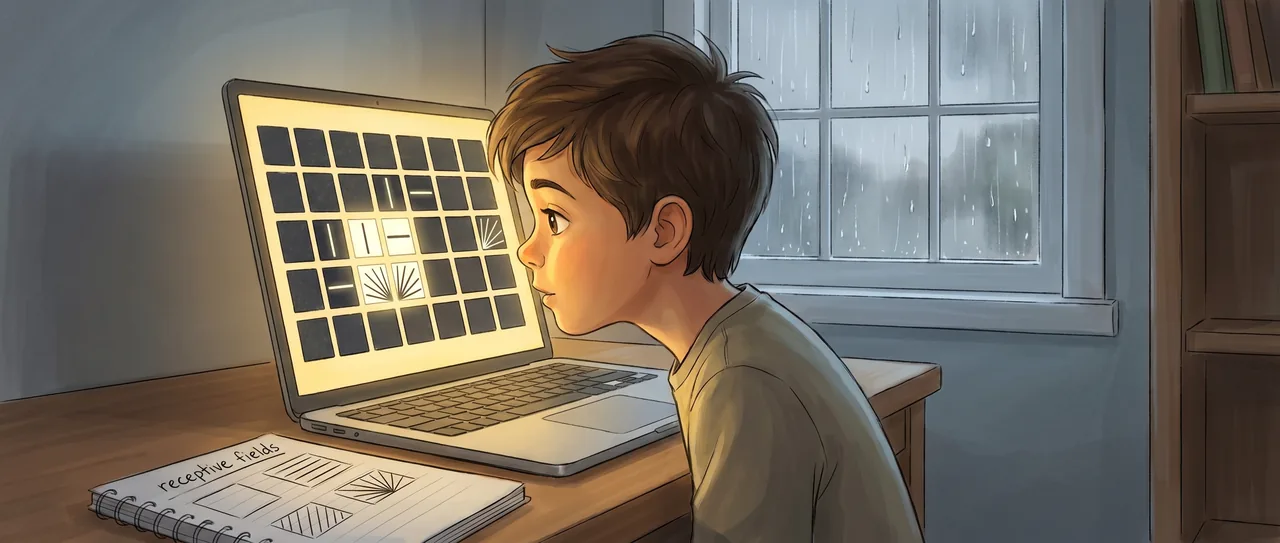
The grid had stopped being static.
It was slow, the way the minute hand is slow, the way you only catch it by looking away and back. But the squares were no longer all gray. Some had grown a pale stripe down the middle. Some had a stripe lying flat. Some had a stripe leaning, like the rain on the glass. Each little neuron, which had been a cloud of nothing, was sharpening into one clean line at one clean angle.
Soren stopped breathing for a second and then started again on purpose.
He counted. For any one photo the program looked at now, only a handful of squares flared bright. The rest went dark and waited. To see a whole face, the network had stopped using everybody. It used a few. The one that knew about a vertical edge. The one that knew about a slanted edge near the top. A few. The few that fit.
He wrote in the notebook, pressing hard. A vertical line. A horizontal line. A row of leaning ones at every angle in between, the way a fan opens.
Then he remembered something and went cold and warm at the same time.
Last spring, the optometrist. The poster on the wall of the waiting room while his eyes were still blurry from the drops. A drawing of the back of an eye, and past it the brain, and a caption he had read four times because there was nothing else to do. Neurons in the visual cortex respond to edges at specific orientations. He had not understood it then. He had filed it under things adults put on walls.
This laptop had never seen that poster. Tariq had never read it to the program. Nobody had told the network that brains use edge detectors. He had only told it one thing. Use fewer of yourselves at a time.
And the moment he made it stingy, the moment he forced it to whisper instead of shout, it had invented the same alphabet that was sitting at the back of Soren's own eyes right now, reading the screen. Lines. Angles. The same fan of leaning strokes a real animal grows in the dark of its own skull, without a teacher, just from looking at the world and trying not to waste itself. Not copied. Not borrowed. Two completely different things, a brain made of cells and a program made of numbers, both handed the same problem, see the world, and don't burn your whole self doing it, and both reaching into the dark and pulling out the exact same answer. As if the answer had been waiting there the whole time for anyone who asked the question carefully enough.
He thought about his own classroom. The way he was the one who said the quiet thing, once, instead of the loud thing six times. The way that mostly got you talked over. The way Tariq's program, when it stopped shouting, was the first time it actually saw anything.
The rain kept choosing its branching paths down the glass.
Soren reached for the slider and moved it one more notch. Fewer still. He wanted to know how few it could use and still see.
On the screen the grid of little neurons answered him, square by square, going dark in waves, every angle of line sharpening to a blade as the program decided, one more time, who got to speak. He leaned in until his nose nearly touched the warm glass, watching the bright handful that remained, counting them as they lit, three, then two, then the stubborn last one that would not go out.
Read the interactive version, listen to the narration, and earn a gold star →
A science-verified short story for curious kids · Curiosity Land